
The Fascinating History of 3D Printing: From Origin to Revolution
Introduction
3D printing, or additive manufacturing, has transformed the world of production and creativity. At Tucab, we are proud to be part of this technological revolution. Let's explore together the roots of this innovation and how it has evolved to the present day.
The Origin of 3D Printing
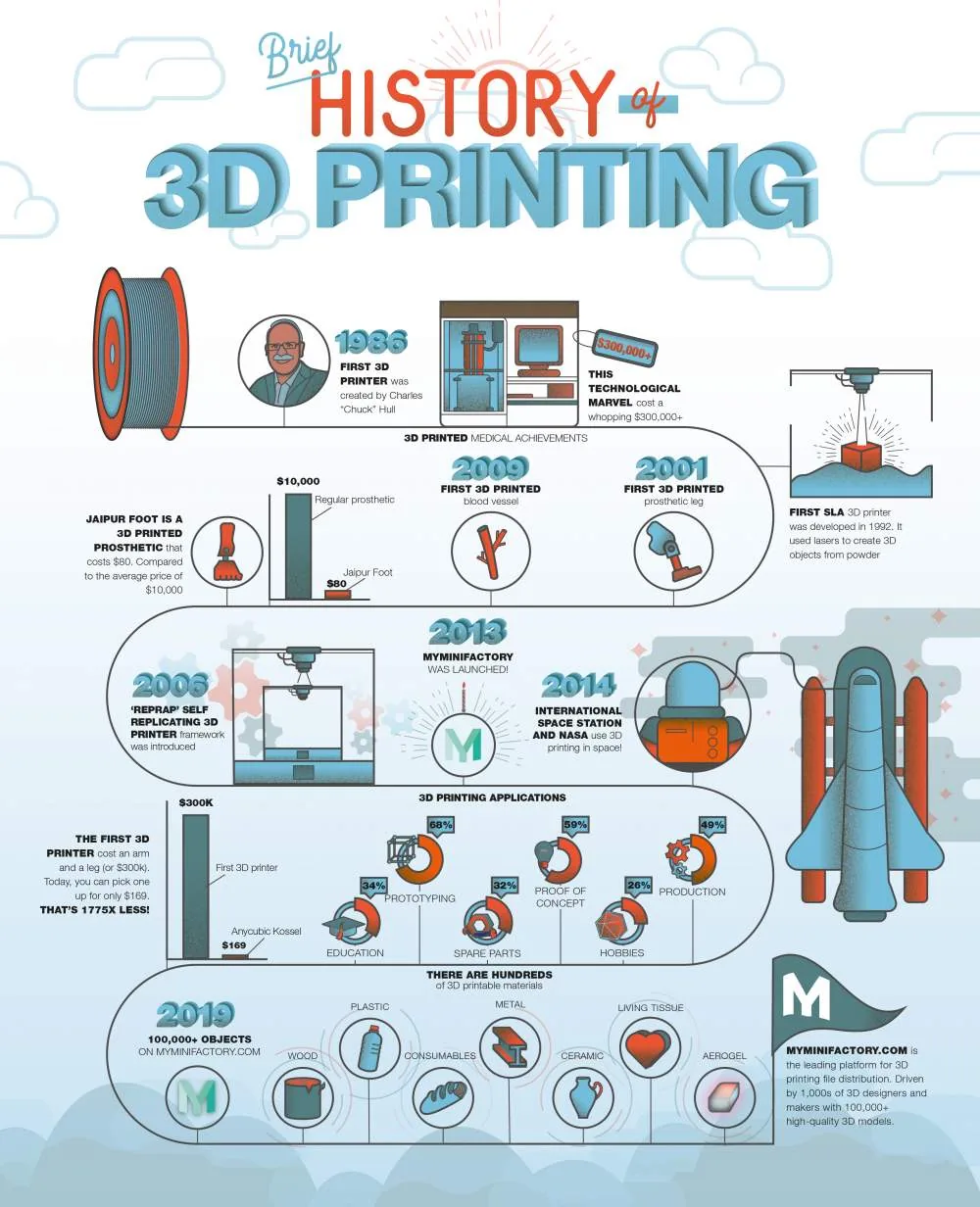
The history of 3D printing begins in the late 70s and early 80s. It was in 1984 that American engineer Charles Hull invented stereolithography (SLA), the first 3D printing process. Hull founded 3D Systems and obtained the first patent for 3D printing in 1986. This process used a laser to cure layers of liquid resin and create solid 3D objects, layer by layer. Laser) was invented by Carl Deckard, allowing the production of parts from powders of materials such as nylon and metal.
These technologies laid the foundation for the expansion of 3D printing, but they were still expensive and niche processes.
Evolution and Democratization
The turn of the century brought significant advances:
- Consumer Access: With the advent of desktop 3D printers, such as the RepRap in the early 2000s, 3D printing began to democratize. These machines were more affordable and allowed enthusiasts and small businesses to experiment with additive manufacturing.
- Innovative Materials: The range of usable materials has expanded to include metals, ceramics, and even biomaterials, opening new doors for medical and industrial applications.
- Software and Design: The development of free, easy-to-use 3D modeling software like Blender, and sharing platforms like Thingiverse, accelerated adoption and innovation.
3D Printing Today
Today, 3D printing is used in countless sectors:
- Medicine: Production of personalized prosthetics, anatomical models for surgeries.
- Aerospace: Manufacturing of lightweight and complex parts.
- Automotive: Rapid prototyping and production of on-demand parts.
- Education: As a teaching tool and hands-on exploration.
Tucab has been a witness and active participant in this evolution with our line of Fil3D filaments, designed to meet the needs of today's creators, whether they are professionals or amateurs.
The Future of 3D Printing
The future is promising with continuous advances:
- Sustainability: Increased focus on recyclable materials and printing processes that minimize waste.
- Mass Customization: The ability to produce on a small scale with the same efficiency as mass production.
- Integration with Other Technologies: Such as AI to optimize designs or robotics for production automation.
3D printing has gone from a science fiction concept to a tangible reality that is shaping the future of manufacturing.
At Tucab, we are excited to be part of this journey, always innovating to bring you the best 3D printing solutions.
#3D Printing #HistoryOfTechnology #Innovation #Tucab 3dprint #3dprinting