
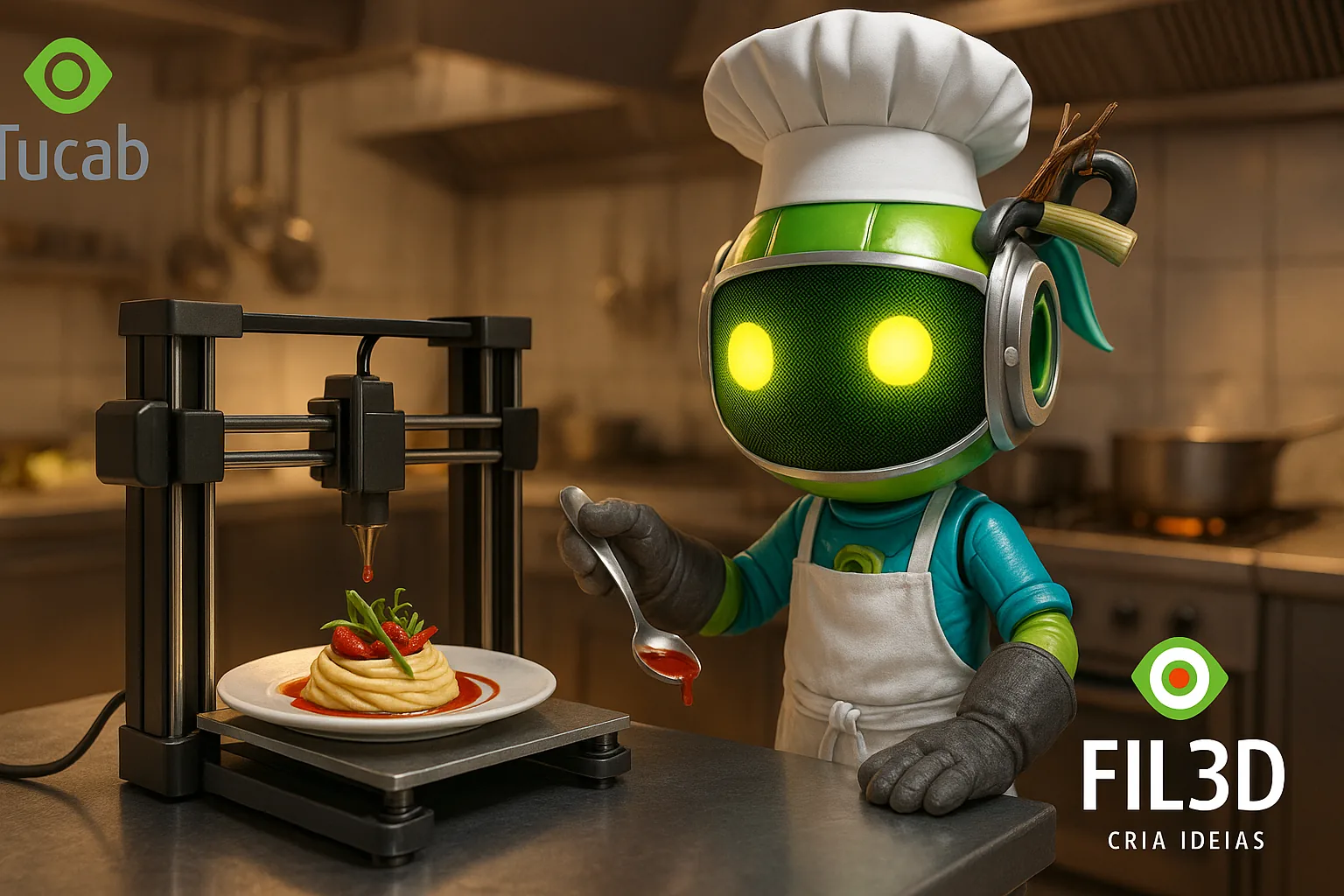
At the border between art and science, a silent revolution is emerging that is transforming the way we create, taste and understand food.
3D printing, known for its industrial precision and technological innovation, has reached haute cuisine — and promises to redefine the culinary experience as we know it.
With the same cutting-edge vision which guides the development of FIL3D® technical filaments, this new era unites engineering, design and flavor in a single dish.
From the laboratory to the table – the kitchen enters the digital era
Food 3D printing uses edible masses such as chocolate, vegetable puree, protein pastes or pasta artisanal, which are extruded layer by layer, just like technical plastic in an FDM printer.
The result? Unique, precise and three-dimensional culinary creations that are impossible to reproduce manually.
Avant-garde chefs use this technology to explore new textures and geometric combinations, transforming the meal into a visual and sensorial spectacle.
From designing desserts with mathematical shapes to nutritional personalization, 3D printing is the new creative utensil of the kitchen of the future.
“If art is The form of imagination, 3D printing is the tool that makes it edible.”
The technology behind the flavor
As with industrial printers, 3D gastronomy depends on precision, temperature and flow control.
Printing “cartridges” contain ingredients prepared under conditions specific viscosity and temperature.
The software defines complex geometries — chocolate towers, dough spirals or fruit sculptures — and the printer executes each layer with millimeter accuracy.
Some advanced systems even use texture and density analysis to simulate different types of cooking or resistance to chewing.
The result is more than aesthetics: it is personalized nutrition and sustainability, printing only what is necessary and reducing waste.
Sustainability with flavor
3D food printing is also an intelligent response to the challenges of the future:
-
Reduces food waste by using exact portions;
-
Allows the use of alternative and sustainable ingredients (such as vegetable proteins or algae);
-
Creates foods optimized for specific health, sports or aging needs;
-
Promotes creative and more responsible gastronomy.
It's the perfect balance between technological innovation and environmental awareness — a concept that FIL3D® applies daily in the production of its sustainable filaments, including the FIL2NDLIFE® line, made from recycled plastic.
From engineering to taste – the FIL3D® philosophy
In FIL3D®, we believe that innovation is a universal process.
The same rigor we apply to the extrusion of our filaments — dimensional precision, material purity and thermal control — is what drives 3D gastronomy.
Each printed layer, whether technical polymer or artisanal chocolate, represents the same principle:
transforming matter into art, function into form, and idea into reality.
With PLA and PETG Skygreen filaments, FIL3D® inspires creators, engineers and now... chefs of the future.
“Innovation is the secret ingredient in 3D printing — and the future of creativity is printing, layer by layer.”
The future of kitchen is printed
Today, university laboratories and luxury restaurants around the world are experimenting with new ways of preparing food through additive manufacturing.
But the real impact is yet to come:
personalized food, local and sustainable production, and gastronomic experiences designed with digital precision.
FIL3D®, part of the engineering and innovation of TUCAB® celebrates this transformation — because printing the future is also giving shape to the imagination.
FIL3D® – High quality 3D Printing Filaments, manufactured in Portugal.