
Introduction
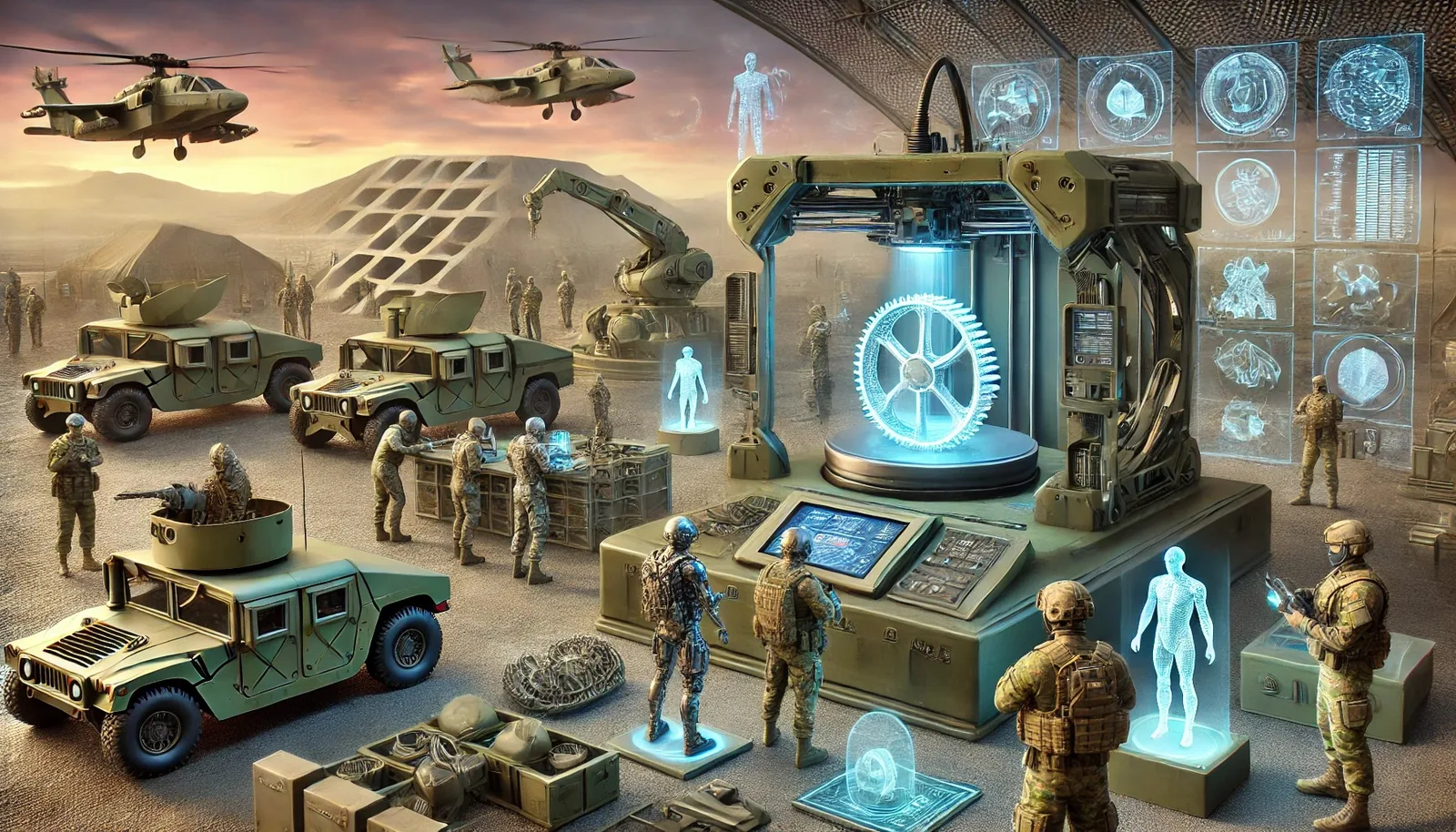
3D printing, also known as additive manufacturing, is a process that creates three-dimensional objects layer by layer from a digital model. This technology has gained relevance in the military sector due to its ability to produce complex, personalized designs quickly, responding to the needs of innovation, logistics and operational readiness in challenging environments. This article explores how 3D printing is being used in the military context, focusing on specific applications, case studies, challenges and future perspectives, considering the wide range of technologies available, such as FDM, SLA, SLS, DMLS and EBM.
Types of 3D Printing Technologies
There are several 3D printing technologies, each with specific advantages and applications in the military sector:
- Fused Deposition Modeling (FDM): Uses thermoplastic filaments, such as ABS or PETG, to build objects layer by layer. It is the most affordable and common technology, used for prototypes and plastic parts, such as vehicle covers printed by the US Army (How the US Military uses 3D Printing Technologies).
- Stereolithography (SLA): Uses a laser to solidify liquid resin, producing high-precision parts with smooth finishes, ideal for detailed models and molds.
- Selective Laser Sintering (SLS): Employs a laser to fuse powders, such as plastics or metals, creating robust and complex parts, suitable for functional prototypes.
- Direct Metal Laser Sintering (DMLS): Similar to SLS, but for metal parts, used in production of lightweight and resistant components for aerospace applications, such as fighter and satellite parts (Military 3D Printing: How is Additive Manufacturing Changing the Defense Industry – Raise3D).
- Electron Beam Melting (EBM): Uses a beam of electrons to melt metal powder, creating strong parts for extreme environments, such as jet engine components.
The choice of technology depends on specific needs, with FDM being preferred for plastics and DMLS/EBM for critical metals, such as in aircraft parts or military vehicles.
Detailed Military Applications
3D printing is being applied in several areas of the military sector, with concrete examples that demonstrate its impact:
- Spare Parts and Maintenance:
- One of the most significant uses is the production of spare parts in remote locations or combat zones, reducing dependence on complex supply chains. For example, the US Army printed combat vehicle covers using FDM, solving an obsolete parts problem within days at a cost of just $2.50 per part, saving 1,472 days of operational incapacity (3D printing technology enhancing logistics for Army).
- A Royal Navy has installed a 3D printing workshop aboard HMS Queen Elizabeth, enabling the printing of tools and parts during missions, increasing self-sufficiency in remote locations (From Battlefield to Base: 3D Printing Revolutionizes the U.S. Military | Capitol Technology University).
- Rapid Prototyping:
- 3D printing accelerates the development of new equipment, allowing for rapid design iterations. The US Air Force, for example, printed a titanium part for the F-22 Raptor stealth fighter, demonstrating the ability to produce high-performance components (3D Printing Uses in the Military). technology to allow testing in real conditions before mass production.
- Customized Equipment:
- Soldiers need equipment adapted to their specific measurements and needs. 3D printing allows you to create personalized helmets, armor and other items, improving comfort and effectiveness. The US Marine Corps has explored 3D printing for fitted armor, increasing protection in operations (Militaries Worldwide Leverage 3D Printing to Enhance Readiness, Enable Repairs | All3DP Pro).
- Applications Medical:
- In the military medical context, 3D printing is used to create custom prosthetics, surgical tools and models for surgical planning, improving healthcare in the field. Walter Reed National Medical Center used the technology for surgical guides, facilitating complex operations on injured soldiers.
- Large-Scale Construction:
- 3D printing of concrete is being explored to build fortifications, such as blast-proof bunkers, in conflict zones. The US Army has experimented with this technology for field bases, enabling the rapid construction of robust structures essential for operations (Military 3D Printing: How is Additive Manufacturing Changing the Defense Industry – Raise3D).
- Training and Simulation:
- 3D printed models are used for training, simulating battle conditions or creating replicas of enemy equipment. U.S. Army Combat Training Centers use printed replicas of enemy vehicles for realistic exercises, improving soldier readiness (How 3D Printing is Making an Impact in Defense).
- Ammunition and Explosives:
- 3D printing is being investigated to create ammunition and explosives with complex geometries, optimizing performance and safety. The research includes the printing of propellants and explosive materials, with the potential for more efficient ammunition, although still in the experimental phase (The dawn of military 3D printing).
Case Studies
- U.S. Army AM Project:The Army's Additive Manufacturing program produced a critical part for the HMMWV vehicle using FDM, saving significant time and costs while demonstrating efficiency in field operations (U.S. Military To 3D Print Its Way Out Of Supply Chain Woes).
- Royal Navy 3D Printing Workshop: Aboard HMS Queen Elizabeth, the Royal Navy printed parts and tools during missions, increasing self-sufficiency in remote locations (From Battlefield to Base: 3D Printing Revolutionizes the U.S. Military | Capitol Technology University).
- Israel Defense Forces (IDF): The IDF used 3D printing to produce parts for Merkava tanks, reducing dependence on external suppliers and improving operational readiness (r/WarCollege on Reddit: Does Does 3D printing have any serious potential for use in military applications?).
Challenges and Future Perspectives
Despite the benefits, 3D printing in the military sector faces significant challenges:
- Quality Control: Ensure that printed parts meet rigorous safety and performance standards, with certification processes that include tests such as X-ray and CT scanning (Military 3D Printing: How is Additive Manufacturing Changing the Defense Industry – Raise3D).
- Security: Protect digital designs and intellectual property from cyber threats, especially with digital libraries like the US Army's RAPTOR (3D printing technology enhancing logistics for Army).
- Materials Science: Develop and qualify new materials suitable for military applications, such as high-temperature resistant metals or biocompatible plastics.
- Training: Provide appropriate training to military personnel to operate and maintain 3D printing equipment, especially in field environments.
Looking to the future, 3D printing military promises significant advances. The integration of artificial intelligence and machine learning can optimize designs and production processes, while new technologies, such as printing large structures in remote locations, can revolutionize logistics. The technology is expected to continue to evolve, with potential applications in autonomous drones and advanced wearable technology, keeping the military at the forefront of innovation.
Conclusion
3D printing has become an indispensable tool for the military sector, offering solutions to logistics, maintenance and innovation problems. By adopting this technology, military forces around the world are improving their operational capabilities, increasing soldier safety, and staying ahead in an increasingly complex and dynamic security landscape.
Technology Comparison Table
To illustrate the differences, here is a comparison table of the most commonly used 3D printing technologies in the military sector:
| Technology | Advantages | Limitations | Usage Examples Military |
|---|---|---|---|
| FDM | Low cost, easy to use, large parts | Lower resolution, visible layer lines | Plastic parts such as caps vehicles |
| SLA | High precision, smooth finish | High costs, limited volumes | Detailed training models |
| SLS | Robust parts, no supports | Expensive equipment, complex post-processing | Functional weapon prototypes |
| DMLS | Light, strong metal parts | High costs, slow processes | Aircraft components, such as brackets |
| EBM | Parts for extreme environments | Expensive equipment, limited materials | Jet engine parts |
This table highlights how each technology meets specific needs, with FDM being ideal for low-cost applications and DMLS for critical components.
Key Quotes
- How the US Military uses 3D Printing Technologies Detailed Applications
- 3D Printing Uses in the Military Comprehensive Examples
- Militaries Worldwide Leverage 3D Printing to Enhance Readiness Detailed Analysis
- Military 3D Printing How is Additive Manufacturing Changing the Defense Industry Technical Insights
- From Battlefield to Base 3D Printing Revolutionizes the U.S. Army Military Impactful Applications
- The dawn of military 3D printing Early Stage Developments
- How 3D Printing is Making an Impact in Defense Global Perspectives
- r/WarCollege on Reddit Does 3D printing have any serious potential for use in military applications? Community Insights
- 3D printing technology enhancing logistics for Army Army Specific Applications
- U.S. Military To 3D Print Its Way Out Of Supply Chain Woes Strategic Overview