
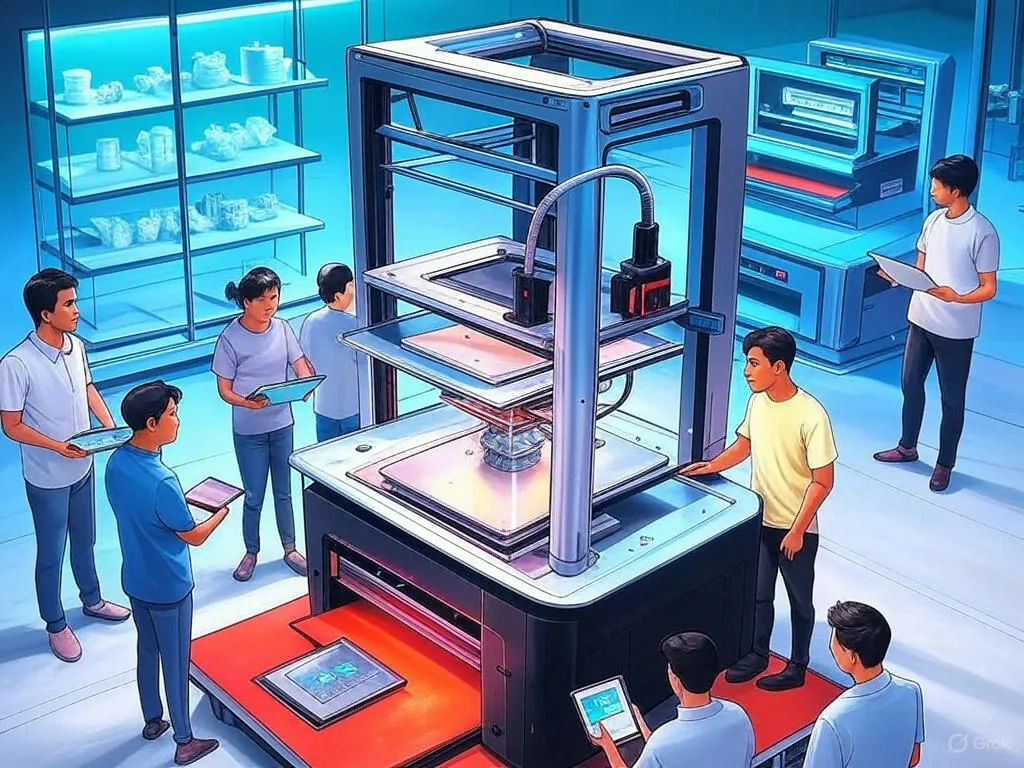
In industry, time is money. Equipment downtime due to lack of parts or time-consuming repairs is costly. 3D printing comes into play to solve this – and more. Let's get into the details:
1. Spare Parts Ready On Time
Forget about warehouses full of parts. With 3D printing, all you need is a digital file to create components on demand. This is gold for old or rare machines.
- Example in Portugal: Bosch Car Multimedia, in Braga, uses FDM printers to manufacture gears and supports for its production lines. What used to take weeks to arrive from suppliers is now done in 48 hours, cutting costs and downtime.
- European example: Volkswagen, in Wolfsburg (Germany), 3D prints replacement parts for its industrial robots. Using SLS with nylon, the company keeps production moving without delays.
2. Quick and Smart Repairs
Why replace an entire part if you can fix it? 3D printing allows you to add material to worn components, such as turbines or molds.
- Example in Portugal: Mold company for the automotive industry in Oliveira de Azeméis, uses 3D metal deposition to restore damaged areas of injection molds. Result? Less waste and molds back to work in days, not weeks.
- European Example: Siemens Energy in Germany repairs gas turbines with metal 3D printing. Using lasers to deposit special alloys, they salvage critical parts, saving millions in replacements.
3. Custom-Made Tools
Custom tools are a luxury that 3D printing makes affordable. Jigs, fixings or supports? Everything ready in hours.
- Example in Portugal: Critical Manufacturing, in Porto, 3D prints customized supports for testing electronic components. With SLA, they create lightweight and precise parts, accelerating the development of new products.
- European example: Airbus, in Spain, manufactures drilling jigs for assembling airplanes. Printed on nylon via SLS, these templates are resistant and adjusted to the millimeter, ensuring safety and speed.
4. Prototyping that Makes a Difference
Testing ideas before applying them on a large scale is essential. 3D printing makes this quick and cheap.
- Example in Portugal: Efacec, in Matosinhos, uses 3D printing to prototype parts of electrical transformers. With FDM and high-strength plastics, they test designs in days, adjusting before final production.
- European example: Renault, in France, prints prototypes of engine parts in 3D. They test different materials – such as reinforced polymers – to find the perfect combination of weight and durability.
5. Complex Parts without Limits
Impossible geometries for traditional machines? 3D printing does the trick. Internal channels, organic shapes – everything is possible.
- Example in Portugal: Hovione, in Loures, uses SLS to create parts with internal channels for pharmaceutical equipment. This improves the flow of liquids in critical processes, something unthinkable with conventional milling.
- European example: Rolls-Royce, in the United Kingdom, 3D prints jet engine components with optimized internal structures. Made from titanium via SLS, these parts are lighter and more efficient.
Benefits that speak for themselves
3D printing in industrial maintenance is not just fashionable – it is a competitive advantage. Here's why:
- Fewer Downtime: Parts ready in hours keep machines running.
- Lower Costs: Less stock, less waste, repairs instead of replacements.
- Customization: Every part or tool adjusted what you need.
- Sustainability: Less material used, more life for equipment.
Challenges? Yes, But There Are Solutions!
Not everything is perfect. 3D printing has obstacles, but companies are working around them:
- Quality: Rigorous testing ensures printed parts meet standards. Simoldes, for example, validates each mold with simulations before use.
- Materials: New alloys and polymers are emerging, such as those used by Hovione to resist aggressive chemicals.
- Training: In Portugal, initiatives such as Portugal 3D Printing trains technicians and engineers to master technology.
The Future is Coming
What's next? 3D printing in industrial maintenance will become even more impressive:
- Advanced Metals: Techniques such as electron beam fusion will create ultra-resistant parts.
- IoT in Play: Printers linked to sensors can predict failures and print parts before they are needed.
- New Materials: Lightweight, recyclable composites are on the way, perfect for sustainable industry.
In Portugal, INEGI (Institute of Science and Innovation in Mechanical Engineering) is at the forefront, testing these innovations with local companies.
Conclusion: A Revolution Within Our Reach
A 3D printing is no longer fiction – it is a reality that is transforming industrial maintenance in Portugal and Europe. From Bosch in Braga to Rolls-Royce in the UK, companies are using this technology to work faster, spend less and innovate more. With real technical examples and clear benefits, it is clear: 3D printing is the present – and the future – of the industry. Are you ready to join this revolution?