
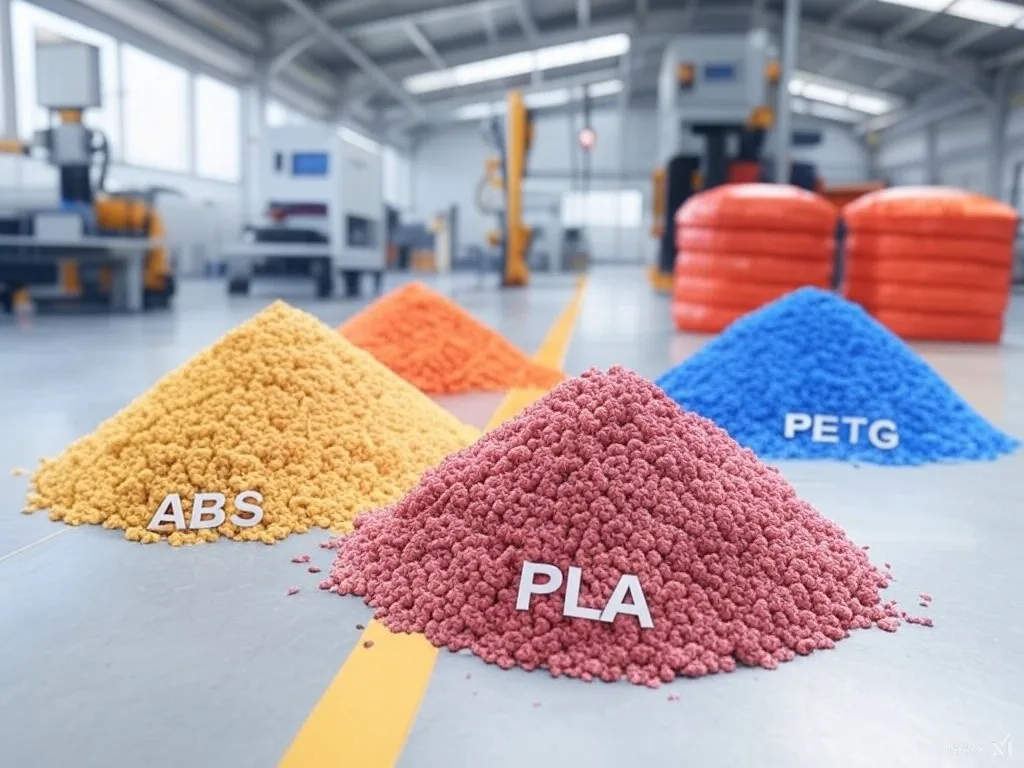
Comparison of Materials for FDM 3D Printing: PLA, PETG and ABS
Introduction
FDM (Fused Deposition Modeling) 3D printing is one of the most accessible techniques for additive manufacturing, where the choice of material is crucial to the success of the project. This article examines three of the most common materials for FDM - PLA, PETG and ABS - detailing their characteristics, comparisons, differences, as well as the advantages and disadvantages of each. Understanding the properties of each material allows you to select the most suitable one for your needs, whether for prototyping, production of functional parts or industrial applications.
Material Characteristics
PLA (Polylactic Acid):
- Origin: Derived from renewable materials, such as corn or sugar cane.
- Printing Temperature: 180-230°C.
- Properties: Biodegradable, rigid, low heat resistance, easy to print, good surface quality.
- Applications: Rapid prototyping, visual models, decorative items.
PETG (Polyethylene Terephthalate Glycol):
- Origin: Modification of PET with glycol to improve flexibility and impact resistance.
- Printing Temperature: 220-250°C.
- Properties: Impact resistant, flexible, good chemical and thermal resistance, natural transparency.
- Applications: Functional parts, prototypes that require flexibility, contact with food (when not colored).
ABS (Acrylonitrile Butadiene Styrene):
- Origin: Synthetic polymer, not derived from renewable sources.
- Printing Temperature: 210-250°C, requires heated surface.
- Properties: High thermal resistance, good impact resistance, can be satin but prone to warping.
- Applications: Intensive use parts, mechanical components, products that need heat resistance.
Comparisons and Differences
| Feature | PLA | PETG | ABS |
| Ease of Printing | Easy | Moderate | Hard |
| Mechanical Resistance | Moderate | High | High |
| Thermal Resistance | Low (50°C to 60°C) | Medium (70°C to 80°C) | High (80°C to 100°C) |
| Flexibility | Rigid | Semi-flexible | Semi-flexible |
| Chemical Resistance | Low | High | Medium |
| Biodegradability | Yes | No | No |
| Tendency to Warp | Low | Medium | High |
| Cost | Low | Moderate | Moderate |
Advantages and Disadvantages
PLA:
Advantages:
- Easy to print, ideal for beginners.
- Biodegradable, more environmentally friendly.
- Smaller odor and gas production during printing.
- Good surface quality and available in different colors.
Disadvantages:
- Low resistance to heat and impact.
- Not suitable for outdoor use or in hot environments.
- May be fragile for functional parts.
PETG:
Advantages:
- Good impact resistance and flexibility.
- Chemical resistance superior to PLA.
- Less prone to warping than ABS, with good surface quality.
- Suitable for parts that require durability and moderate heat resistance.
Disadvantages:
- Higher printing temperature compared to PLA.
- Less environmentally friendly than PLA due to non-biodegradability.
- May be more difficult to sand or paint.
ABS:
Advantages:
- High heat resistance, ideal for parts that will be used in environments
- Good impact resistance.
- Can be finished with techniques such as acetone bath for a satin finish.
- Widely used in industry.
Disadvantages:
- Prone to warping, requires heated print bed and good ventilation.
- Produces a characteristic odor during printing, potentially toxic.
- Non-biodegradable and derived from non-renewable sources.
Common Applications
PLA:
- Suitable for: Rapid prototypes, visual models, decorative items, toys and educational pieces.
- Examples: Models, sculptures, disposable packaging.
PETG:
- Suitable for: Functional parts that require impact resistance, flexibility and durability.
- Examples: Gears, mechanical supports, containers for liquids, medical components.
ABS:
- Suitable for: Parts that need to withstand high temperatures, impacts and severe conditions.
- Examples: Automotive components, electronics, tools, industrial parts.
Conclusion
The choice between PLA, PETG and ABS for printing 3D FDM largely depends on the purpose of the project:
- PLA is ideal for prototyping, education and where aesthetics and sustainability are a priority.
- PETG suits an intermediate range of applications, where strength and flexibility are required without the complexity of printing.
- ABS is the choice for parts that need to withstand harsher conditions, with good impact and heat resistance, but requires more preparation and care during printing.
Each material has its place in additive manufacturing, and selection should be made based on the specific needs of the application, considering factors such as strength, durability, ease of use and environmental impact. Whatever the choice, PLA, PETG and ABS offer versatile and efficient solutions for a wide variety of 3D printing projects.