
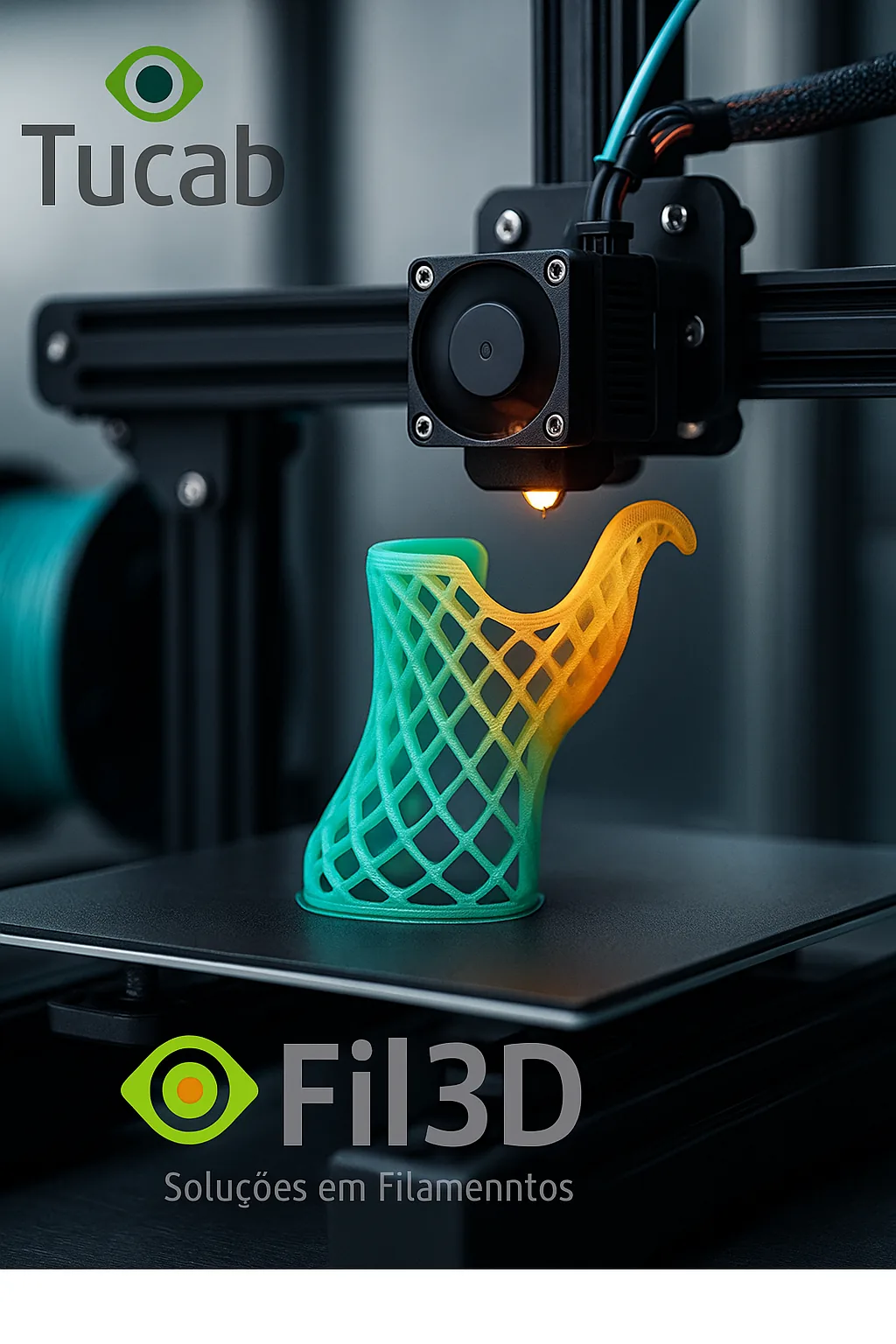
Smart filaments: the future of 3D printing with responsive materials
3D printing continues to evolve and open new horizons. Today, we are not just talking about PLA, ABS or PETG. The future has already arrived with smart filaments — materials capable of responding to external stimuli such as temperature, light, humidity or mechanical stress.
What are responsive materials?
Responsive materials are advanced polymers that change their shape, color or physical properties depending on external conditions. In the context of 3D printing, these filaments allow us to create parts that are not static, but rather dynamic and adaptable.
Application examples
-
Medical devices: prostheses or supports that adjust to body temperature.
-
Automobile: components that react to variations in temperature or pressure.
-
Architecture: structures that change shape to optimize ventilation or light.
-
Daily consumption: intelligent packaging that indicates food freshness.
The role of Fil3D®
At Fil3D® by TUCAB, we follow these trends and we work on research and development of new formulations. We believe that the future of 3D printing will be marked by the integration of:
-
Shape memory filaments, capable of returning to their original geometry after deformation.
-
Conductive filaments, which pave the way for printed electronics.
-
Biodegradable and intelligent filaments, combining innovation and sustainability.
Why does it matter for industry?
Smart filaments are a bridge between materials and living systems. They allow the creation of more efficient, sustainable and adaptable solutions, reducing waste and multiplying the applications of 3D printing in strategic sectors.
The future is already in development. Discover more about how smart filaments will transform 3D printing.
Read the full article on the TUCAB website:
tucab.pt