
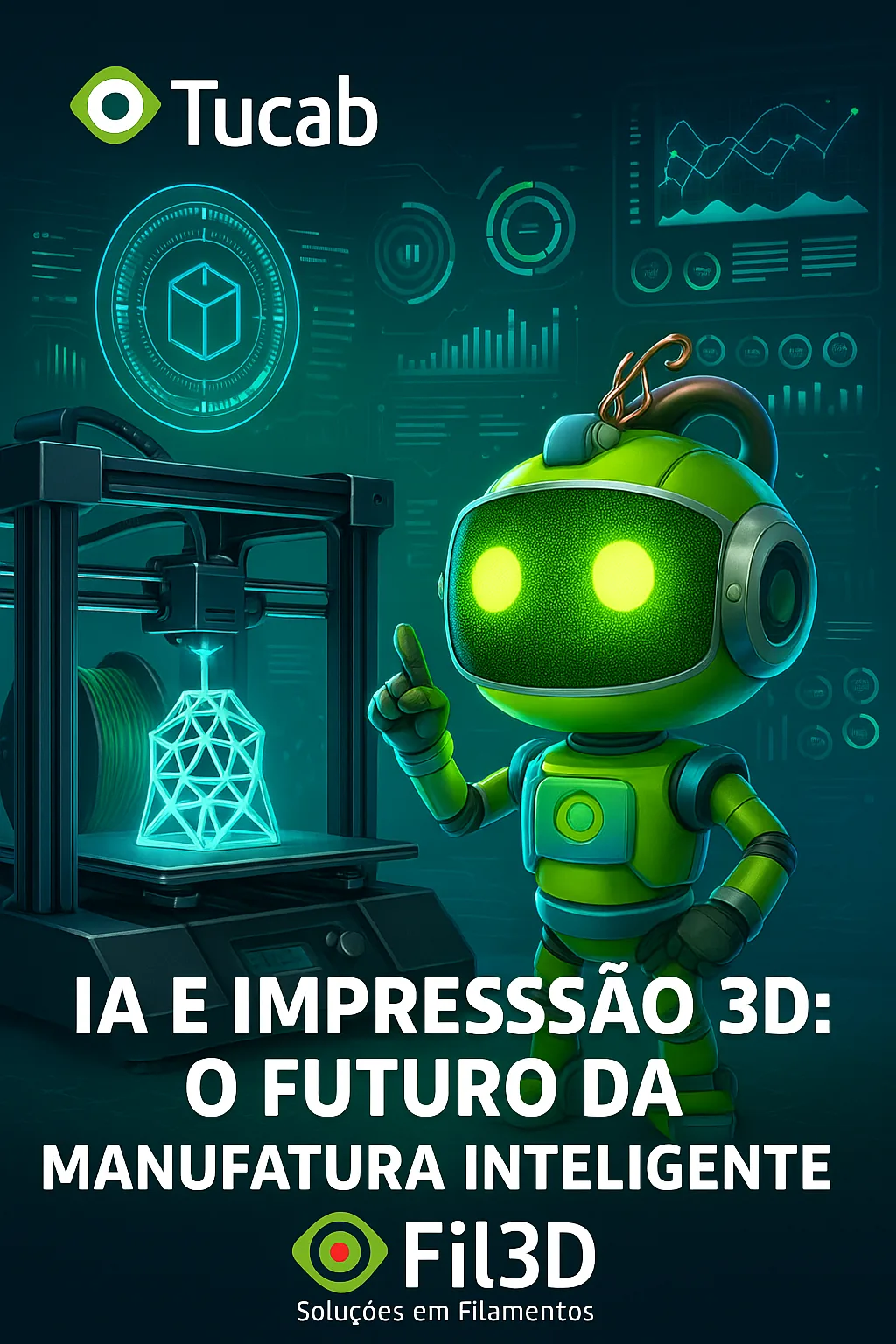
The combination between 3D Printing and Artificial Intelligence (AI) is creating a silent revolution in the industry. If 3D printing was already seen as a driver of innovation due to its ability to produce complex, personalized and sustainable parts, the integration of AI takes these possibilities to a new level: greater efficiency, predictability and autonomy.
Theory: where AI intersects with 3D Printing
AI, applied to additive manufacturing, operates in three main areas:
-
Print parameter optimization
-
AI automatically analyzes variables such as nozzle temperature, extrusion speed, retractions or layer height.
-
Instead of relying on trial and error, algorithms adjust in real time to maximize part quality.
-
-
Error recognition and correction
-
Integrated sensors and cameras allow AI systems to detect failures (warping, adhesion failures, under/over-extrusion).
-
The system corrects parameters automatically, reducing filament waste.
-
-
Generative design
-
Algorithms create geometries optimized for mechanical strength and lightness, impossible to design manually.
-
The result is lighter, stronger parts with better material efficiency.
-
Practical: real examples of the application of AI in 3D Printing
-
Real-time monitoring: companies already use cameras linked to computer vision systems to supervise 3D printers. If the part moves, the system pauses or corrects the process.
-
Failure prediction: machine learning algorithms can predict whether a print will fail in the first layers, avoiding wasted hours of production.
-
Automation of printer fleets: in industrial environments, dozens of printers can be managed centrally, where AI distributes tasks, adjusts parameters and guarantees efficiency.
-
Series customization: AI processes customer data (e.g. biometric measurements) and automatically generates personalized models for large-scale printing.
The future of AI in 3D Printing
The next decade will bring even more disruptive advances:
-
Manufacturing autonomous: printers capable of self-diagnosis and self-regulation, without human intervention.
-
AI applied to new materials: algorithms that test combinations of polymers (such as PLA, PETG, ABS, TPU) and suggest formulations with better performance.
-
Integration with intelligent production chains: 3D printing + robotics + AI = flexible factories, fully adaptable to demand.
-
Enhanced sustainability: optimization of energy consumption, reuse of materials and development of new recycled filaments with performance controlled by AI.
The role of Fil3D® by TUCAB
At Fil3D®, we believe that the alliance between 3D printing and AI represents the next technological leap.
-
We work on developing consistent, high-performance filaments, prepared for smart industrial environments.
-
We invest in research and innovation, to ensure that our materials support cutting-edge optimization and monitoring algorithms.
3D printing has never been so smart.
With AI, we are entering a new era of efficiency, personalization and sustainability. Discover more about the future of 3D printing with Fil3D® at:
tucab.pt