
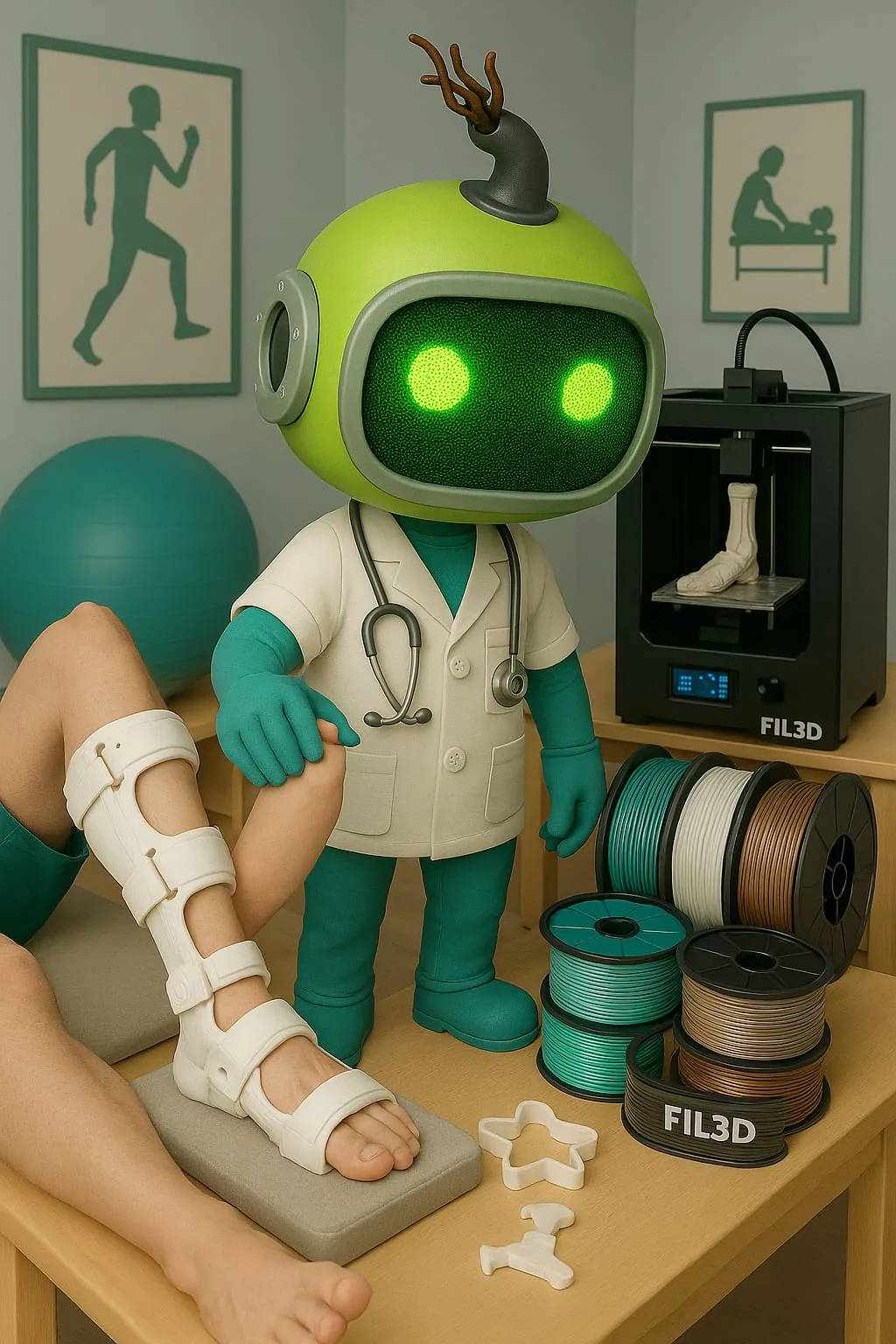
FDM 3D Printing: A Transformative Tool for Physiotherapists in Everyday Life
Physiotherapy is an essential area for recovering mobility and relieving pain, helping patients regain their quality of life. However, physical therapists often face the challenge of finding personalized solutions for each patient's unique needs. This is where FDM (Fused Deposition Modeling) 3D printing comes into play, offering an innovative way to create bespoke devices and tools. At TUCAB, we believe that this technology can revolutionize the daily lives of physiotherapists, bringing practical and accessible benefits. In this article, we explore how FDM 3D printing is being used in physical therapy, with technical details, practical examples and a look to the future.
What Is FDM 3D Printing and How Can It Benefit Physical Therapy?
FDM 3D printing uses plastic filaments, such as PLA, PETG and TPU, which are melted and deposited in a layer by layer to form three-dimensional objects. This technology is particularly useful in physiotherapy, as it allows you to create personalized solutions quickly and economically. From orthoses adjusted to the patient's anatomy to exercise tools, FDM 3D printing offers physical therapists a new way to improve rehabilitation results by adapting to the specific needs of each case.
Technical Details: Printing Materials and Parameters
To apply FDM 3D printing in physical therapy, it is important to understand the materials and parameters Technicians involved:
- Materials:
- PLA (Polylactic Acid): Biodegradable and easy to use, ideal for anatomical models or temporary tools. Extruded at 190-220°C, it is light but less resistant to impacts.
- PETG: More durable and resistant, perfect for orthoses and supports that need to support weight or tension. Requires temperatures of 230-250°C and supports forces of up to 50 MPa.
- TPU (Thermoplastic Polyurethane): Flexible and elastic, ideal for parts that imitate natural movements, such as dynamic orthoses. Extruded at 220-240°C, it offers good resistance to abrasion.
- Printing Parameters:
- Layer Height: 0.1 mm for fine details (e.g. anatomical models) or 0.3 mm for quick prints (e.g. simple supports).
- Print Speed: 40-60 mm/s, reduced to 30 mm/s on complex parts such as orthoses, to ensure accuracy.
- Infill: 20% for lightweight parts (e.g. exercise tools) or 50-100% for weight-bearing orthoses.
- Heated Bed: 50-60°C for PLA and PETG, to avoid deformation; not required for TPU.
Software like Tinkercad (for simple designs) or Fusion 360 (for more complex projects) allows you to create models, while slicers like Cura adjust the parameters for printing.
Practical Examples: How 3D Printing is Transforming Physiotherapy
FDM 3D printing offers practical solutions that can be implemented directly into the daily lives of physiotherapists. Here are some examples:
- Custom Wrist Orthosis: A patient with carpal tunnel syndrome may benefit from a PETG-printed orthosis fitted to their hand using a 3D scan. With a layer height of 0.2 mm and infill of 50%, the orthosis takes 4 hours to print and costs around €5 in filament. This device provides stable, comfortable support, aiding recovery.
- Stretching Exercise Tool: A physical therapist can print a TPU finger stretching tool to help patients with joint stiffness. With a 0.3 mm layer and 20% infill, the piece takes 2 hours to print and costs €2. This tool allows smooth movements, facilitating therapeutic exercises.
- Anatomical Model for Patient Education: To explain a knee injury, the physiotherapist prints a model of the joint in PLA, with details of 0.1 mm, taking 6 hours and costing €3. This model helps the patient understand the problem and the rehabilitation plan, increasing adherence to treatment.
Benefits of 3D Printing in Physiotherapy
The adoption of FDM 3D printing in physiotherapy brings significant advantages:
- Total Customization: Devices adjusted to each patient's anatomy, ensuring greater comfort and efficiency.
- Cost Reduction: Producing orthoses and tools on site is more economical than purchasing commercial solutions, especially for unique parts.
- Speed: Printing an orthosis or tool in a few hours eliminates waiting times, allowing for faster treatments.
- Affordability: With affordable printers and filaments like TUCAB's FIL3D, any clinic can implement this technology.
A Look to the Future: The Potential of 3D Printing in Physical Therapy
The future of 3D printing in physical therapy is promising and could include:
- Smart Devices: Orthoses with printed sensors that monitor pressure or movement, helping to adjust treatments in real time.
- Bioprinting: Production of biocompatible tissues, such as cartilage, to regeneratively treat joint injuries.
- Advanced Rehabilitation Tools: Printing equipment with ergonomic designs, such as adjustable supports for stretching or strength exercises.
- Education and Training: Detailed anatomical models for training new physical therapists, enabling hands-on simulations of rehabilitation techniques.
Although large-scale adoption still depends on training and access to technology, the potential to improve the practice of physical therapy is undeniable.
Conclusion
FDM 3D printing is opening up new horizons in physiotherapy, allowing professionals to create personalized solutions quickly, economically and accessible. At TUCAB, we are committed to supporting this innovation by offering high-quality filaments, like FIL3D, that are ideal for these applications. If you are a physical therapist and are curious about how 3D printing can transform your practice, we invite you to explore this technology. Together, we can help patients "renew" their mobility and quality of life, in a spirit of new beginnings that resonates with the Easter season.
Discover FIL3D and Elevate Your Physiotherapy Practice!