
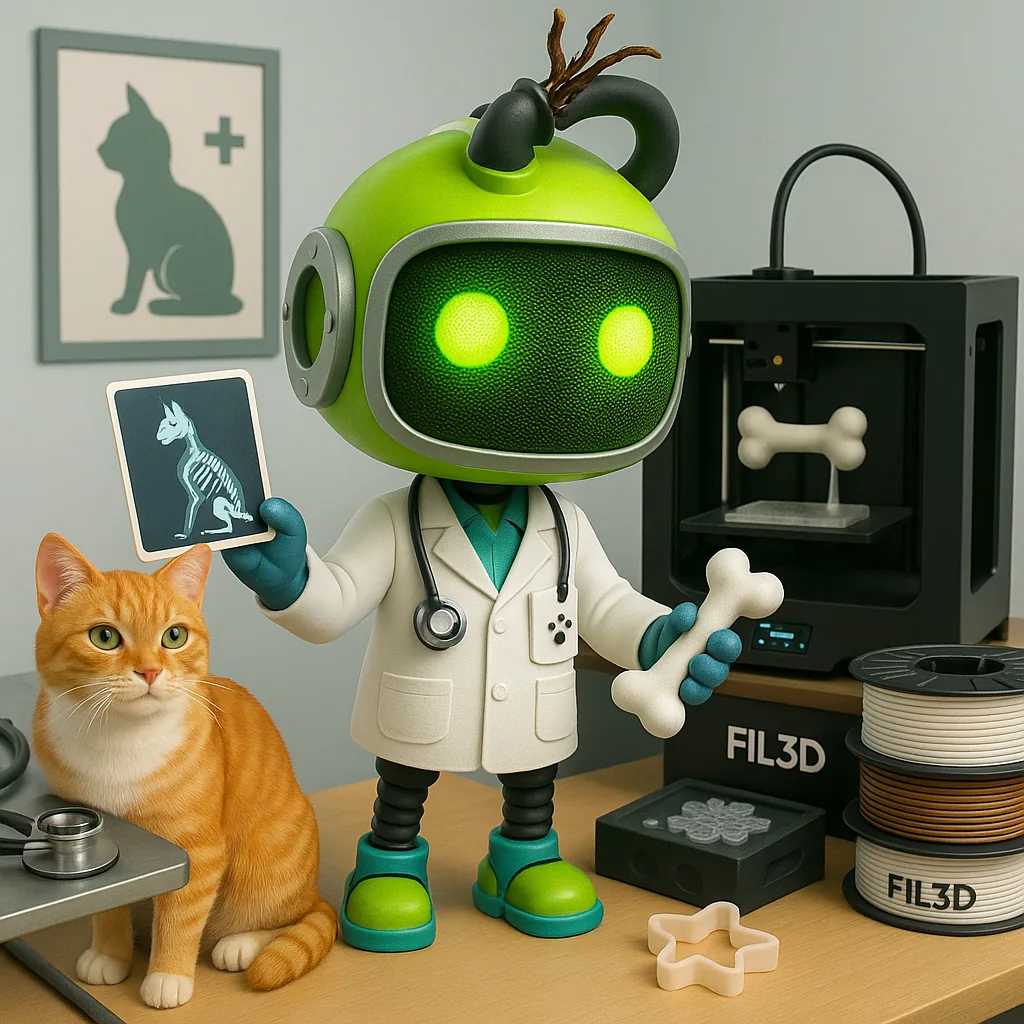
FDM 3D Printing: A Revolution in Veterinary Medicine
Veterinary medicine is experiencing a silent transformation, driven by technological innovation. Among the tools that are revolutionizing animal care, FDM 3D printing (Fused Deposition Modeling) stands out for its accessibility, versatility and customization capacity. At TUCAB, we believe that this technology can significantly improve the daily lives of veterinarians, offering practical and economical solutions to complex challenges. In this article, we explore how FDM 3D printing is being used in veterinary medicine, with technical details, practical examples and a look to the future.
What Is FDM 3D Printing and Why Is It Important in Veterinary Medicine?
FDM 3D printing is a technology that creates three-dimensional objects layer by layer using melted plastic filaments such as PLA, PETG and TPU. These materials are heated and deposited with precision to form customized parts, from prosthetics to anatomical models. In veterinary medicine, this ability to customize is crucial, as each animal has unique needs, whether for a prosthesis adjusted to their anatomy or a model to help plan a delicate surgery.
In addition, FDM 3D printing is affordable and can be implemented in clinics with limited resources, democratizing access to advanced animal care solutions.
Technical Details: Materials and Printing Parameters
To understand how FDM 3D printing can be applied in veterinary medicine, it is important to know the materials and technical parameters involved:
- Materials:
- PLA (Polylactic Acid): Biodegradable and easy to print, ideal for temporary anatomical models or prototypes. Requires extrusion temperatures between 190°C and 220°C.
- PETG: More resistant and durable than PLA, perfect for prosthetics and splints that need to withstand weight or impact. Extruded between 230°C and 250°C, it supports forces of up to 50 MPa.
- TPU (Thermoplastic Polyurethane): Flexible and elastic, used in prosthetics that imitate natural movements, such as artificial paws. Extrusion temperature between 220°C and 240°C.
- Printing Parameters:
- Layer Height: Varies between 0.1 mm for high resolution (e.g. detailed anatomical models) and 0.3 mm for fast and less complex parts.
- Printing Speed: Generally between 40 and 60 mm/s. For more delicate parts, such as prosthetics, it can be reduced to 30 mm/s.
- Infill: Defines the internal density of the part. A 20% infill is common for lightweight parts, while 100% is used for maximum strength in prosthetics or splints.
These parameters can be adjusted in slicing software like Cura, allowing veterinarians to customize each impression according to the patient's needs.
Practical Examples: How 3D Printing is Transforming Animal Care
Below are some practical examples of how FDM 3D printing is being used in veterinary medicine:
- Prostheses for Dog: A veterinarian can print an artificial paw for a dog with an amputation, using TPU to mimic natural flexibility. With a layer height of 0.2 mm and infill of 40%, the prosthesis takes around 12 hours to print and costs approximately €50 in filament. This personalized solution allows the animal to regain mobility and improve its quality of life.
- Anatomical Model for Surgical Planning: Before a complex surgery, such as correcting a heart malformation in a cat, veterinarians can print a model of the patient's heart in PLA. With a layer height of 0.1 mm to capture fine details, the model takes 8 hours to print and costs around €10. This model allows surgeons to visualize and rehearse the procedure, reducing risks and increasing precision.
- Custom Splint for Fracture: To treat a fracture in a cat's paw, a PETG splint can be printed, adjusted to the animal's anatomy through a 3D scan. With a layer height of 0.2 mm and infill of 30%, the splint takes 3 hours to print and costs just €5. In addition to being light and comfortable, the splint speeds up recovery and improves the patient's well-being.
These examples demonstrate how FDM 3D printing can be a valuable tool in veterinarians' daily lives, offering fast, economical and personalized solutions.
Benefits of 3D Printing in Veterinary Medicine
The adoption of FDM 3D printing brings several advantages to medicine veterinary:
- Total Customization: Each animal is unique, and 3D printing allows you to create solutions adapted to their specific needs, from prosthetics to splints.
- Cost Reduction: Compared to traditional methods, 3D printing is more economical, especially for unique or low-volume parts.
- Accessibility: With printers becoming more accessible, small and medium-sized veterinary clinics size can implement this technology without large investments.
- Speed: The ability to print parts on site reduces waiting time for devices or models, speeding up treatment.
A Look to the Future: The Potential of 3D Printing in Veterinary Medicine
The future of 3D printing in veterinary medicine is promising and may include:
- Bioprinting: The creation of living tissue for transplants, such as skin or cartilage, which could revolutionize animal regenerative medicine.
- Rehabilitation Devices: Customized supports for physiotherapy, such as collars or harnesses printed in TPU, adjusted to the animal's movement.
- Veterinary Education: Detailed anatomical models for training students, such as replicas of organs or skeletal systems, integrated into college curricula.
- Integration with Artificial Intelligence: Software that automatically generates 3D models from scans or descriptions, simplifying the process for veterinarians.
While large-scale adoption still faces challenges, such as access to technology and the need for training, the potential is undeniable.
Conclusion
FDM 3D printing is opening up new possibilities in veterinary medicine, offering personalized, cost-effective and accessible solutions for animal care. At TUCAB, we are committed to supporting this innovation by providing high-quality filaments, like FIL3D, that are ideal for these applications. If you are a veterinarian and are curious about how 3D printing can transform your practice, we invite you to explore this technology. Together, we can build a more innovative and compassionate future for our four-legged friends.
Discover FIL3D and Bring Innovation to Your Clinic!