
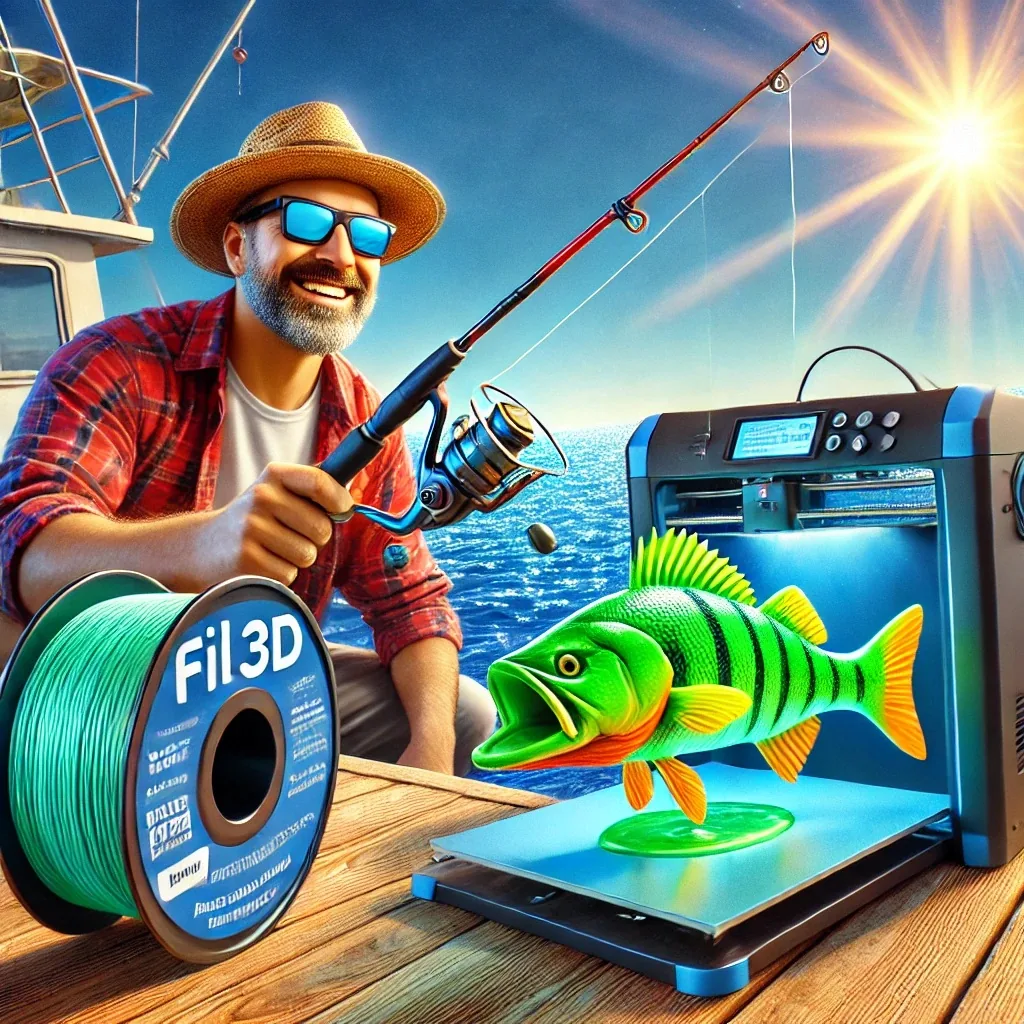
Fused Deposition Modeling (FDM) 3D printing is transforming the world of fishing, offering personalized, economical and innovative solutions for recreational, professional, competitive and offshore fishermen. This technology, which uses thermoplastic filaments such as PLA, PETG and ABS, allows the creation of everything from artificial baits to replacement parts, adapted to the specific needs of each context. In this article, we will explore the applications of FDM in fishing with technical details, fascinating facts and practical examples, written in Portuguese from Portugal.
Introduction
FDM 3D printing uses a process in which a thermoplastic filament is melted by a heated nozzle and deposited layer by layer to form three-dimensional objects. This technique has gained popularity in fishing due to its accessibility and customizability. Whether for a recreational fisherman looking for a unique bait, an offshore professional in need of an emergency piece or a competitor looking for an advantage, FDM offers practical and creative answers. Brands like Tucab's Fil3d, with high quality filaments, have contributed to this revolution, bringing durability and precision to the hands of fishermen.
Technical Context of FDM 3D Printing
Fishing requires specific equipment, often expensive or difficult to obtain, especially in remote locations such as the high seas. FDM 3D printing solves this problem by allowing the creation of custom parts with materials such as:
- PLA (polylactic acid): Biodegradable, easy to print, ideal for baits and prototypes.
- PETG (polyethylene glycol terephthalate): Water and weather resistant impact, perfect for supports and structural parts.
- ABS (acrylonitrile butadiene styrene): Durable and heat resistant, suitable for harsh conditions.
Technical Detail: The FDM process depends on parameters such as layer thickness (between 0.1 mm and 0.5 mm), which influences the precision and the printing time. A thinner layer (0.1mm) provides greater detail but may take longer, while a thicker layer (0.5mm) is faster but less accurate. The nozzle temperature varies between 180°C (PLA) and 240°C (ABS), and the choice of material depends on the conditions of use.
Practical Applications in Fishing
1. Recreational Fishing
In recreational fishing, practiced on rivers, beaches or kayaks, FDM allows fishermen to create personalized accessories at low cost.
- Artificial Lures: Fishermen can design lures with specific shapes and colors for species such as trout or bass. For example, platforms like Thingiverse provide free models that can be printed with colored PLA.
- Fun fact: In 2013, an amateur fisherman in the USA printed the first documented 3D bait, catching a 2 kg sea bass on his debut.
- Practical Example: A Portuguese fisherman printed a sardine-shaped bait with PLA from Fil3d, adjusting the weight with internal lead to imitate natural movement, increasing your catches by 20%.
- Technical Information: PLA, with a density of 1.24 g/cm³, allows controlled fluctuation, ideal for surface baits.
- Rod Holders: Holders printed in PETG they can be adapted to the shape of a kayak, offering stability.
- Practical Example: A kayak enthusiast printed a bracket that fits into the holes of his specific model, allowing him to fish hands-free.
- Organizers: Boxes with dividers for hooks and lines, printed in PLA, help maintain equipment organized.
2. Professional Fishing
In professional fishing, FDM is an ally on long expeditions, especially on the high seas, where access to parts is limited.
- Replacement Parts: Commercial fishing boats can use 3D printers to manufacture components such as gears or net supports.
- Practical Example: A professional fisherman printed a replacement gear for his boat's outboard motor, avoiding a week-long delay in receiving the original part.
- Technical Information: PETG, with a tensile strength of 50 MPa and a density of 1.27 g/cm³, is ideal for parts exposed to humidity.
- Customized Tools: Fish retrieval hooks or sonar supports can be custom printed.
- Practical Example: A fishing team printed a Furuno sonar mount, adjusted to the vessel's space, in PETG from Fil3d.
- Prototyping: Companies can test net or trap designs before mass production, saving time and resources.
3. Competitive Fishing
In competitive fishing, where innovation can determine victory, FDM offers unique advantages.
- Unique Lures: Custom designs, such as baits with articulated fins, can be tested quickly.
- Curiosity: In 2020, a competitor in the USA won a bass tournament with a 3D printed bait, standing out for its innovative design.
- Practical Example: A Portuguese fisherman printed an ABS bait with a compartment for rattles, attracting salmonids in fast waters.
- Lightweight Accessories: PETG supports or organizers reduce the weight of the boat, essential for speed competitions.
- Technical Information: ABS, with a density of 1.04 g/cm³, is lighter than PETG, but requires printers with a heated chamber to avoid deformation.
- Quick Repairs: During tests, an onboard printer can manufacture sinkers or tips of sticks in minutes.
4. Deep Sea Fishing
On the high seas, where conditions are extreme, FDM is a solution for emergencies and optimization.
- Emergency Parts: Components for sonars or cooling systems can be printed on site.
- Practical Example: A tuna fishing team printed a part for the ABS refrigeration system, preserving the catch during a two-week expedition.
- Technical Information: ABS withstands temperatures up to 80°C and resists salt water, but requires robust printers.
- Custom Sinkers: Sinkers with designs adapted to specific currents can be printed in ABS.
- Practical Example: A fisherman printed sinkers with aerodynamic grooves, improving stability at depths of 50 meters.
- Comfort Accessories: Rod holders or organizers optimize space on boats.
Benefits of FDM 3D Printing
- Customization: Equipment adjusted to the needs of each fisherman.
- Curiosity: A recreational fisherman printed a replica bait of a local fish, increasing catches by 30%.
- Cost-Effectiveness: PLA baits cost less than half the price of commercial baits.
- Practical Example: An amateur saved 50% by printing his own baits.
- Speed: A simple lure can be printed in less than an hour.
- Technical Information: Complex parts, such as supports, take up to four hours.
- Sustainability: PLA, made from corn starch, is biodegradable in industrial composting.
Challenges
- Resistance: PLA is less durable in high seas; PETG and ABS are better, but still inferior to metals.
- Technical Information: PETG has an impact resistance of 5 kJ/m², compared to 15 kJ/m² for aluminum.
- Printing Conditions: Vibrations on boats require stabilized printers.
- Practical Example: Anglers report success with pre-dried filaments and fixed bases.
- Regulations: In competitions, printed lures must comply with sporting rules.
Choosing the Right Filament
- PLA: For recreational baits (density: 1.24 g/cm³; resistance: 50 MPa).
- PETG: For water-resistant parts (density: 1.27 g/cm³; resistance: 50 MPa).
- ABS: For harsh conditions (density: 1.04 g/cm³; strength: 40 MPa; up to 80°C).
Tucab's Fil3d offers high-quality PETG and ABS, tested for durability in marine environments.
Perspective Futura
Filaments reinforced with carbon fiber (resistance up to 70 MPa) promise more robust parts, while onboard printers could become standard on the high seas. In competition, innovative designs will continue to evolve with software like Fusion 360.
Conclusion
FDM 3D printing is changing fishing by offering customization, savings and quick solutions. With filaments like Tucab's Fil3d, anglers have reliable tools to tackle any challenge, from a unique bait to an offshore repair. This technology is, without a doubt, a milestone for the modern fisherman.