
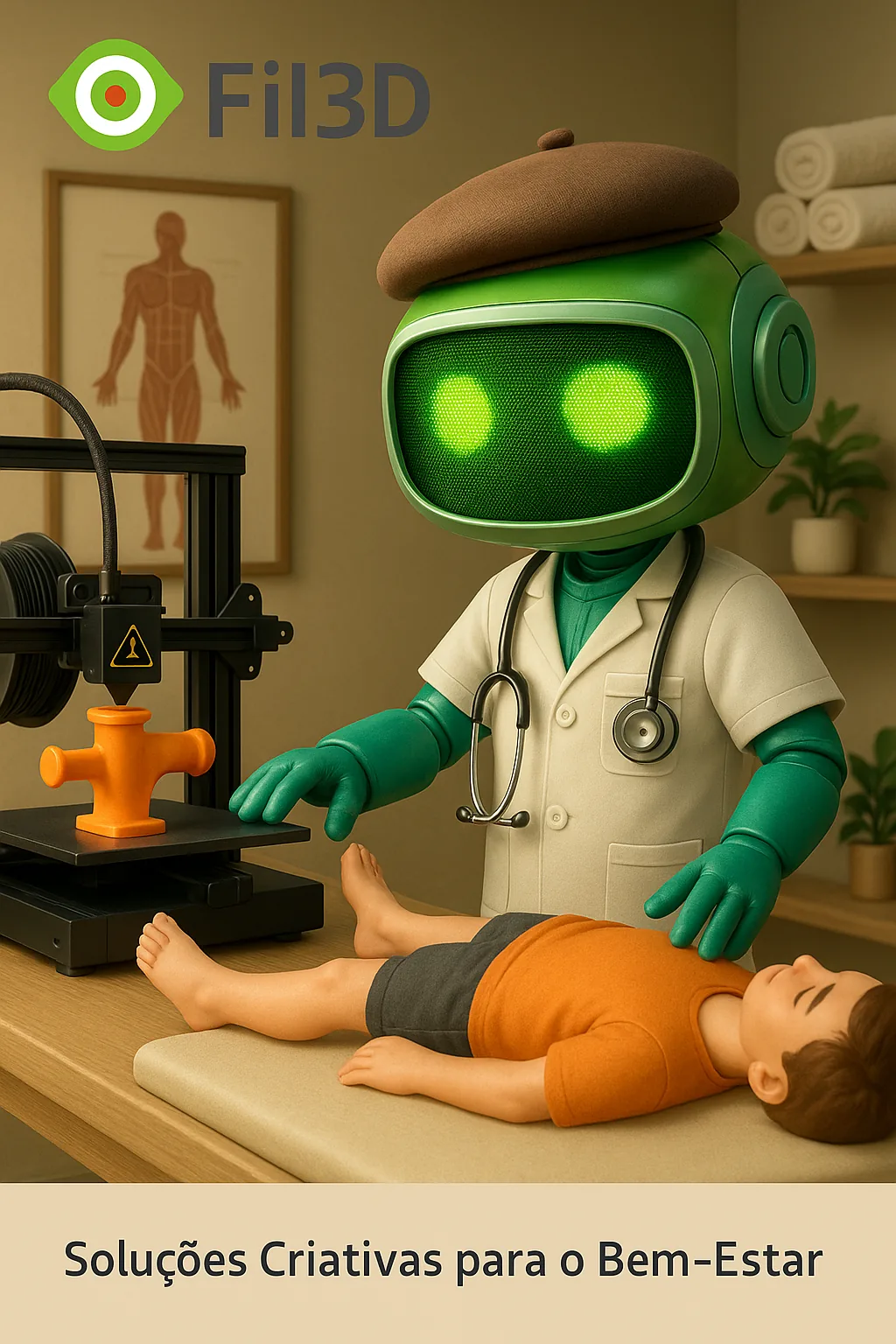
3D Printing in Physiotherapy: How Technology is Changing the Day to Day Life of Physiotherapists with Tucab
Physiotherapy Gains a New Ally with 3D Printing
Hello! Have you ever thought about how technology can help those who take care of our health? Physiotherapists, those professionals who help us recover from injuries, relieve pain or get our bodies moving again after surgery, are discovering an incredible ally: FDM 3D printing. In Portugal, from Minho to the Algarve, more and more physiotherapists are using this technology to create custom tools, models to explain treatments and even accessories for patients' exercises. With Tucab's FIL3D filaments, everything is easier, cheaper and even more environmentally friendly. Do you want to know how? Let's find out together!
How 3D Printing Helps Physiotherapists in Everyday Life
FDM 3D printing is a technology that creates objects layer by layer, using filaments such as FIL3D PLA or PETG from Tucab. For physiotherapists, this is almost like having a “magic machine” that does exactly what they need. Here are some ways to use it:
- Custom-Made Splints and Supports:
Imagine you have an injury to your wrist. Your physiotherapist can measure your wrist and print a splint in FIL3D PETG, which is very resistant and light, in a discreet color such as gray or blue. This way, the splint fits perfectly for you, without squeezing or bothering you. - Models to Explain Things Better:
Sometimes, understanding what is happening to our body is not easy. Physiotherapists can print models of joints or muscles in FIL3D PLA, such as a knee or shoulder in white or beige, to show you where the problem is and what you will do to improve. - Accessories for Your Exercises:
To help you recover, your physiotherapist can create things like resistance rings or exercise supports in FIL3D TPU, a more flexible material, in fun colors like green or orange. They are tailored to your needs, so the exercises are more effective. - Prototypes of Useful Things:
Have you ever thought about a non-slip base for your crutch? Or on a stand to hold a light weight while you exercise? Physiotherapists can print these things in FIL3D PLA, test and tweak until it's perfect. - Take Care of the Planet While They Take Care of You:
Tucab's FIL3D PLA filaments are recycled and biodegradable, which means physiotherapists can use 3D printing without creating as much waste, helping the environment while helping you.
One Day in the Life of Mariana, Physiotherapist in Alentejo
Let's meet Mariana, a physiotherapist who works at a clinic in Évora and loves using her 3D printer to help patients. Today, she has a busy day, and 3D printing will make all the difference!
In the morning, Mariana tends to Mr. António, who sprained his ankle playing football with his grandchildren. She measures his ankle and prints a splint in gray FIL3D PETG. It uses a layer height of 0.2 mm, a fill of 30% to make it resistant, and the piece is ready in 2 hours, costing just €2. Mr. António is impressed: “This is really made for me, it doesn't tighten anything!”
At lunchtime, Mariana has an appointment with Dona Clara, who had shoulder surgery. To explain how the shoulder works and the exercises they will do, Mariana prints a model of the shoulder in white FIL3D PLA. With a layer height of 0.15 mm and 20% infill, the model takes 1 hour to print and costs €1. Dona Clara smiles: “Now I understand better what is happening, thank you!”
In the afternoon, Mariana works with a young athlete who needs to strengthen his hand after an injury. It prints a resistance ring in green FIL3D TPU, with 40% infill and 0.2 mm layer height, ready in 45 minutes. The ring is perfect for the tightening exercises that the athlete needs to do.
What Does a Physiotherapist Gain from 3D Printing?
- Everything Tailored to You: Each patient is unique, and 3D printing allows you to create splints, supports or accessories that fit perfectly, helping with recovery.
- Faster and Cheaper: Making a splint or model with FIL3D is much faster and more economical than having it done outside, and you can have the piece on the same day.
- Better Communication: With 3D models, patients better understand what is happening to their body, and this gives them more confidence in the treatment.
- Doing Good for the Planet: Using recycled FIL3D filaments is a way of taking care of the environment, something that goes well with a profession that takes care of people.
A Little Bit of Technique for Those Who Want to Know More
If you're curious, here are some details about how 3D printing works in physiotherapy:
- Filaments: FIL3D PLA is great for models and simpler things, FIL3D PETG is stronger for splints, and FIL3D TPU is flexible for accessories like resistance rings.
- How to Print: Use a layer height between 0.15 and 0.2 mm to get detail without taking too long; padding varies between 20% (for light things) and 40% (for stronger things); the temperature is 200-220°C for PLA, 230-250°C for PETG and 220-240°C for TPU.
- How much does it cost and how long does it take: A PETG splint can cost €2 and take 2 hours; a PLA model costs €1 and is ready in 1 hour.
What will the future of physiotherapy look like with 3D printing?
Imagine a future where 3D printing is even more common in physiotherapy! With Tucab's FIL3D filaments, physiotherapists can start making incredible things, like supports with sensors that measure the force you're exerting during an exercise, or even complete kits to carry out your rehabilitation at home, with everything you need already printed and ready to use.
Think about this: what if every physiotherapy clinic had a small 3D printer, to make splints or accessories on the spot, while you wait? Or if physiotherapists could share their 3D designs with other professionals around the world, so that all patients have access to custom-made things, even in more remote places, like a village in the interior of Portugal?
Let's Innovate in Physiotherapy with Tucab?
FDM 3D printing is bringing a new world to physiotherapy, with tailor-made solutions, cheaper and still help the planet. With Tucab's FIL3D filaments, physical therapists can take a leap forward in how they help patients recover. Want to know more about how 3D printing is changing other professions?
Take a look at our articles about painters and innovation engineers
And you, what do you think about using 3D printing in physiotherapy?
Tell us in the comments, we'd love to know your opinion!
#Tucab #Impressao3D #Fisioterapia #FIL3D #CuidarComTecnologia