
3D Printing: The Catalyst for Innovative and Unreplicable Parts by Traditional Methods
Introduction
3D printing, or additive manufacturing, has opened up a universe of possibilities in the design and production of parts that, due to their unique characteristics of shape, functionality or material, would be impossible or extremely costly to manufacture using conventional methods. This article explores how 3D printing is being used to create innovative parts, highlighting examples that illustrate the revolution that this technology represents in the industry, with a special focus on the issue of time, as it is much faster and requires fewer steps from conception to the final part.
The Complexity Revolution
1. Complex Geometries:
- Internal Structures: 3D printing allows the creation of structures with complex internal cavities without the need for post-production assembly, significantly reducing manufacturing time.
- Optimized Topology: Parts can be designed to be lighter and stronger, optimizing the use of materials and accelerating the development and production process.
2. Customization:
- Prosthetics and Implants: The production of personalized prosthetics and implants can be done in a matter of days, instead of weeks or months, thanks to 3D printing, improving the response time to medical treatment.
- Jewelry and Product Design: In the field of jewelry, 3D printing reduces the production time for pieces of complex design, allowing rapid design iterations before final production.
Materials and Applications
3. New Materials:
- Compounds and Mixtures: Combining different materials into a single part can be done quickly, facilitating experimentation and innovation.
- Biodegradable Materials: Manufacturing of sustainable products is accelerated as 3D printing allows for rapid adjustments to meet new material requirements.
4. Micro and Nanotechnology:
- Microstructures: Printing on smaller scales enables faster production of minute components, with fewer intermediate steps.
Practical Examples
- Cooling Tools: The complexity of internal cooling channels can be designed and printed directly, cutting production steps and reducing development time.
- Musical Instruments: New instruments with innovative acoustic designs can be prototyped and produced in much less time than would be possible with traditional techniques.
- Space Parts: NASA benefits from a faster manufacturing process for parts that require rapid validations before being sent into space.
Large Surface Automation
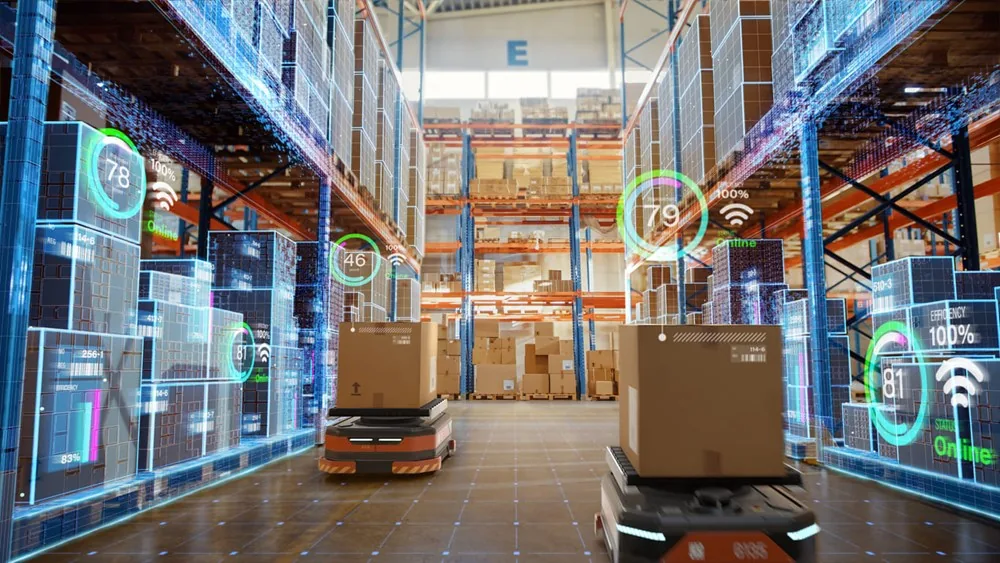
- Global Automation Parts: A notable example is the use of 3D printing to create parts intended for large surfaces, such as warehouses or distribution centers, which are at the forefront of global automation. 3D printing allows the manufacturing of highly specialized components, such as sensors, actuators and support structures for autonomous robots, which can operate without the need for human labor. These parts can include:
- Navigation Systems: Parts that allow robots to navigate complex spaces with precision, using geometries that would be difficult to mass-manufacture traditionally.
- Maintenance Components: Parts that can be automatically replaced or repaired by other robots, reducing downtime and increasing operational efficiency.
- Modular Structures: Components that can be quickly adapted or expanded to meet changing logistical needs, without the need for extended downtime for reconfiguration or construction.
The Time Factor
- Rapid Prototyping: 3D printing enables prototyping Fast, where ideas can be tested and adjusted in an accelerated development cycle, rather than waiting for molds and traditional manufacturing.
- Reduced Steps: The process of going from CAD (Computer-Aided Design) to the physical part is straightforward, eliminating many manufacturing steps that increase time and cost in traditional methods.
- Time to Market: Companies can reduce the time needed to bring new products to market, making them more responsive quickly respond to changing consumer demands or industry needs.
Challenges and Future
- Scale and Cost: Although 3D printing is ideal for one-off parts or small production runs, scalability is still a challenge for mass production.
- Quality and Durability: Continuous evolution in the quality of 3D printed parts is underway. reduce this difference, but the time required for adjustments and testing may vary.
- Future of Manufacturing: With the speed at which 3D printing can turn ideas into reality, the future of manufacturing is in a direction where innovations can be implemented with unprecedented agility.
Conclusion
3D printing is not just a new production tool; it is a revolution that allows the creation of pieces that defy the physical, economic and temporal limitations of traditional manufacturing. The ability to produce quickly and efficiently is transforming the way we think about design, production and innovation, showing that the future of innovation is inextricably linked to the ability to print what was previously impossible to manufacture, and do so in record time. The automation of large surfaces is a clear testimony to this transformation, where 3D printing not only facilitates innovation, but also redefines the role of human labor in industry.