
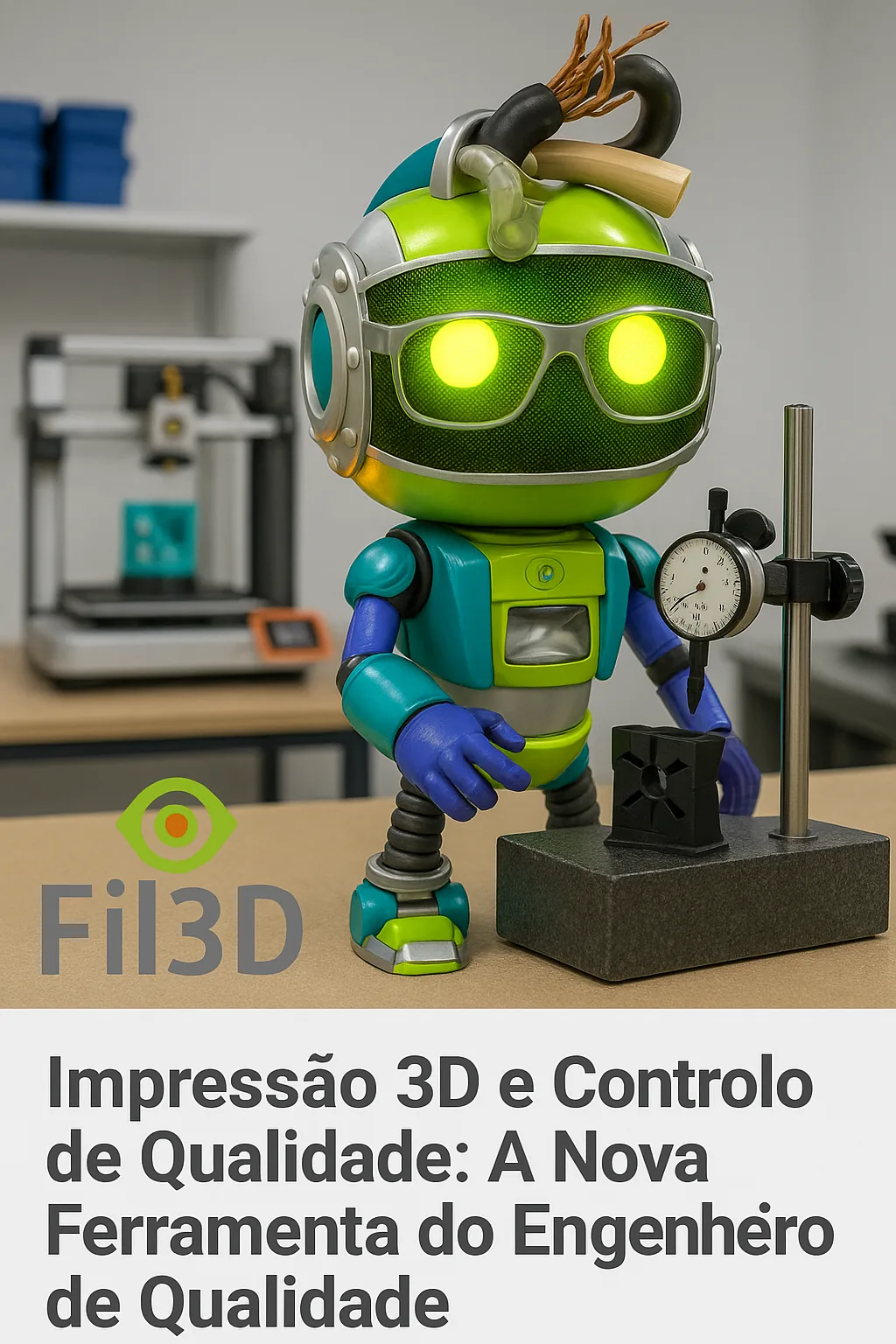
The profession of Quality Engineer requires method, rigor and reliable tools to ensure that each product meets the defined standards. 3D printing, with its flexibility and quick response capacity, has become an increasingly present ally in laboratories and assembly lines. Fil3D filaments offer the stability, resistance and versatility that this area demands.
The role of 3D printing in Quality
In quality engineering, the main objectives are:
-
Ensure dimensional and functional conformity of parts;
-
Evaluate the resistance, finish and safety of components;
-
Help implement and improve statistical control and Poka-Yoke processes.
3D printing allows you to create, in an accessible and fast way:
-
Tools for verification, alignment and measurement;
-
Support devices for operator training;
-
Technical support for audits and traceability.
Practical day-to-day examples
1. Templates measuring and fitting
Instead of waiting weeks for a milled part or a control device, the engineer can print templates with specific tolerances in-house, testing fits, drilling positions or alignments in seconds.
2. Visual control masks
To check the presence of holes, finishing or correct positioning, 3D printing allows you to create masks adapted to the actual geometry of the part, ensuring speed in the control process.
3. Supports and testing devices
In vibration, impact or torque tests, the engineer can design and print supports that simulate real conditions of use, adapted to each new product.
4. Simulation of failures for formation
3D printing allows you to create parts with simulated defects (e.g.: cracks, lack of material, deformations), used in internal training sessions for operators, as part of the Poka-Yoke methodology.
5. Continuous improvement with real data
Printed templates can be quickly redesigned as statistical data (CPK, PPM, R&R) is collected, making quality control more dynamic and effective.
Fil3D Materials recommended
-
PLA – excellent dimensional stability, ideal for measuring prototypes or fixed supports.
-
PETG – moderate chemical and thermal resistance; perfect for environments with greater demand for robust tools, with greater resistance to impact and wear.
3D Printing and the Future of Quality
The Quality Engineer of the future will have at his disposal:
-
Printed devices with integrated sensors that collect contact, pressure or temperature data;
-
Customized interfaces for contact or laser measuring machines;
-
Smart jigs with automatic reading of presence or compliance;
-
Systems modular systems that allow you to reconfigure control lines without downtime.
With the help of Fil3D, the quality professional also becomes a solution designer, accelerating the cycle of continuous improvement.
Conclusion
3D printing does not replace the rigor of the Quality Engineer — elevate it. It allows you to test, validate, control and form more quickly, reducing costs and increasing reliability.
Fil3D – Precision that is printed, quality that is guaranteed.