
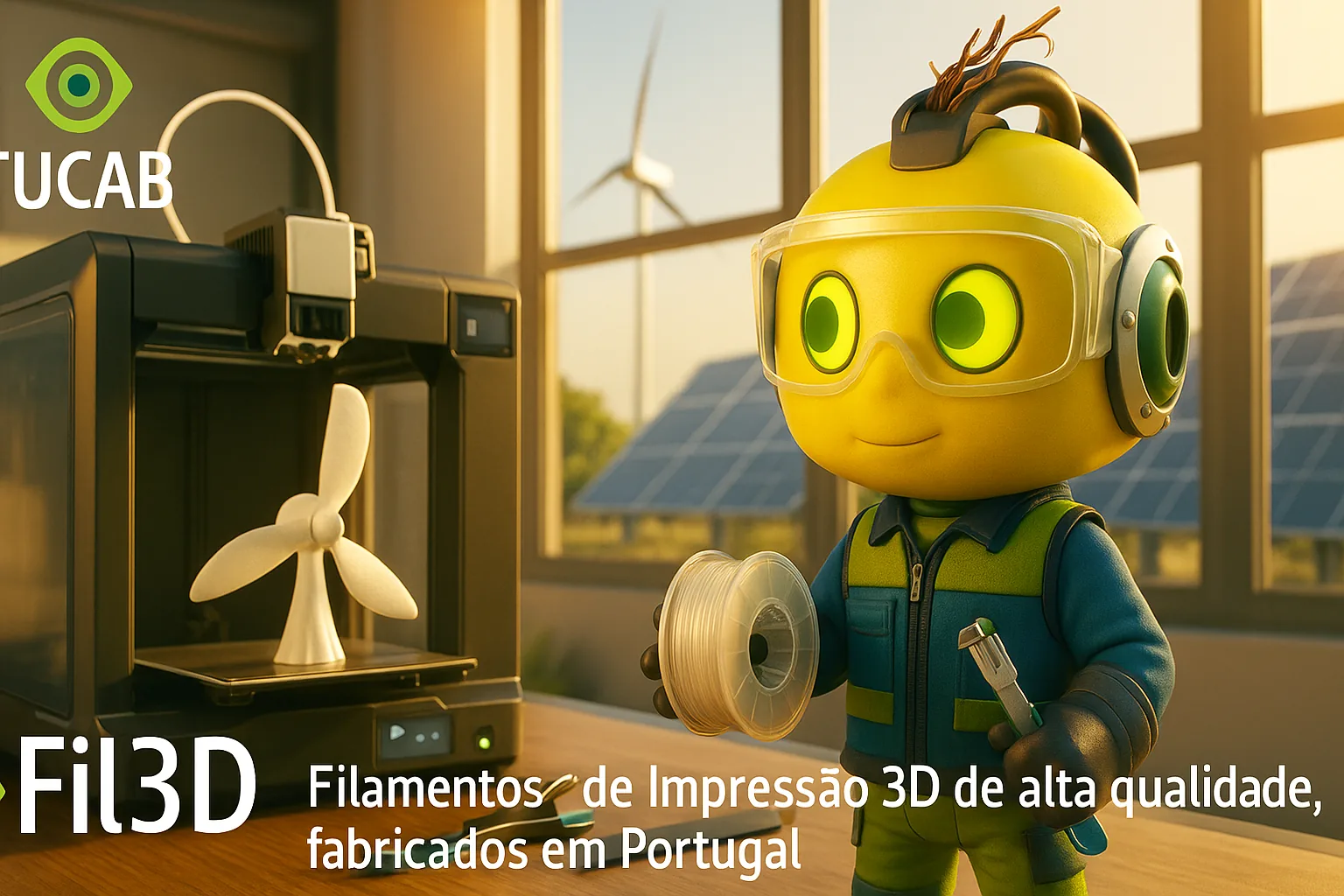
The energy transition is no longer a distant vision — it is an urgent mission.
From wind to sun, from waves to electric mobility, the world is looking for cleaner, more efficient and smarter ways to generate and store energy. redefine the way the energy future is built: 3D printing.
Layer by layer, innovation takes shape. And with FIL3D®, every filament is a thread of change.
The energy of innovation: when 3D printing meets engineering
FDM (Fused Deposition Modeling) 3D printing has become an indispensable tool for engineers and researchers in the energy sector.
Allows you to create technical components complex, personalized and low-cost, reducing waste and accelerating the development of sustainable solutions.
With this technology, it is possible to manufacture:
-
Structural parts for solar panels, light and resistant to UV radiation;
-
Protectors and housings for wind turbine sensors;
-
Custom wiring harness holders, connectors and electrical insulators;
-
Rapid prototyping of fuel cells, batteries and microgenerators.
The result is a more agile, affordable and sustainable energy sector — powered by ideas that are printed in real time.
Solar energy: the future shines brighter with printing 3D
In solar energy, 3D printing plays a fundamental role in the development of new photovoltaic systems and modular support structures.
With technical filaments such as PETG Skygreen and PLA from FIL3D®, it is possible to manufacture:
-
Frames resistant to temperature and solar radiation;
-
Tailored parts for integration into urban roofs and panels;
-
Optimized ventilation and heat dissipation systems.
These solutions allow you to reduce costs and installation time — transforming the sun into energy with more efficiency and less environmental impact.
Wind energy and marine: resistance that comes from the right polymer
In wind farms, 3D printing is used to prototype blades, gears, control components and monitoring systems.
FIL3D® materials offer the robustness needed for high vibration and humidity environments, with:
-
Technical PETG, resistant to traction and impact;
-
Reinforced PLA, ideal for test and calibration models;
-
Customized filaments that balance rigidity and flexibility.
Even at sea, 3D printing is gaining ground: underwater drones and ocean waste collection systems include parts printed with FIL3D® filaments, due to their durability and dimensional stability.
Prototyping of electrical and energy systems emerging
Startups and research centers use 3D printing to develop new energy solutions, from mini turbines to conductive structures for hydrogen cells and solid batteries.
Rapid prototype manufacturing dramatically reduces the time between concept and practical testing.
With PLA from FIL3D®, it is possible to print millimeter-precision components to study thermal flow and insulation efficiency, while PETG Skygreen guarantees superior chemical and thermal resistance — ideal for devices that operate at high temperatures.
FIL3D®: the filament that drives the energy future
A FIL3D®, a TUCAB® brand, has been playing a pioneering role in the production of 3D printing filaments in Portugal, supporting technological development in multiple areas — now also in the energy sector.
Each FIL3D® coil is produced with full traceability, micron diameter control and environmental commitment.
The result? Materials that ensure precision, durability and sustainability.
-
FIL3D® PLA – rigidity and surface quality for technical components.
-
FIL3D® PLA – superior detail and dimensional stability.
-
FIL3D® PETG Skygreen – ideal mechanical and thermal resistance for industrial use.
-
FIL2NDLIFE® – sustainable version made from recycled plastic, perfect for circular economy projects.
The future of energy will be printed
3D printing is making possible a new era of energy autonomy, where every part, every support and every structure can be manufactured locally and customized as needed.
In a world that demands efficiency and environmental responsibility, FIL3D® filaments are the link between technology, sustainability and clean energy.
Because the future of energy... is printed with precision.
Conclusion
“Every gram of filament is an investment in a more efficient and sustainable planet.”
With FIL3D®, TUCAB® continues to prove that innovation can be Portuguese, sustainable and global.
Energy, technology and 3D printing — together, they are shaping tomorrow.
FIL3D® – High quality 3D Printing Filaments, manufactured in Portugal.