
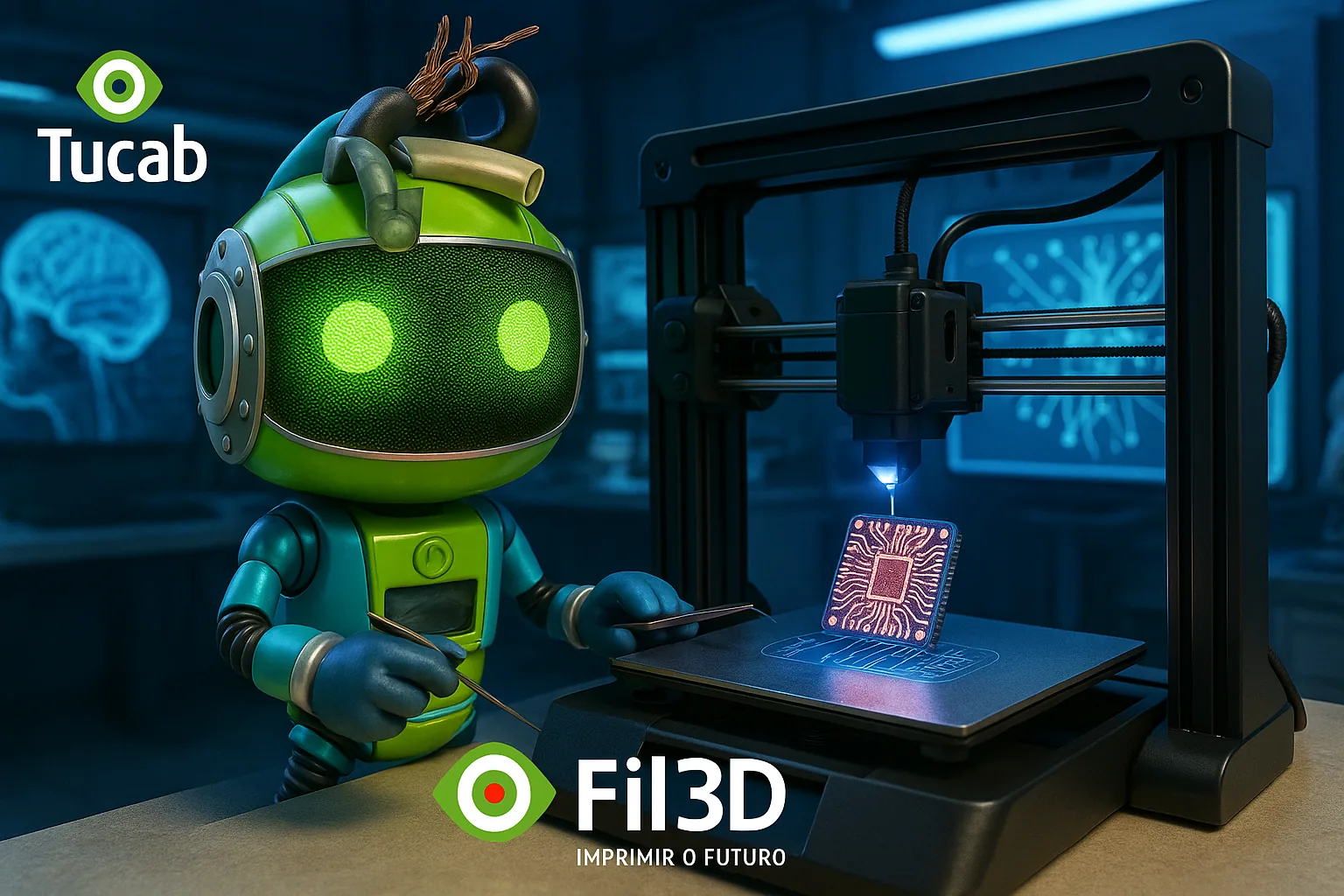
The border between the human and the technological has never been closer.
In the last decade, the advancement of neurotechnology — the science that connects the brain to machines — has transformed the way we understand the body, the mind and the very definition of intelligence.
And, at the heart of this silent revolution, lies a tool that gives form to the invisible: printing 3D.
With FIL3D® technical filaments, produced by TUCAB®, additive manufacturing is making the unthinkable possible — printing the physical link between man and machine, with precision and biocompatibility.
The engineering of thought
A neurotechnology seeks to create neural interfaces, devices capable of translating electrical impulses from the brain into digital commands.
These are the basis of brain implants, smart prostheses, neurostimulators and motor rehabilitation systems that allow movement, vision and communication to be restored to those who have lost them.
But manufacturing these structures is an extreme challenge: it requires microprecision, complex geometries and biocompatible materials — and that's where 3D printing becomes essential.
Through FDM (Fused Deposition Modeling) technology and high-resolution printers, researchers are able to create:
-
Three-dimensional neuronal scaffolds;
-
Porous structures for integration with biological tissues;
-
Molds for microelectrodes and flexible sensors;
-
Customized cranial prostheses with perfect anatomical fit.
“3D printing gives shape to what the mind imagines — literally.”
From Prosthetics to Thought: When Biology Merges with Polymer
The most promising advances are happening in neuroengineering labs, where technical polymeric materials are used to mimic the flexibility and conductivity of human tissues.
Filaments like PLA and PETG Skygreen FIL3D® offer the ideal basis for experimental models, prototypes and biomedical devices, thanks to their:
-
High dimensional accuracy;
-
Purity and absence of metallic impurities;
-
Sterilization capacity and thermal stability.
These properties make FIL3D® materials a bridge between medical engineering and applied neuroscience — a symbiosis that redefines the limits of personalized medicine.
3D Neuroprinting – The future of prosthetics intelligent
Printing a neural interface is not just a question of design: it is creating a living, responsive system.
Thanks to 3D printing, engineers can:
-
Reproduce neuronal microchannels that conduct electrical impulses;
-
Integrate flexible sensors that communicate directly with the system nervous;
-
Produce biocompatible supports adapted to each patient.
These technologies are already being tested in motor rehabilitation, brain control of robotic prostheses and even in cognitive neurostimulation — a new era of human body engineering.
FIL3D® – Precision and innovation at the service of science
The philosophy of FIL3D® is clear: each layer is a step towards the future.
With filaments extruded with micrometric precision, the Portuguese brand of TUCAB® guarantees quality, purity and thermal stability, essential factors in medical and scientific applications.
Just as a neuron transmits signals with precision, FIL3D® ensures that each filament transmits innovation with the same precision.
“Between thought and creation, there is only one layer — and FIL3D® prints it.”
From the brain to the machine – and from returns to the human being
The future of neurotechnology is human, even when it is made of polymers, sensors and algorithms.
With 3D printing, the brain is no longer just studied — it starts to be replicated, integrated and understood through engineering.
And with the right materials, this integration becomes safe, precise and real.
A TUCAB®, through FIL3D®, is present where science and imagination meet — helping to print the next generation of human-machine interfaces.