
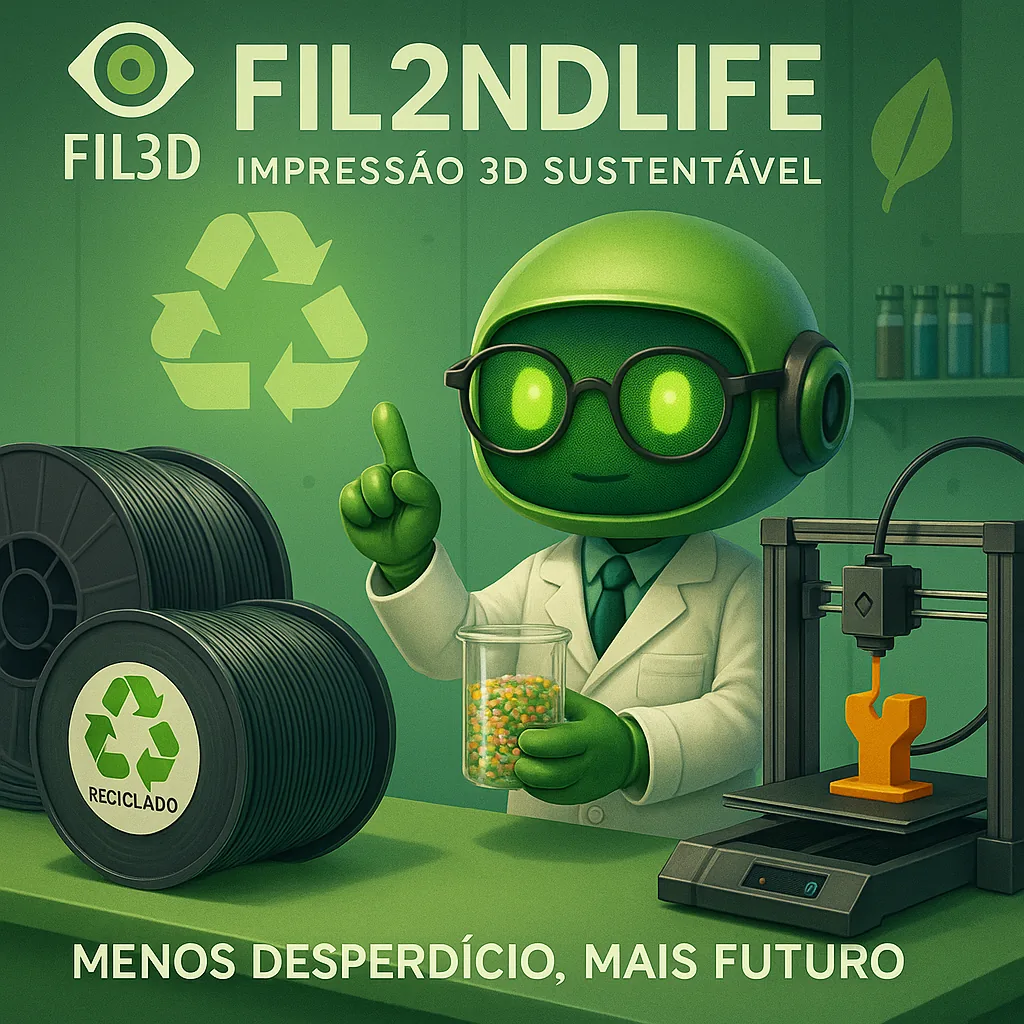
We live in an era in which sustainability is no longer an option and has become a necessity.
3D printing appears as a powerful tool in promoting the circular economy, allowing us to reduce waste, reuse materials and create products more efficiently and responsibly.
At FIL3D, a TUCAB brand, we believe that the future of 3D printing involves sustainable innovation, with solutions that respect the environment without compromising quality.
The problem of plastic waste
Every year millions of tons of plastic are produced, much of which ends up in landfills or the ocean.
Industry and consumers are looking for alternatives that help reduce this environmental impact. This is where 3D printing makes a difference.
How 3D printing can help
-
Production of only what is necessary → unlike traditional production, 3D printing uses only the material strictly necessary to create the part, reducing waste.
-
Recycled filaments (FIL2NDLIFE) → FIL3D has developed a line of recycled filaments that give new life to plastic, transforming waste into useful and functional solutions.
-
Repair instead of disposal → with 3D printing it is possible to create replacement parts and extend the useful life of equipment and everyday objects.
Practical examples
-
Education: Schools and universities print teaching tools without using disposable materials.
-
Industry: Companies use 3D printing for prototypes and support parts, saving time and reducing waste.
-
Consumers: At home, any user can print a missing part to repair instead of buying new.
A vision of a sustainable future
In the future, we imagine circular factories with 3D printers capable of transforming plastic waste into new products directly at the point of consumption.
Communities will be able to produce locally and autonomously, reducing transport, emissions and dependence on large production chains.
Conclusion
Printing 3D is much more than technological innovation — it is a sustainability tool.
At FIL3D, we work daily to develop filaments that allow the creation of products with a lower environmental impact, such as FIL2NDLIFE, our recycled filament.Discover more at: tucab.pt
Contact us: comercial@tucab.pt