
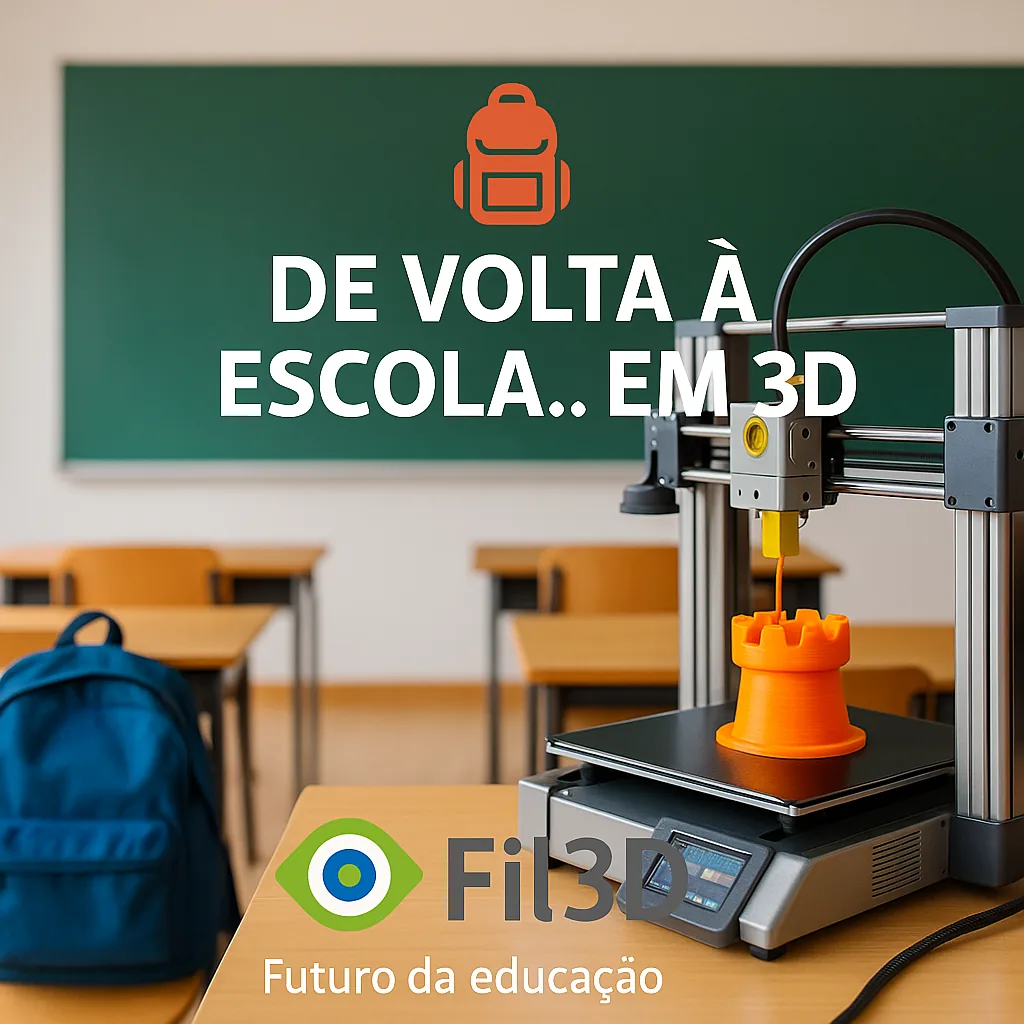
School is a space for learning, but also for experimentation and discovery.
3D printing has added a new layer to this process: the possibility of transforming ideas into real objects, stimulating curiosity, creativity and innovation at all levels of education — from kindergarten to university.
At FIL3D, we believe that the classroom is the ideal place to plant the seeds of innovation, and 3D printing is the tool that gives them shape.
Theoretical and applied examples
Mathematics and Geometry
-
Theoretical: study of mathematical formulas and properties, such as volume, area and proportions.
-
Practical: solid printing geometric structures (pyramids, cubes, spheres) that allow students to visualize and manipulate abstract concepts.
-
Impact: greater understanding and retention of content that was previously limited to paper.
Natural Sciences and Biology
-
Theoretical: study of human anatomy and of ecosystems.
-
Practical: printing models of organs (heart, lungs, brain), enlarged-scale cells, fossils and even replicas of extinct animals.
-
Impact: practical and immersive learning, complementing traditional teaching.
History and Geography
-
Theoretical: study of monuments, maps and cultural heritage.
-
Practical: printing of relief maps for the study of physical geography and replicas of historical monuments such as the Pyramids of Egypt, the Tower of Bethlehem or the Colosseum of Rome.
-
Impact: promotes the inclusion of students with visual impairments and brings life to historical and geographical landmarks.
Arts and Design
-
Theoretical: exploration of shapes, colors and artistic styles.
-
Practical: students can create sculptures, design pieces or even fashion prototypes.
-
Impact: development of creativity, critical thinking and digital skills.
Engineering and Technology
-
Theoretical: introduction to concepts of mechanics, electronics and product design.
-
Practical: printing of parts for robotic prototypes, drones, architectural structures and engineering projects.
-
Impact: preparation for professions linked to Industry 4.0.
Practical benefits
-
Stimulation of creativity → freedom to create and experiment.
-
Collaborative learning → group projects that reinforce working together team.
-
Educational inclusion → tactile resources for students with special needs.
-
Sustainability → use of recycled filaments such as FIL2NDLIFE, showing circular economy concepts in practice.
-
Development of digital skills → students learn to use 3D modeling and printing software, preparing for the future.
The Future of School with 3D Printing
Makers Laboratories in all schools
Each school will be able to have its own innovation space, with 3D printers accessible to all students.
Integrated Curriculum
3D printing will be part of the subjects, not an isolated activity. Mathematics, science, arts and history will use 3D as a daily tool.
Global Projects
Students from different countries will be able to share digital models and print locally, creating international collaborative learning networks.
Education for Sustainability
Schools will have the capacity to transform plastic waste into recycled filament for educational projects.
University Training and Professional
The use of 3D printing in technical and university courses will enable professionals to be trained with practical experience from an early age, ready for the challenges of Industry 4.0.
Conclusion
3D printing is not just a technological tool, but a bridge between theory and practice.
At school, it can be the engine for more creative, inclusive and sustainable learning.At FIL3D, we continue to invest in quality filaments that help give shape to ideas, contributing to an education that prepares students for the future.
Discover more at: tucab.pt