
Introduction
Returning to school is always an opportunity to start over with new ideas, tools and ways of learning.
3D printing is no longer just a technology for engineers or researchers – it is reaching classrooms as a teaching resource that transforms theory into practice.
At FIL3D, we believe that education takes on a new dimension when students can see, touch and create knowledge.
Practical application examples
Mathematics and Geometry
-
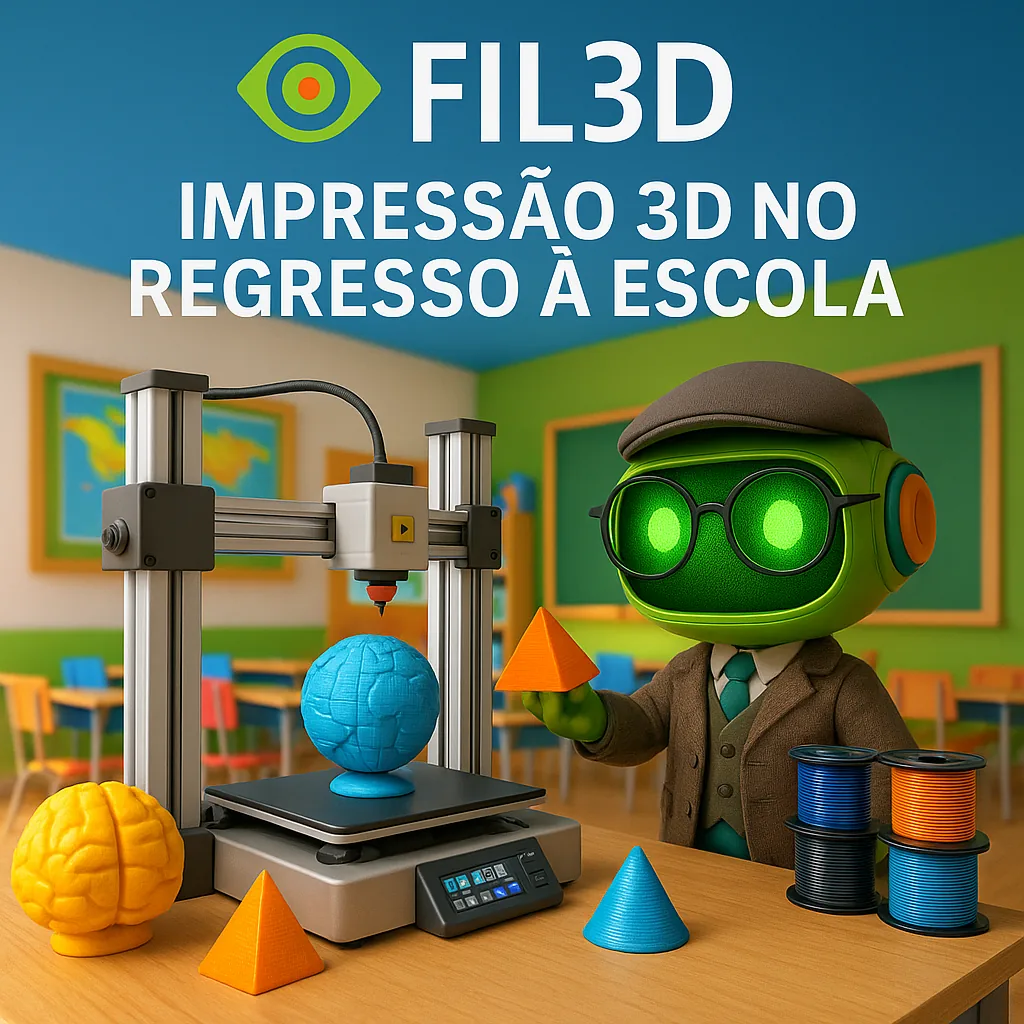
Printing geometric solids such as cubes, pyramids, prisms and spheres.
-
Students can explore properties such as area, volume and angles in a tangible way.
-
Impact: abstract concepts become concrete, facilitating understanding.
Natural Sciences
-
Creation of three-dimensional models of the human body (heart, lungs, bones) or cells and molecules.
-
Models of the solar system with proportions correct.
-
Impact: studying becomes more visual and engaging, with materials that complement school textbooks.
History and Geography
-
Replicas of historical monuments, archaeological artifacts and relief maps.
-
Allows students “travel in time” or feel geography through touch.
-
Impact: promotes the inclusion of students with visual impairments and increases general interest in the subject.
Arts
-
Sculptures created directly by students from digital drawings.
-
Creation of art pieces design, jewelry or even prototypes of artistic inventions.
-
Impact: combines technology with creativity, developing artistic and digital skills.
Engineering and Technology
-
Introduction to prototyping and 3D design from an early age.
-
Printing simple mechanical parts or architectural structures.
-
Impact: prepares students for professions linked to Industry 4.0 and entrepreneurship.
Benefits of 3D Printing in Education
Stimulating Creativity and Critical Thinking
-
The freedom to create any shape or object motivates students to think innovatively.
-
Develops problem-solving skills through experimentation.
Collaborative Learning
-
Group projects where students design, model and print together.
-
Promotes team spirit and the sharing of ideas.
Educational Inclusion
-
Printing tactile materials adapted for students with special needs.
-
Examples: relief maps for the visually impaired or tools adapted for students with motor difficulties.
Sustainability
-
Production of only what is necessary, without wasting materials.
-
Use of recycled filaments, such as FIL2NDLIFE, which contributes to more education conscious and environmentally friendly.
The Future of 3D Printing in Education
Makers Classrooms
Each school will be able to have its digital manufacturing laboratory, with 3D printers accessible to all students.
Curriculum Integration
3D printing will not be an extracurricular activity, but integrated into all subjects: from mathematics to history, from arts to biology.
Global Collaboration
Students from different backgrounds countries will be able to share 3D models, creating a global knowledge network.
Sustainability in Practice
Schools will be able to collect recyclable plastics and convert them into filament for educational use, closing the cycle of the circular economy.
Conclusion
The back to school is no longer just a return to books – it also becomes a return to innovation and creativity.
With 3D printing, students and teachers gain a tool that transforms the way they learn, making it more practical, inclusive and sustainable.At FIL3D, we are ready to support this future, with quality filaments that shape students' ideas, from kindergarten to university.
Discover more at: tucab.pt