
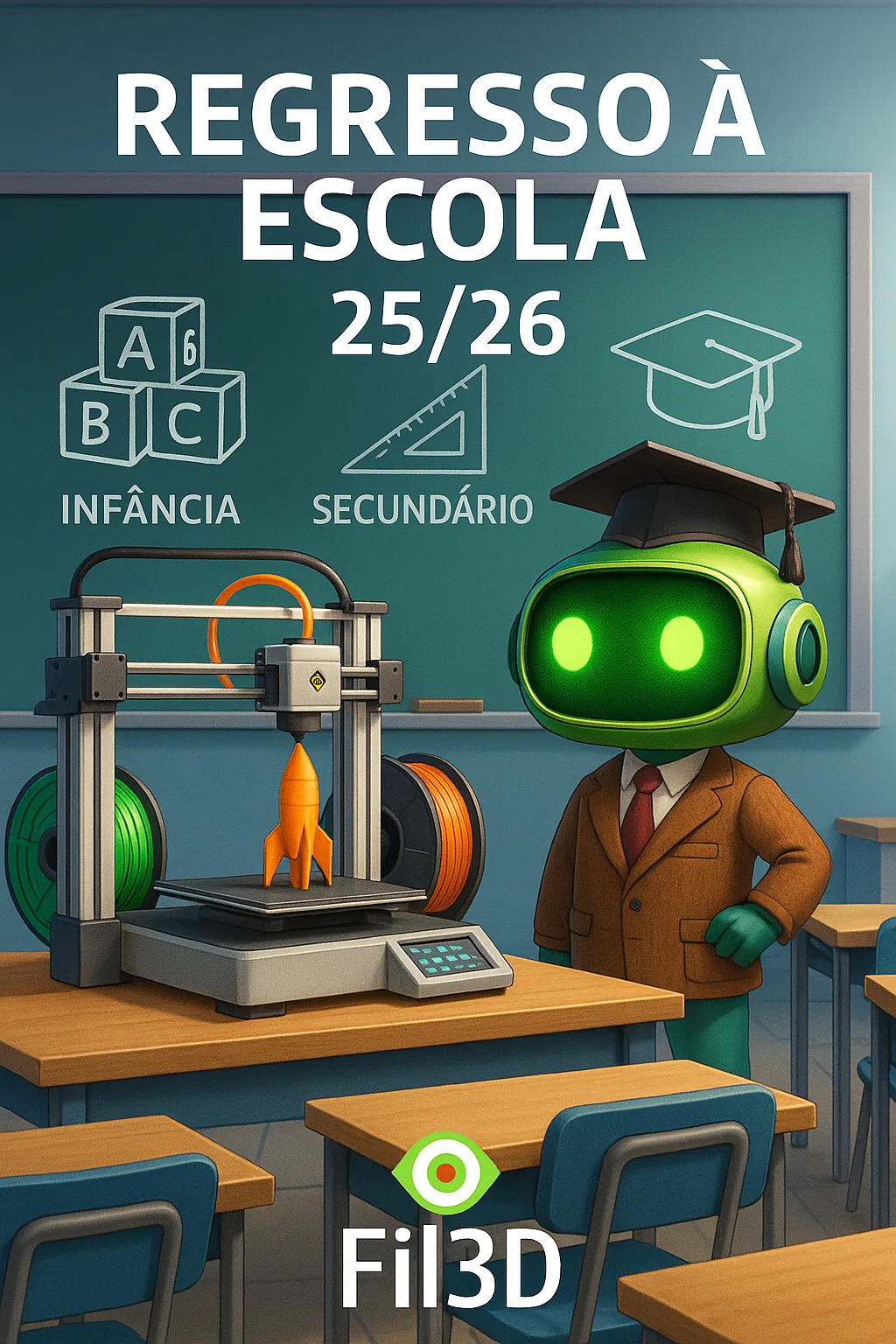
How 3D printing is transforming education, from kindergarten to university
The academic year 2025/26 marks a turning point in education. 3D printing, which a few years ago was seen as just a technological curiosity, is now asserting itself as a transversal pedagogical tool.
From kindergarten to universities, this technology allows students and teachers to build knowledge in a practical, visual and personalized way.
At FIL3D, a TUCAB brand, we believe that this is the bridge between theory and practice, helping to form generations that are more creative, critical and prepared for the challenges of society and industry 4.0.
1. Kindergarten — Learning with your hands
-
The challenge: capture the attention of young children and stimulate motor and cognitive development.
-
The solution: With 3D printers it is possible to create blocks, puzzles, geometric shapes and even tactile alphabets.
-
Benefit: more interactive, creative learning and adapted to the rhythm of each child.
Future vision: teaching materials can be produced directly at school, adjusted to individual needs.
2. Teaching Basics — Making the Invisible Visible
-
The Challenge: Many math and science concepts are abstract and difficult to understand from books alone.
-
The Solution: 3D-printed models make these concepts tangible — relief maps, solar systems, biological cycles, or replicas of historical monuments.
-
Benefit: greater retention of knowledge, inclusion of students with special needs and increased motivation for learning.
Future vision: democratization of access — any school, even with few resources, will be able to print its own teaching kits.
3. Secondary Education — From theory to practice
-
O challenge: prepare young people to apply knowledge in real contexts.
-
The solution: 3D printing allows you to create parts for experiments in physics and chemistry laboratories, prototypes of inventions in science clubs or even structures for robotics and drones.
-
Benefit: development of critical reasoning, creativity and entrepreneurial spirit.
Future vision: students will be able to launch microprojects and even real products during secondary school.
4. Professional and Polytechnic Education — Workshops of the future
-
The challenge: train highly prepared technicians for demanding sectors such as engineering, architecture, health and design.
-
The solution: printing architectural models, functional mechanical parts, teaching prosthetics for health courses, among others.
-
Benefit: practical training, reduced costs and proximity to Industry 4.0 tools.
Future vision: each institute will be able to have a “mini teaching factory”, producing in the prototypes and learning tools you need in real time.
5. University — Research and applied innovation
-
The challenge: develop cutting-edge research with impact on society.
-
The solution: 3D printing is today applied in areas as diverse as biomedicine, aerospace, engineering, digital arts and architecture.
-
Practical examples:
-
Printing biomedical models for surgical training.
-
Creation of ultra-light parts for aeronautics.
-
Innovative artistic installations.
-
-
Benefit: acceleration of research, reduced prototyping costs and multidisciplinary innovation.
Future vision: extreme personalization — each student will be able to design and print specific solutions to scientific, social or industrial problems.
Transversal Impact: Education, Industry and Sustainability
The adoption of 3D printing in education goes far beyond the classroom:
-
Personalization of teaching: materials adapted to the profile of each student.
-
Inclusion: tactile solutions for students with special needs.
-
Sustainability: reduction of material waste through the use of recycled filaments such as FIL2NDLIFE from FIL3D.
-
Connection to the job market: training aligned with the demands of Industry 4.0.
The academic year 25/26 will not just be a return to school, but rather a step towards the future of education.
With 3D printing, every student can be a creator, every teacher can innovate and every school can become a center for experimentation and development.FIL3D, a TUCAB brand, is prepared to support this path, providing high-quality filaments — PLA, PETG, ABS and recycled — that shape students' ideas, from kindergarten to university research.
Because the future of education is also 3D printed.