
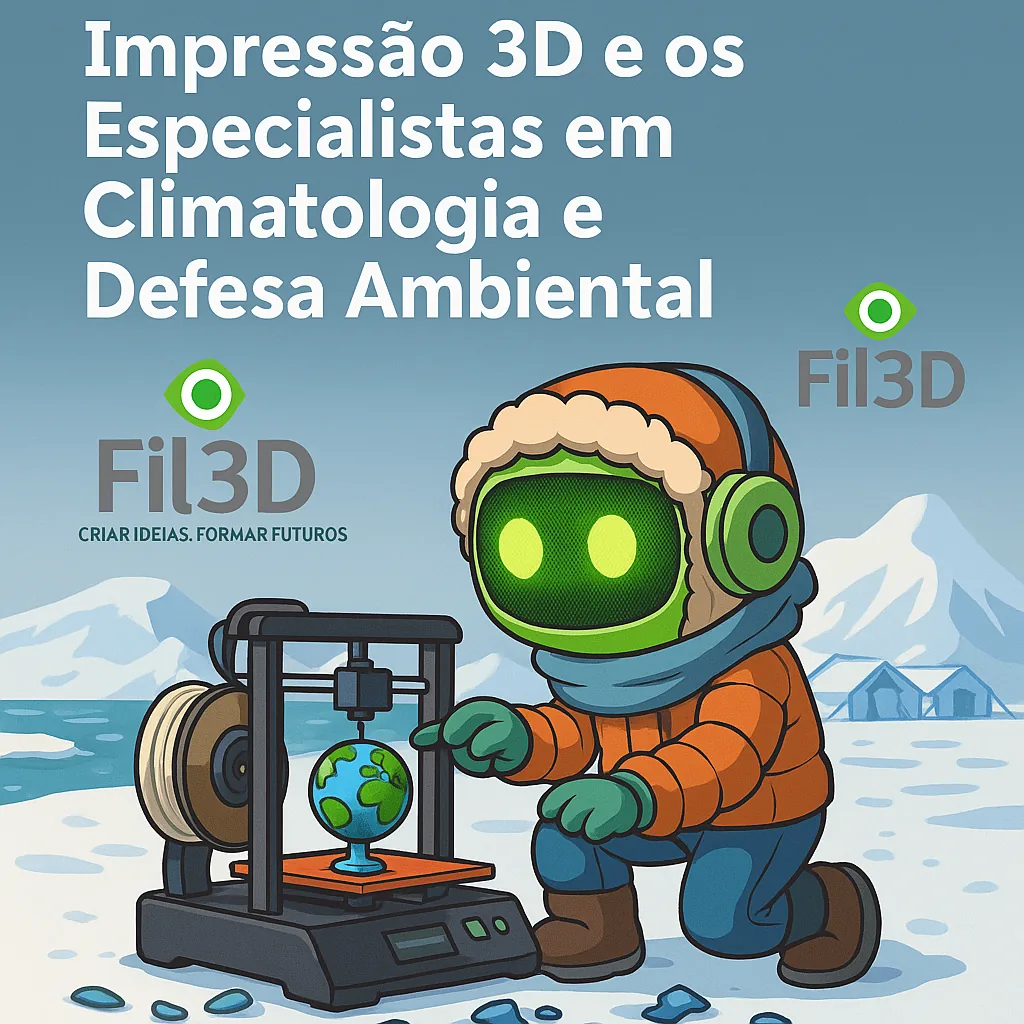
FIL3D®, we believe that innovation should serve the environment. And that's precisely what happens when the precision of our filaments meets climate science.
When every gram matters
Climate research demands customized, light and resistant instruments, capable of withstanding rain, wind, humidity and extreme temperatures.
Traditionally, these parts were expensive and time-consuming to produce — but 3D printing has changed everything.
Today, environmental drones, atmospheric measurement sensors, portable weather stations and sample collection parts can be printed directly in the laboratory, adapted to each mission.
The use of technical filaments such as PETG and ABS from FIL3D® makes it possible to manufacture components resistant to UV radiation, thermal variations and physical impacts, ideal for operations in the field and in remote areas.
From the laboratory to the atmosphere
Climatologists and environmental engineers use 3D printing to build:
-
Atmospheric monitoring drones, which collect data on temperature, CO₂ and humidity at different altitudes;
-
Oceanographic sensors, to analyze water temperature and salinity;
-
Modular structures for meteorological stations, customized according to the climate and terrain;
-
Filtering and sampling devices, designed with millimeter precision.
These solutions are lightweight, scalable and reduce environmental impact, as they can be recycled or reused through TUCAB®'s Fil2ndLife® program. FIL3D® prints the future with ecological awareness.
Our filaments are produced in Portugal, with certified raw materials and strict dimensional control, guaranteeing quality and stability even in the most adverse conditions.
And when the missions end, the cycle continues: filament waste can be collected, recycled and transformed into new spools Fil2ndLife®, completing the cycle of green innovation.
“At FIL3D®, we believe that protecting the planet is also a matter of engineering.”
Technology that predicts, protects and preserves
Modern climatology is no longer limited to observing — now, it creates, builds and reacts in time
Thanks to 3D printing, environmental experts today have more efficient, accurate and sustainable tools, helping to predict storms, analyze ecosystems and develop climate mitigation solutions.
Each 3D printed part is a small engineering gesture that contributes to a big global impact.