
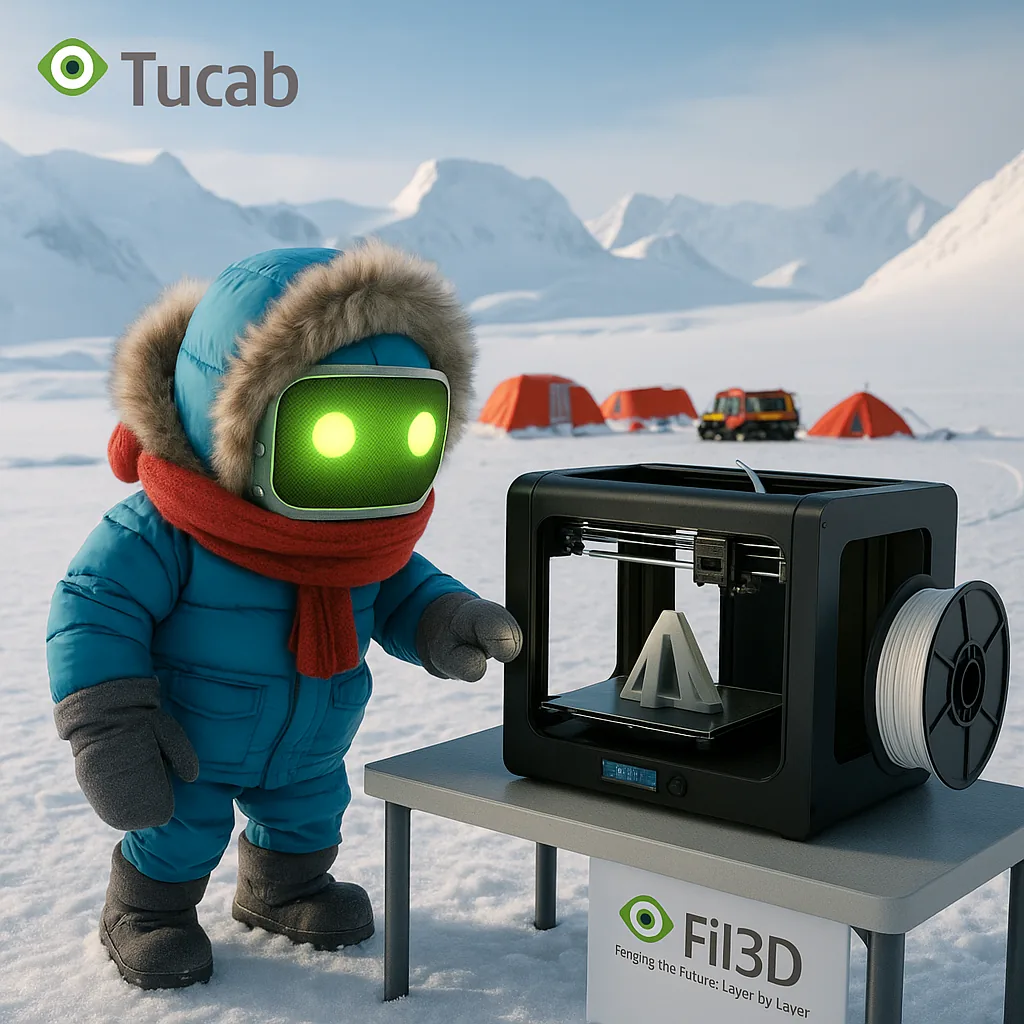
Printing in extreme cold – Antarctica and beyond
At polar science bases, such as those in Antarctica, temperatures can reach –60°C, and logistics are a daily challenge.
Transporting replacement tools, parts and equipment is expensive, slow and risky.
So several research teams have started using FDM 3D printers to produce components on site, from brackets and gaskets to custom adapters.
FIL3D® filaments, like PETG Skygreen, are ideal for these conditions:
-
Maintain mechanical resistance and dimensional stability even at low temperatures;
-
They are easy to print and highly resistant to humidity and thermal fatigue;
-
They allow you to create custom-made parts with millimeter precision, without depending on distant warehouses.
“In Antarctica, printing a simple replacement part can mean the difference between success and failure on a scientific mission.”
Innovation under pressure – 3D printing under the sea
3D printing is also diving deep — literally.
Ocean engineering companies use 3D printers in underwater laboratories and stations coastal waters to produce pressure, corrosion and saltwater resistant components.
PETG and PLA FIL3D® materials offer high compressive strength, inter-layer adhesion and controlled waterproofing, making them perfect for:
-
Underwater drone parts (ROVs and AUVs) real, even far from the coast.
Remote exploration – Sustainability and autonomy
Whether at sea, in the desert, on ice or even in space, technological self-sufficiency is essential.
With FDM 3D printing, researchers and engineers can manufacture locally the parts they need. need, reducing transport, waste and costs.FIL3D® plays a crucial role in this new paradigm:
-
Filaments produced in Portugal, with micron dimensional control;
-
Sustainable raw materials, including the line FIL2NDLIFE®, made with recycled plastic;
-
Compatibility with professional and field printers, even in harsh environments.
This combination of technology, precision and sustainability makes FIL3D® the ideal partner for cutting-edge scientific and industrial projects.
The future of 3D printing is resilient
From polar stations to exploration submarines, from deserts to space platforms — 3D printing is making the impossible, possible.
And when the challenge is extreme, engineering needs materials to match.“Where nature imposes limits, 3D printing with FIL3D® creates solutions.”
With TUCAB® know-how and quality, FIL3D® continues to prove that true innovation does not depend on location — but rather on the ability to create, adapt and print the future.
FIL3D® – High quality 3D Printing Filaments, manufactured in Portugal.
TUCAB® – Since 1996. -