
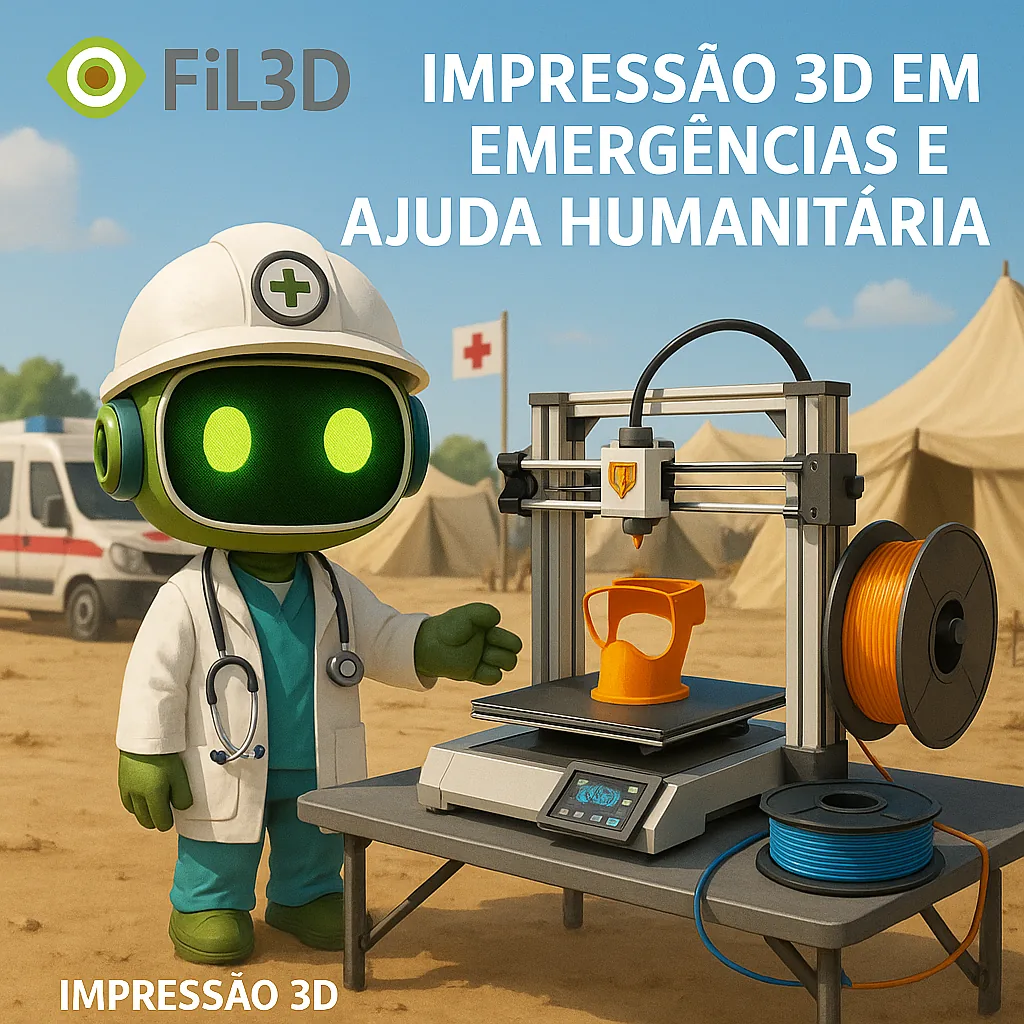
Introduction
In emergency scenarios — whether after natural disasters, conflicts or humanitarian crises — time is one of the most valuable resources.
3D printing has been establishing itself as a technology capable of providing fast, economical and personalized solutions to support medical teams, NGOs and affected communities.
Practical applications
Medical equipment for emergency
-
Printing of temporary prostheses and orthoses.
-
Production of masks, visors and adapters for ventilators.
-
Simple surgical utensils, such as forceps or supports.
Access to drinking water
-
Printing filters, adapters and parts for water purification systems.
-
Low-cost solutions for isolated communities.
Shelters and infrastructure
-
3D printed modular shelter structures.
-
Parts replacement for quick repair of tents, community kitchens or support networks.
Communications and logistics
-
Printing supports for antennas, connectors or equipment boxes.
-
Tools adapted to specific field scenarios.
Advantages
-
Speed → parts ready in a few hours, at the emergency site.
-
Reduced cost → affordable solutions compared to transporting equipment.
-
Customization → adapts to needs of each community or patient.
-
Sustainability → possible use of recycled materials, reducing waste.
Curiosities
-
During the COVID-19 pandemic, thousands of makers and 3D printing companies produced visors and adapters for ventilators, filling supply gaps.
-
In 2022, a Red Cross team tested portable 3D printers in refugee camps to create replacement parts for community kitchens.
-
NASA is studying the use of 3D printing for rapid response to emergencies in space.
The Future
-
Mobile printing units 3D in emergency vehicles.
-
Humanitarian centers equipped with 3D printers for local self-sufficiency.
-
Development of new biodegradable filaments for crisis contexts.
Conclusion
3D printing is transforming way in which emergency situations are responded to, offering quick, effective and adapted solutions.
At FIL3D, we believe that innovation can — and should — also serve humanitarian causes, supporting communities in critical moments.
Discover more at: tucab.pt