
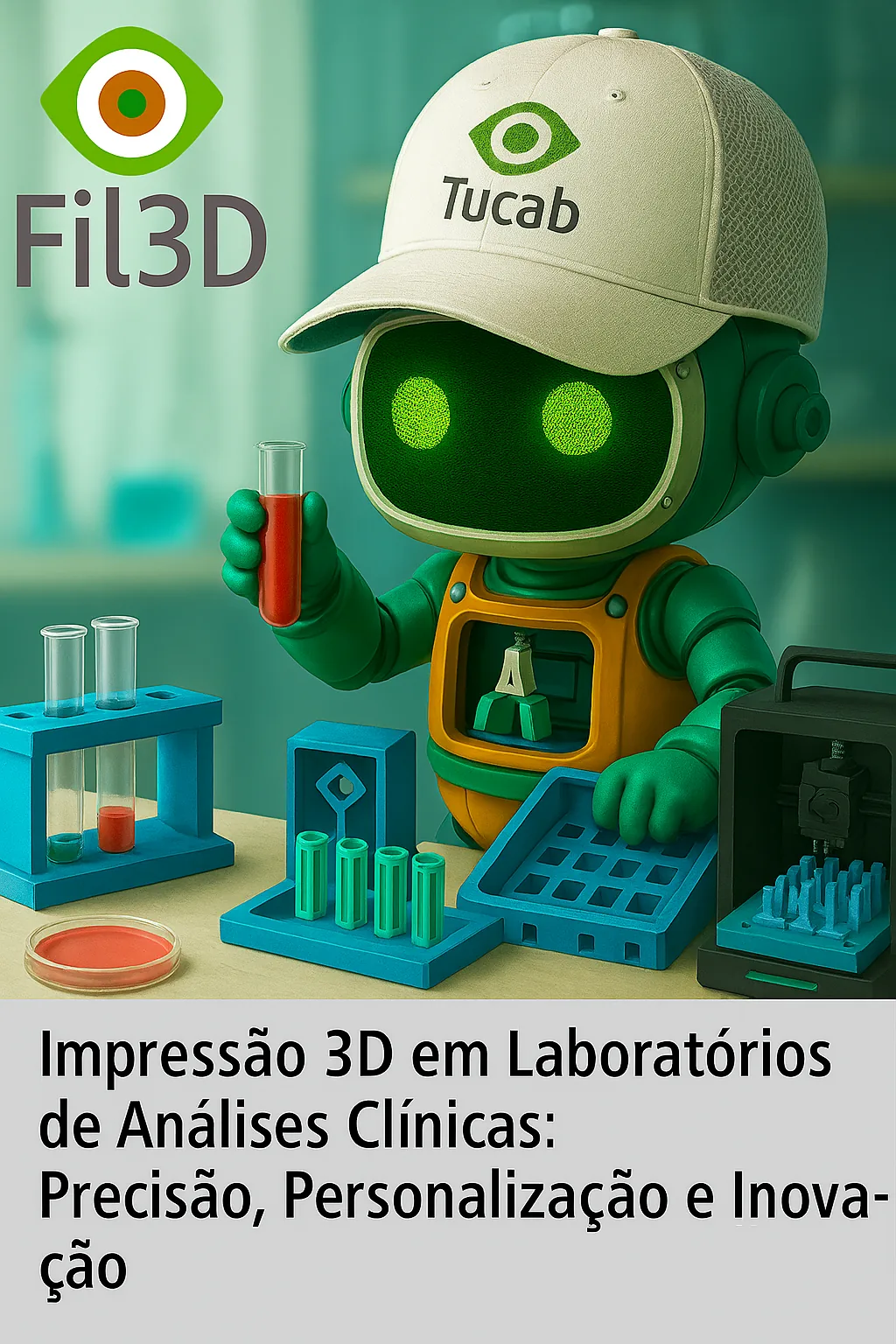
3D Printing in Clinical Analysis Laboratories: Precision, Personalization and Innovation
At the heart of modern medicine, clinical analysis laboratory technicians guarantee the reliability of diagnoses, processing biological samples accurately and safely. In an environment where every second and every milliliter counts, 3D printing with Fil3D appears as a revolutionary tool — capable of transforming the functioning of laboratories through customization, organization and cost reduction.
The versatility of 3D printing allows the creation of customized technical accessories, facilitating the work of professionals and improving laboratory flows.
Theoretical Examples – The Application Structured 3D Printing
-
Racks and modular supports for test tubes, adapted to the layout of each bench;
-
Customized organizers for reagents, tips, filters or microscopy slides;
-
Adapters for centrifuges, incubators or spectrophotometers;
-
Embossed labeling on the supports, allowing tactile and visual identification;
-
Ergonomic supports for pipettes, reducing fatigue in frequent changes.
Practical Examples – Real Laboratory Cases
-
Printing a compact vertical rack for blood samples, optimizing space in old equipment;
-
Creation of a safe transport base for tubes that need to be transferred between departments without vibration;
-
Manufacture of an alignment device for punching microplates, used in technical training;
-
Customization of a storage box for biological quality controls, with removable separators;
-
Printing of caps identifiable by color and text for frozen samples.
Vision of the Future – 3D Printing at the Service of Preventive Medicine
With the evolution of materials and personalized medicine, the future holds great advances:
-
3D printing of sterile supports directly compatible with autoclave or UV light;
-
Local and on-demand production of parts for obsolete or difficult-to-import equipment;
-
Development of kits personalized collection, adapted to the type of analysis and patient;
-
Printing anatomical simulators for training laboratory techniques in an academic context;
-
Use of biodegradable filaments for single-use disposable accessories.
Why Choose Fil3D?
Fil3D combines technological innovation, sustainability and industrial reliability, guaranteeing results that meet laboratory requirements:
Laser-controlled diameter 1.75 mm
PLA, PETG and recycled filaments (Fil2ndLife)
Robust, dry and sealed spools
Manufactured in Portugal with technical rigor and environmental responsibility
Conclusion
3D printing does not replace the technical knowledge of laboratory professionals, but amplifies your ability to solve problems, adapt the workspace and improve organization. With Fil3D, each technician can also be a creator, innovator and agent of change in their own laboratory.
Read more technical articles and learn about our filaments at:
tucab.pt