
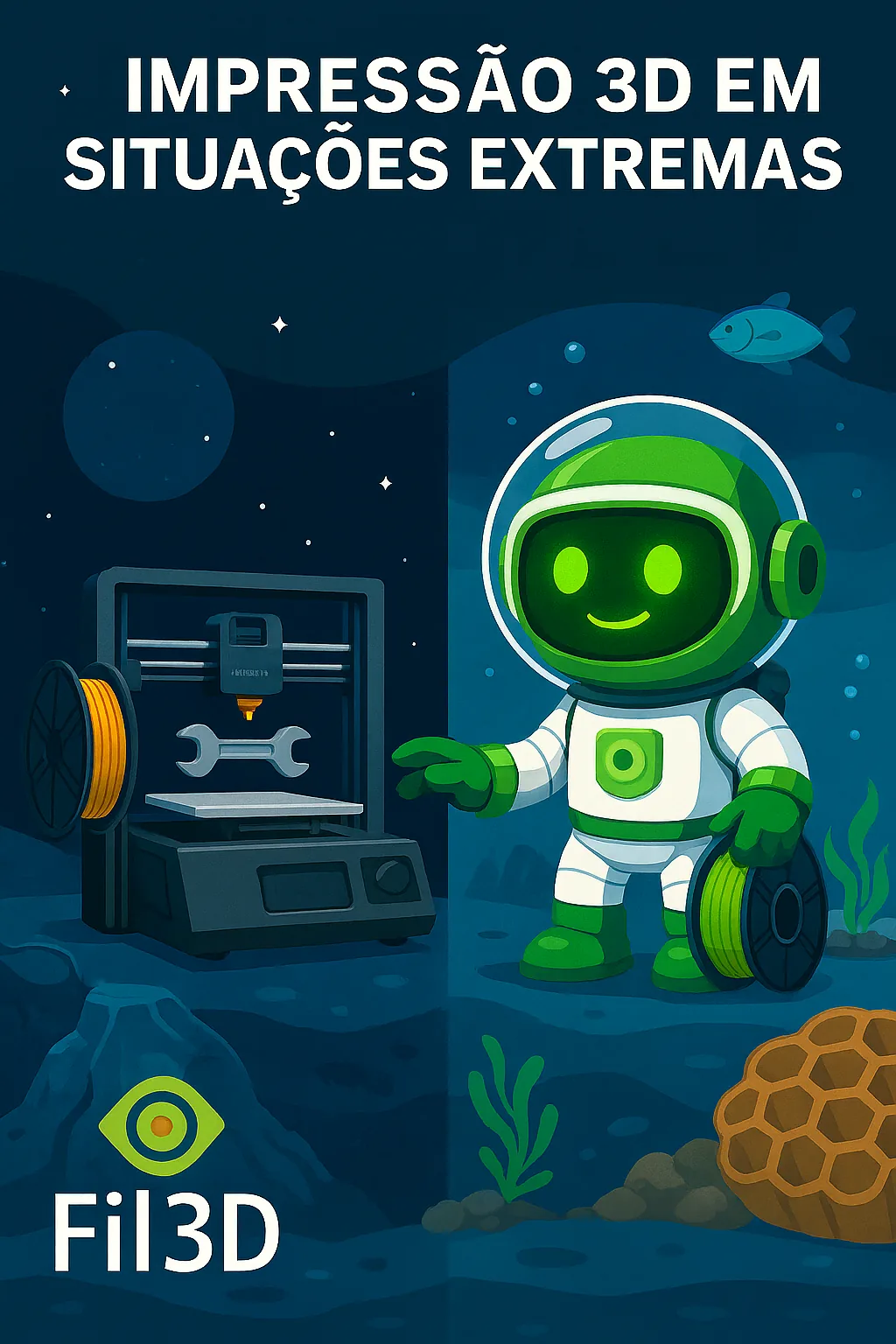
3D printing is one of the most versatile and revolutionary technologies of the 21st century.
Its true strength is in adapting where other solutions fail — in environments without oxygen, under extreme pressure, at negative temperatures or exposed to radiation.
What once seemed like science fiction is now a possible reality, with FIL3D and its technical filaments playing a fundamental role in this evolution.
The new frontier of production: printing in the impossible
Traditional manufacturing requires assembly lines, molds and transport of parts — limitations that do not exist in 3D printing.
With a printer, energy and filament, it is possible to manufacture anywhere, even in the most hostile environments.
This autonomy has boosted the application of 3D printing in three areas extremes:
space, high temperature zones, the bottom of the sea.
In Space: manufacturing where nothing weighs
NASA, ESA and other space agencies already use 3D printers on board the International Space Station.
In an environment where every gram sent costs thousands of euros, the ability to produce parts on demand is an extraordinary advance.
With 3D printing:
-
Tools and supports are printed in minutes, directly in orbit.
-
The technical filaments, such as ABS and PETG from FIL3D, maintain stability even with intense thermal variations between -100°C and +120°C.
-
Parts printed in microgravity show structural performance equivalent to that of parts produced on Earth.
This means self-sufficiency, reduced logistics costs and continuous innovation, even at 400 km altitude.
Under the Sea: Strength under Pressure
The ocean depths are another natural laboratory for 3D printing.
pressure, salt corrosion and lack of light challenge any material — but they also inspire creative solutions.
With filaments like PLA and PETG Skygreen, FIL3D offers:
-
Resistance to deformation under pressure.
-
Good impermeability and chemical resistance, ideal for prolonged contact with salt water.
-
Geometric adaptation, creating components that reduce turbulence and increase hydrodynamics.
Among the real applications, the following stand out:
Structures for the regeneration of coral reefs; Tailor-made parts for ROVs (remotely controlled underwater vehicles); Technical support for sensors and marine monitoring systems.In Extreme Industrial Environments
In addition to space and the sea, there are equally challenging terrestrial scenarios:
-
Industrial furnaces and high-temperature production lines.
-
Aggressive chemical environments (such as laboratories or pharmaceutical factories).
-
Extreme cold environments in food logistics and cryogenics.
The company's ABS, PETG and PLA filaments FIL3D demonstrate:
Thermal and structural resistance,Dimensional stability,
Compatibility with demanding mechanical and chemical processes.
The engineering of adaptability
The future of 3D printing involves smart materials — filaments that respond to the environment.
Ongoing research focuses on:
-
Shape memory polymers, which adapt to temperatures or external forces.
-
Conductive filaments, which allow create integrated electrical circuits.
-
Hybrid materials, with layers of different properties (flexibility + resistance).
FIL3D, integrated into the industrial experience of TUCAB, follows this evolution with continuous investment in R&D and technical formulation.
From the laboratory to the real industry
These innovations are already being applied in:
Aeronautics and Space: technical supports, insulation and light structural parts.Nautical and Subsea Engineering: aquatic drones and watertight connectors.Industry: tailored parts that reduce downtime and maintenance costs.Each extreme challenge requires a filament to match — and this is where FIL3D stands out:
technically reliable filaments, tested, and produced in Portugal, with industrial quality standards.
From Space to the Sea: a common thread
What connects the vacuum of space to the depths of the ocean?
The human need to innovate, explore and adapt.3D printing and FIL3D filaments represent exactly that:
Autonomy.Resistance.
Innovation.
Whether it's zero gravity or 11,000 meters deep, there's always a solution that starts with a simple thread — the right thread.