
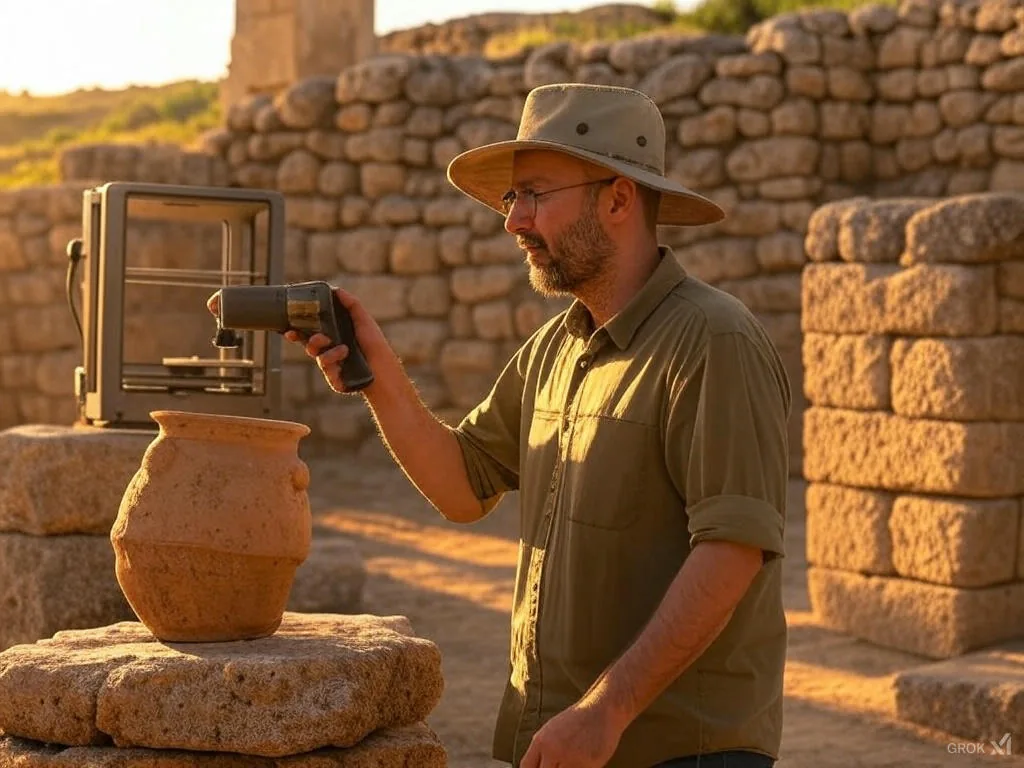
Introduction: The Past Comes to Life with Innovation
In Portugal, a country rich in historical remains such as those of Conímbriga or Citânia de Briteiros, archeology is a window into the past. But what if we could touch on that past without compromising it? 3D printing is revolutionizing the way Portuguese archaeologists preserve, study and share artefacts. This article explores how this technology is changing archaeology, with technical details and practical examples that show its potential in Portuguese lands and beyond.
How does 3D Printing Transform Archaeology?
3D printing creates physical replicas from digital models, using materials such as plastics or resins. In archaeology, the process begins with the digitization of artefacts — through 3D scanners such as laser or photogrammetry — and culminates in the printing of detailed copies. This technique allows you to preserve fragile originals while opening up new possibilities for analysis and dissemination.
Technical Steps
- Scanning: Surface capture with 0.1 mm precision.
- Modeling: Editing in software such as MeshLab to correct imperfections.
- Printing: Using FDM or SLA printers to create exact replicas.
Technical Specifications: Materials and Tools
The effectiveness of printing 3D in archeology depends on appropriate materials and equipment. Here are the details:
Materials
- PLA (Polylactic Acid):
- Characteristics: Tensile strength of 50-60 MPa, biodegradable.
- Temperature: Prints between 190-220°C.
- Application: Ideal for exhibition or teaching replicas.
- PETG:
- Characteristics: Greater durability and flexibility than PLA.
- Temperature: 230-250°C.
- Application: Sturdy parts for practical testing.
- Resins:
- Characteristics: Resolution up to 0.025 mm, fine finish.
- Application: Detailed details such as engravings or jewelry.
Equipment
- FDM printers: Example: Creality Ender 3 (up to 220x220x250 mm).
- SLA printers: Example: Anycubic Photon, for high precision.
- Scanners: Artec Eva, with resolution of 0.1-0.5 mm.
Practical Applications: 3D Archeology in Portugal
3D printing is gaining ground in Portuguese and global archeology. See concrete examples:
1. Preservation of Artifacts
- Example: A Roman vase from the Conímbriga Museum is scanned and printed in PLA, allowing public display while the original rests safely.
- Benefit: Protects fragile pieces from deterioration.
2. Reconstruction of Fragments
- Example: Fragments of an Iron Age stele found in Alentejo are scanned and reconstructed in PETG for physical study.
- Benefit: Allows analyzing complete forms without damaging the originals.
3. Education and Cultural Tourism
- Example: The National Museum of Archeology in Lisbon prints replicas of Bronze Age axes in PLA for educational activities with schools.
- Benefit: Makes history palpable to the public.
4. Functional Tests
- Example: A team from the University of Minho prints a Citânia de Briteiros spearhead in PETG to test its effectiveness in simulations.
- Benefit: Reveals practical uses of ancient artifacts.
Advantages of 3D Printing in Archeology
- Preservation: Minimizes wear on original pieces.
- Precision: Replicas with details faithful to the millimeter.
- Cost: More affordable than traditional molds.
- Sharing: Facilitates dissemination in museums and schools.
Challenges to Overcome
Despite the potential, there are obstacles:
- Investment: Advanced scanners and printers cost thousands of euros.
- Materials: Plastics do not always replicate original weight or texture.
- Time: Scanning complex parts can be time-consuming.
The Future in Portugal: A Living History
With the advancement of 3D printing, Portugal can lead in the digital preservation of its heritage. The combination with artificial intelligence for automatic reconstructions and ecological materials opens the door to interactive museums and innovative cultural tourism.
Conclusion: The Past in Our Hands
3D printing is bringing the Portuguese past to the present, allowing archaeologists, students and visitors to interact with history in a safe and creative way. From Conímbriga to Minho, this technology is a powerful tool to preserve, study and celebrate our legacy.