
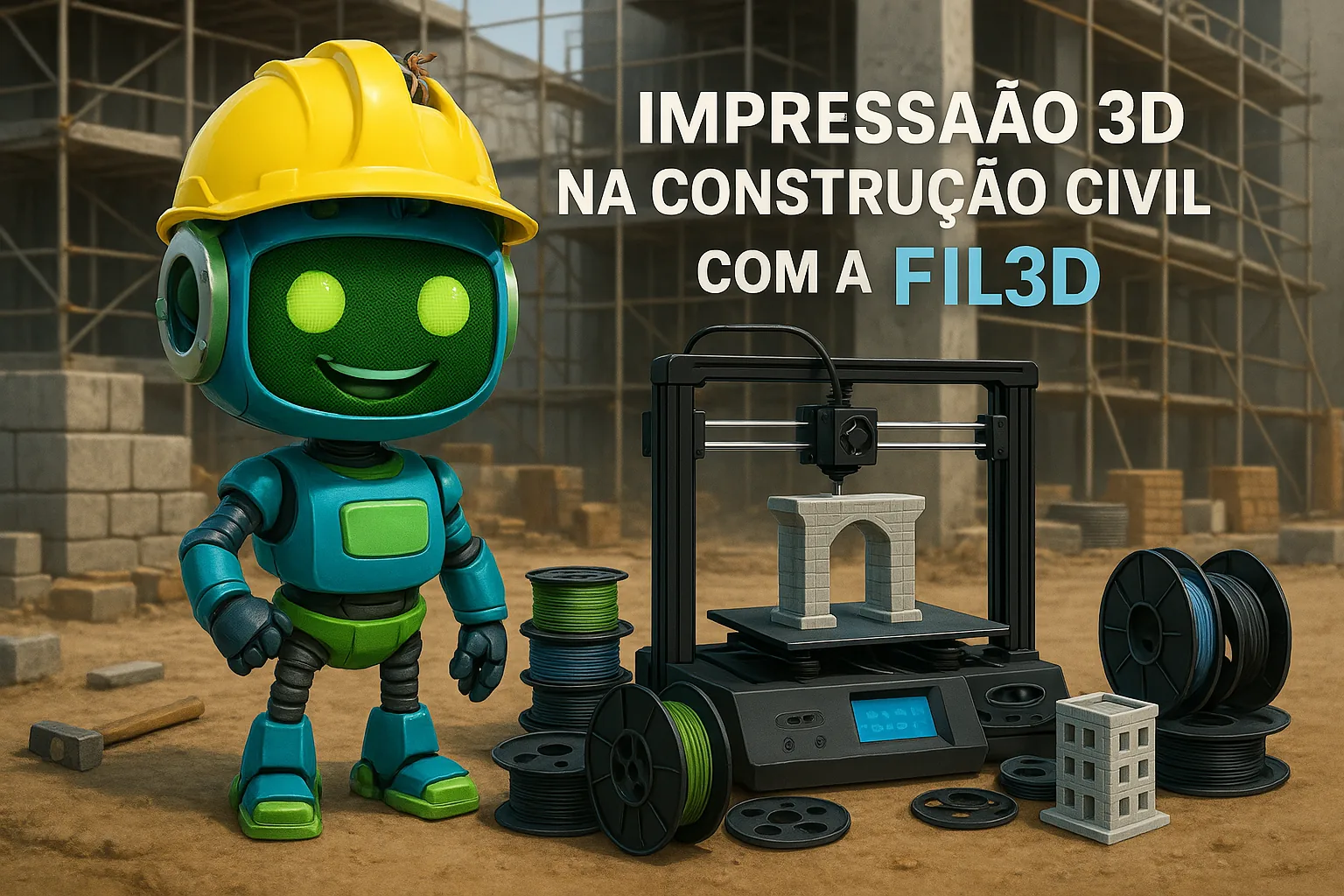
3D Printing in Civil Construction: How Builders Are Revolutionizing the Construction Site
Discover how 3D printing is transforming the daily lives of civil builders, bringing innovation, efficiency and sustainability.
Introduction
3D printing is transforming civil construction, one of the most traditional industries in the world. From detailed models to custom pieces and even entire homes, home builders are discovering how this technology can optimize processes, reduce costs and increase sustainability on the construction site. In this article, we explore how 3D printing is being used in everyday construction, with practical examples and suggestions for builders who want to innovate.
How 3D Printing is Being Used by Civil Builders
- Project Models and Prototyping
One of the most common uses of 3D printing in construction is the creation of detailed models. Builders can print 3D models of buildings, bridges or complex structures to present to clients or use in planning. This allows you to visualize the project in detail, identify possible problems and make adjustments before starting the work, saving time and resources.
Practical Example: A construction worker in Lisbon used an FDM 3D printer to create a model of a small residential building in just 12 hours. During the presentation to the client, a problem was identified in the positioning of the windows, which was corrected in the digital model before the start of the work, avoiding additional alteration costs. - Customized Parts for Construction
3D printing allows the production of custom-made parts directly on the construction site, such as customized connections and supports for metallic or concrete structures, decorative elements (such as ornaments for facades or frames) and specific tools (such as spacers or guides for aligning blocks). FDM 3D printers, which work with resistant plastic filaments, are ideal for these applications, while resin printers can be used for smaller, more detailed parts.
Practical Example: At a shipyard in Porto, a builder needed customized supports to fix a metal structure at a specific angle. Instead of ordering the parts from a supplier, the team used an FDM 3D printer to produce 20 reinforced PLA supports overnight, saving two days of waiting and around 150 euros in transport costs. - Building Structures with Large-Scale 3D Printers
In more advanced projects, builders are using large-scale 3D printers to build walls, foundations and even entire houses. These printers use special concrete to "print" layers of material, creating structures in just a few days. Technology allows you to create organic shapes and innovative designs that would be difficult or expensive with traditional methods.
Practical Example: In 2023, a company in Spain used a large-scale 3D printer to build a 50 m² house in just 20 hours. The structure, made from sustainable concrete, cost 30% less than a traditional building and was used as part of a social housing project, demonstrating the technology's potential to solve housing access issues. - Construction Site Repairs and Maintenance
Builders can use 3D printing to manufacture replacement parts on site, such as handles, brackets or accessories for equipment. This rapid production capacity is especially useful in remote construction sites, where access to suppliers may be limited.
Practical Example: During the construction of a bridge in Alentejo, a part of a concrete mixer failed, stopping work. The builder used an FDM 3D printer to print a replacement part in ABS, a durable material, in just 4 hours. Work resumed on the same day, avoiding a week-long delay that would have occurred if the part had been ordered from a supplier. - Sustainability and Waste Reduction
3D printing allows only the material needed for each part to be used, reducing waste compared to traditional construction methods. Additionally, some builders are experimenting with recycled filaments or sustainable materials, such as eco-concrete, to make construction more environmentally friendly.
Practical Example: A construction team in Coimbra used recycled PET filaments (made from plastic bottles) to print spacers for concrete blocks. This project not only reduced plastic waste on the construction site, but also reduced spacer acquisition costs by 40%, contributing to a more sustainable project.
Benefits of 3D Printing for Civil Builders
- Time Savings: Producing parts or models on site eliminates waiting for external suppliers.
- Cost Reduction: Rapid prototyping and custom production avoid unnecessary expenses with materials or adjustments.
- Personalization: Allows you to create unique elements for each project, such as innovative architectural designs.
- Sustainability: Minimizes material waste and allows the use of recycled materials.
- Flexibility: Builders can quickly adapt to unforeseen circumstances by printing replacement parts or adjusting designs on site.
Challenges and Solutions
- Initial Cost: Although FDM 3D printers are affordable, large-scale concrete printers are still expensive. Solution: Start with an FDM printer for models and small parts, and consider partnerships for larger projects.
- Technical Training: Learning to use 3D printers and design software can be a challenge. Solution: There is free and intuitive software like Tinkercad and many online tutorials for beginners.
- Printing Time: Printing large parts can take several hours. Solution: Plan prints in advance and use the time for other tasks on the site.
How Builders Can Start Using 3D Printing
- Choose the Right Printer: For models and small parts, an FDM printer, such as those available at TUCAB, is a good initial option, with affordable prices and ease of use.
- Learn Basic 3D Design: Software like Tinkercad or FreeCAD is free and easy to use for creating simple models.
- Use Ready-made Models: Sites like Thingiverse offer free 3D models of construction parts, which can be printed directly.
- Test on a Small Scale: Start with simple projects, such as models or supports, before moving on to more complex applications.
- Count on Support: TUCAB offers 3D printers, filaments and technical support to help builders take their first steps.
The Future of 3D Printing in Civil Construction
The future of 3D printing in construction is promising. In the coming years, large-scale printers are expected to become more affordable, allowing entire buildings to be constructed quickly and cost-effectively. Furthermore, integration with other technologies, such as artificial intelligence, can optimize project planning and execution, while new sustainable materials can make construction even more environmentally friendly. For builders, adopting 3D printing now is a way to prepare for this innovative future.
Conclusion
3D printing is changing the way builders work, bringing more efficiency, customization and sustainability to the construction site. Whether to create models, produce custom pieces or even build entire houses, this technology offers incredible opportunities for those who want to innovate in construction. At TUCAB, we have the ideal solutions to help you take the next step with 3D printing. Visit our website and discover how we can support your projects: .