
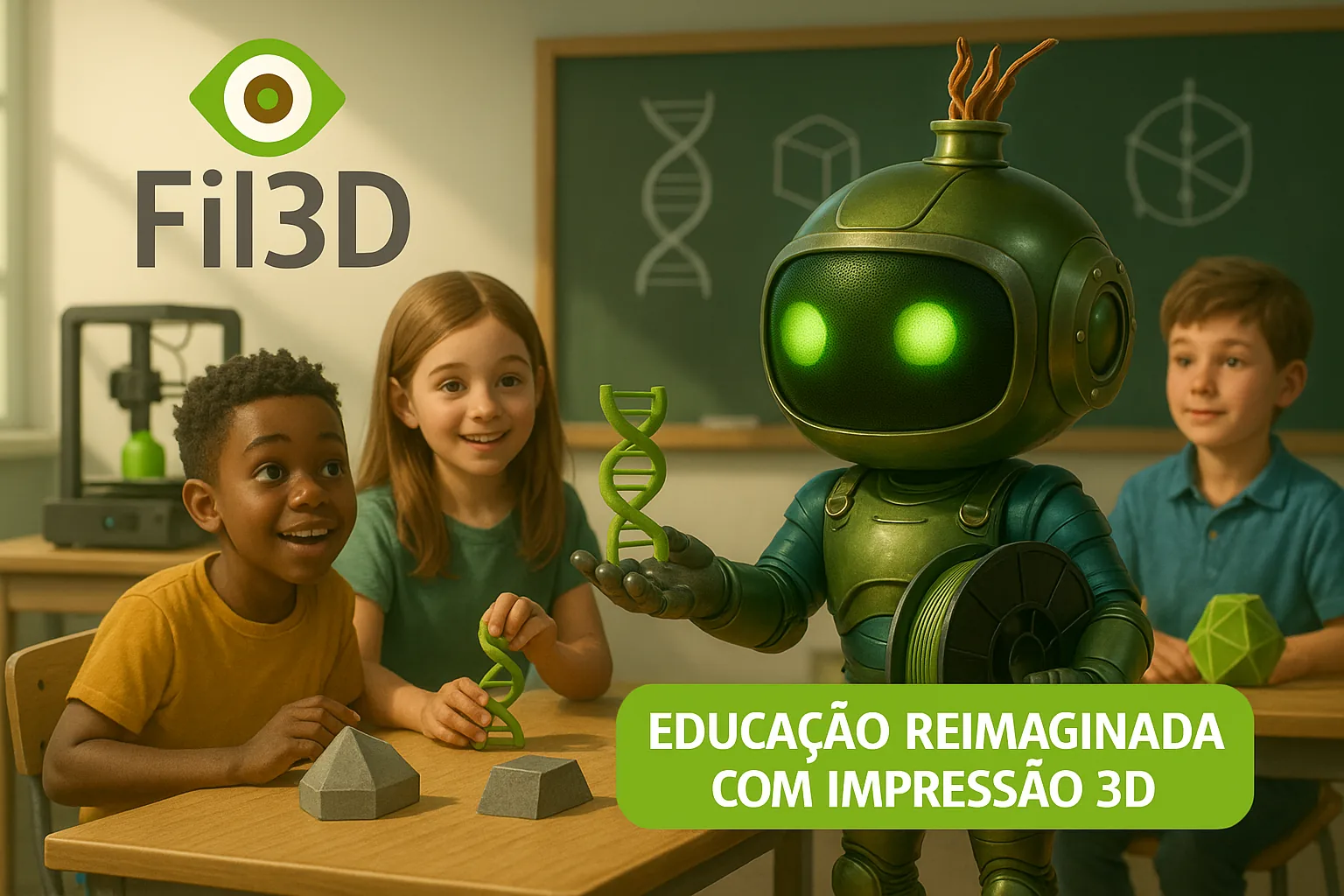
3D Printing in Education: From Kindergarten to University, Layer by Layer
Education is entering a new era. More than decorating, students learn by doing, experimenting, creating. And 3D printing has become the bridge between the world of ideas and the real world. With Fil3D filaments, learning is tangible — from the earliest years to higher education.
Kindergarten and 1st Cycle: exploring shapes and developing creativity
In the initial stages, 3D printing is a fun and educational tool at the same time:
-
Shape printing geometric shapes for visual and tactile learning
-
3D letters and numbers that help in the literacy process
-
Snap-together pieces for fine motor games
-
Figures of animals, fruits and objects that complement stories and association games
Practical example: a kindergarten in Braga prints personalized toys for each class — promoting identity, sharing and belonging.
2nd and 3rd Cycles / Secondary Education: transforming theory into practice
At this stage, 3D printing becomes an interdisciplinary tool:
-
Printing city models for geography
-
Models of molecules, DNA or viruses for natural sciences
-
School robotics components (supports, gears, wheels)
-
Creation of simple measuring instruments for physics
⚙️ Real example: a school in Setúbal printed a renewable energy kit with mini wind turbines and solar panels for teaching experimental.
Higher Education: from prototyping to scientific research
At university, 3D printing is part of everyday life in multiple areas:
-
Engineering: construction of prototypes, templates, adapters and technical boxes
-
Medicine: replicas of organs, anatomical models, simulators surgery
-
Architecture: detailed models with different materials and textures
-
Industrial design: functional parts for ergonomics and assembly tests
-
Social sciences: recreation of historical artifacts, educational tools for inclusion
National example: a Portuguese university uses models of 3D printed jaws to train dental students before their first clinical contact.
International curiosities
-
In France, the government launched a pilot program to bring 3D printers to 1000 public schools.
-
In Finland, all 2nd cycle schools have access to at least one 3D printer connected to classes of STEAM.
-
In Singapore, 10-year-old students are already printing parts for environmental and material reuse projects.
The Future: personalization, autonomy and equal access
In the medium term, 3D printing could become standard equipment in classrooms, just like a computer or projector.
Possible scenarios:
-
Each student prints pieces to personalize their own school supplies
-
Teachers create models adapted for students with special needs
-
School libraries make 3D printers available during free time as a space for experimentation (mini FabLabs)
With Fil3D, students become creators, not just consumers.
Conclusion
3D printing is not just a technology — it is a language.
A way to teach mathematics, art, physics and critical thinking at the same time time.
With Fil3D filaments, education takes shape: layer by layer, generation by generation.