
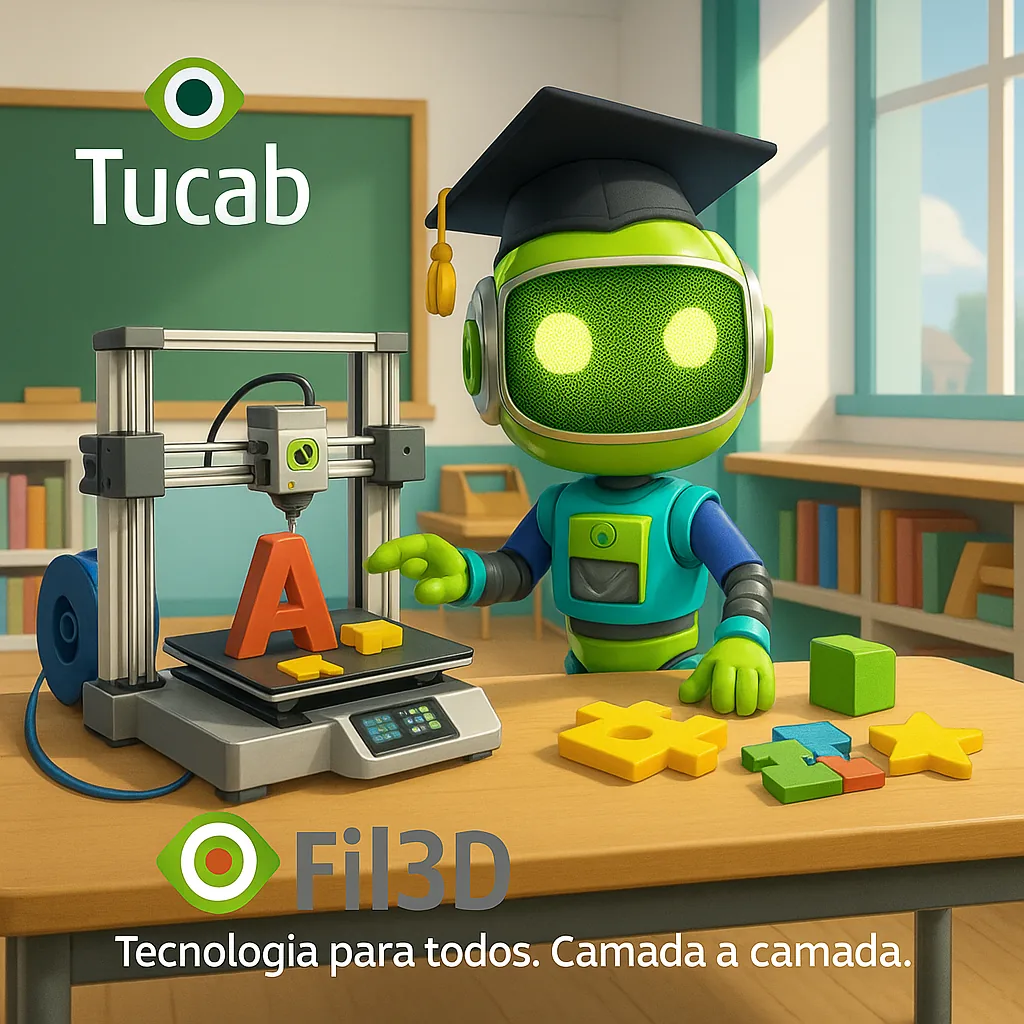
3D Printing in Special and Inclusive Education: Create to integrate
Technology must serve everyone. And in the field of special education, 3D printing is becoming a fundamental tool to promote the inclusion, personalization and active participation of students with specific educational needs.
With Fil3D filaments, it is possible to create adapted resources in an accessible, practical and quick way — whether in schools, support centers, therapy rooms or higher education institutions.
Theoretical Examples
-
Students with low vision: production of letters, symbols and maps in relief;
-
Deaf students: printing visual materials with shapes, gestures or support for sign language;
-
Needs motor skills: adapted utensils, thick handles, accessible fitting parts;
-
Autism or dyslexia: educational games with visual/tactile clues, sequential templates or support for visual routines.
Practical Examples
-
An inclusive school prints, with PLA, parts for a 3D “tactile alphabet” with letters, numbers and textures;
-
In a rehabilitation center, motor coordination molds are used for exercises with children with cerebral palsy;
-
Families and educators print personalized sensory toys with Fil2ndLife — durable, economical and safe;
-
Occupational therapists create games and puzzles with larger pieces and adapted to fine motor difficulties.
Vision of the Future
-
Integration of 3D printing in Individual Educational Plans (IEP);
-
Printers in schools with models shared between teachers;
-
Use of Fil3D as a mediation tool for therapists, educators and technicians;
-
Printing prosthetics or simple technical aids with recycled filaments.
Recommended filaments Fil3D
-
PLA – Ideal for tactile and durable educational pieces;
-
Fil2ndLife – Sustainable, economical and safe for games and prototypes;
-
PETG – Recommended for more robust pieces or pieces with prolonged contact.
Conclusion
With creativity, empathy and accessible technology, 3D printing can change lives in the classroom. And with Fil3D filaments, this change is within everyone's reach — layer by layer.
Discover more at:
tucab.pt