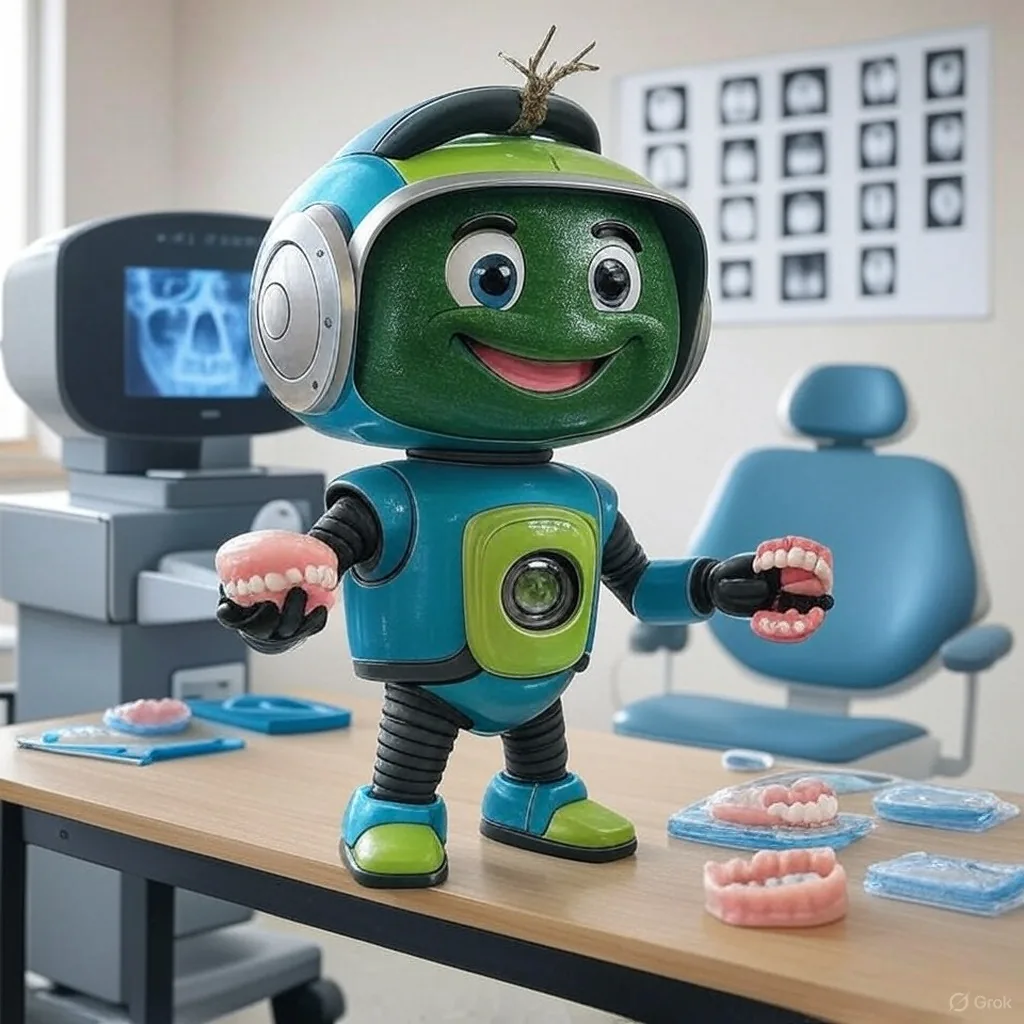
Technical Aspects of 3D Printing in Dentistry3D printing in dentistry depends on specific equipment and materials that guarantee the precision and safety required for applications clinics. Here are the main technical points:Types of 3D Printers
- Resin Printers (SLA - Stereolithography): These are the most used in dentistry due to their high precision, capable of producing details detail on small parts, such as crowns, orthodontic aligners and surgical guides. The SLA process uses a laser to solidify liquid resin layer by layer, reaching resolutions of up to 25 micrometers. r-16dba41">Filament Printers (FDM - Fused Deposition Modeling): Although they are more affordable and common in other sectors, FDM printers are less used in dentistry. This is because their surface finish and precision (generally above 100 micrometers) do not meet the requirements of detailed dental parts. They can, however, be useful for prototypes or simpler study models. dir="ltr">
- Biocompatible Resins: Essential for intraoral applications, these resins are certified for use medical, being safe, durable and resistant. Examples include resins for dentures, surgical guides, and aligners, which must withstand the moisture and chewing forces of the mouth. r-16dba41">Other Materials: In some cases, materials such as hybrid ceramics or reinforced polymers are used for more resistant parts, such as temporary crowns or indirect restorations.
Technical ProcessThese technical aspects make 3D printing a powerful tool, offering dentists the ability to create bespoke solutions quickly and accurately. r-adyw6z r-135wba7 r-b88u0q">Practical Examples of 3D Printing in Current Dentistry3D printing is already a reality in many dental offices and laboratories. See how it is being applied today:1. Surgical Guides for ImplantsDentists use 3D printing to manufacture personalized surgical guides that guide the placement of dental implants. These guides are designed based on tomography scans and digital models of the patient's arches, ensuring millimeter precision. This reduces surgery time, minimizes risks and improves recovery. Custom Orthodontic AlignersThe company Invisalign is an iconic example of the use of 3D printing. It produces millions of clear aligners a year, each molded specifically for a patient's teeth. The process involves printing 3D models of the arch, which serve as a basis for molding the aligners in a thermoplastic material. This method is faster and more economical than traditional orthodontic appliances. Dental ProsthesesProstheses printed in 3D dentures, such as full or partial dentures, are gaining popularity. They are lightweight, aesthetically pleasing and can be produced in a few hours, instead of days or weeks as with conventional methods. Furthermore, the reduced cost benefits both dentists and patients.4. Study and Planning ModelsDentists print exact replicas of dental arches to study complex cases, plan surgeries, or demonstrate procedures to patients. These models are valuable tools for improving communication and accuracy in diagnosis.These examples show how 3D printing is already transforming the day-to-day dentistry, offering practical and tangible benefits. DentistryThe potential of 3D printing in dentistry goes beyond than we already see today. Here are some exciting possibilities for the future: dir="ltr" class="css-146c3p1 r-bcqeeo r-1ttztb7 r-qvutc0 r-37j5jr r-a023e6 r-16dba41 r-1adg3ll r-1b5gpbm r-a8ghvy">Bioprinting, which combines living cells with biocompatible materials, can revolutionize the treatment of tooth damage. Researchers are working on printing dental enamel, the hardest layer of the tooth, and even creating entire teeth from stem cells. This could eliminate the need for artificial implants, offering a biological and natural solution. r-37j5jr r-a023e6 r-rjixqe r-b88u0q">2. Integration with Artificial Intelligence (AI)AI can be combined with 3D printing to optimize treatments. For example, AI algorithms can analyze 3D images of a patient's mouth, suggest personalized treatment plans, and generate print-ready files. This integration promises greater accuracy and efficiency, especially in complex cases such as orthodontics or maxillofacial reconstructions.3. Advanced Artificial TeethIn the future, we will be able to print artificial teeth that perfectly mimic the natural structure, including layers such as enamel, dentin and pulp. These teeth could be produced on demand, reducing costs and making treatments more accessible.4. Expansion with Complementary TechnologiesThe combination of 3D printing with intraoral scanners, augmented reality and even more advanced materials could lead to fully digital dental offices. Imagine a dentist designing a restoration in real time with augmented reality and printing it on the spot – this is a possibility that is getting closer and closer.
Conclusion3D printing is changing dentistry by offering technical precision, practical applications and a promising future. From creating aligners and prosthetics to the possibility of bioprinting natural teeth, this technology is transforming the way how dentists work and how patients take care of their smiles. If you are a professional in the field or just curious, it is worth following this revolution closely. To explore more about printers and materials, check out the solutions from
TUCAB and dive into the world of dental 3D printing!