
Introduction
Fishing has been with humanity since ancient times – first as a need for survival, then as an economic activity, sport and leisure.
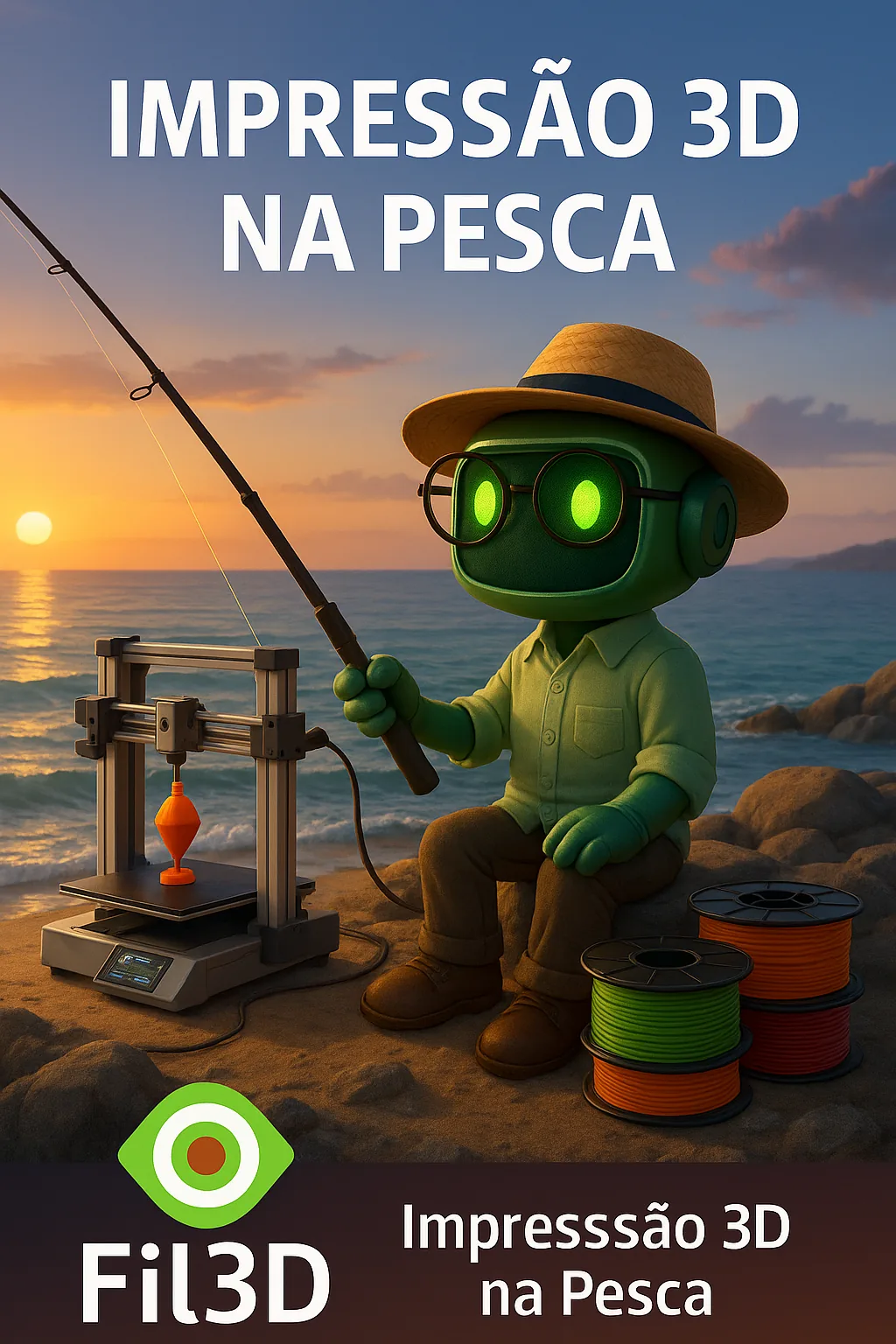
Today, with the arrival of 3D printing, this ancient practice takes on a new dimension: the possibility of creating and customizing equipment adapted to each fisherman and each environment, whether in rivers, lakes or at sea.
In FIL3D, we believe that innovation can be anywhere, even in the coexistence between fisherman, fishing rod and sea.
Practical applications of 3D printing in fishing
Customized baits
With 3D printing it is possible to produce artificial baits of any shape, size or color, replicating insects, small fish or crustaceans.
A fisherman can adapt the bait to the species you are looking for and even to the water and weather conditions.
Supports and fittings
Parts for attaching fishing rods to the boat, reel supports or storage box fittings can be custom created.
They make fishing more comfortable and organized.
Floats and buoys
Light, resistant and colorful live, can be printed quickly and replaced the moment one is lost or damaged.
Replacement parts
Breaking a reel or crank no longer means stopping fishing: with 3D printing, the part can be recreated in a few hours.
Organization accessories
Modular boxes, internal dividers and supports for 3D printed accessories allow you to keep your material close at hand and tidy.
Advantages of 3D printing in fishing
-
Total customization → each fisherman can create a unique kit adapted to their style.
-
Reduced cost → locally printed pieces are more economical than accessories imported.
-
Speed → replacement can be immediate, avoiding wasted fishing time.
-
Sustainability → using recycled filaments, such as FIL2NDLIFE, reduces environmental impact.
-
Affordable innovation → even fishermen Amateurs can experiment and create their own solutions.
Curiosities about 3D printing and fishing
-
First 3D baits: in 2014, the first prototypes of 3D printed baits began to appear in the USA, quickly adopted by sport fishing communities.
-
Perfect copies: Experienced fishermen use 3D scanners to replicate exactly the fish that predators like most.
-
Sustainable fishing: Marine biology universities use 3D printing to create artificial reefs and structures that help ecosystems recover.
-
Maker communities: Fishermen's forums share 3D files of baits, supports and accessories, making innovation collaborative.
The future of fishing with 3D printing
-
Smart baits: with motion sensors to attract fish more effectively.
-
Connected accessories: supports and floats that transmit information via smartphone.
-
Decentralized production: every port or fishing community you can have your own 3D workshop to repair and create equipment.
-
Environmental education: printing prototypes that help teach sustainability in fishing and marine biology schools.
Conclusion
3D printing is revolutionizing even the world of fishing, uniting tradition and innovation.
With it, every fisherman can become one too creator, adapting tools, improving performance and helping to preserve the environment.
At FIL3D, we develop filaments that allow us to transform these ideas into real solutions, so that fishing in rivers, lakes and seas continues to be an unforgettable experience.
Discover more at: tucab.pt
Contact us: comercial@tucab.pt