
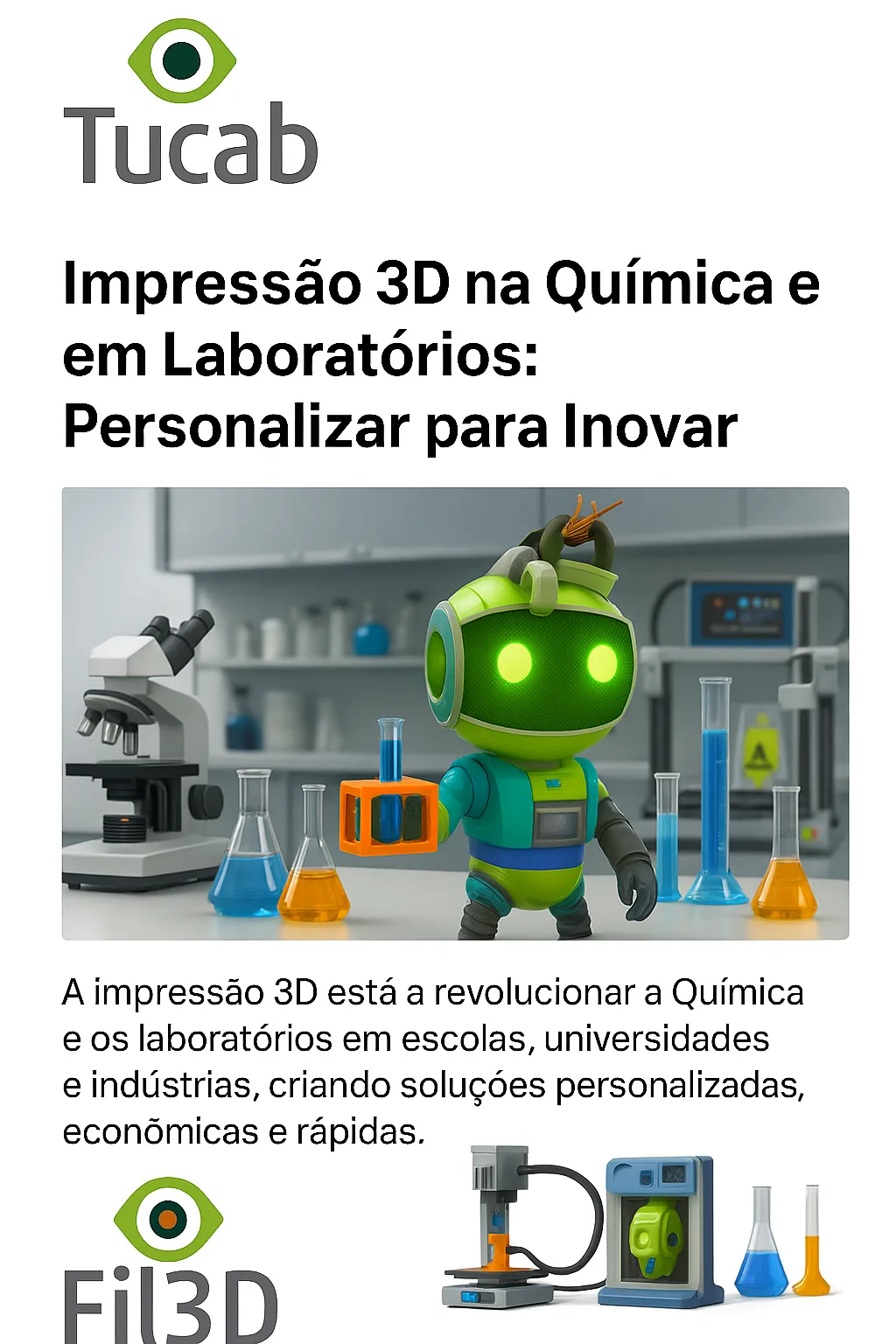
3D Printing in Chemistry and Laboratories: Personalize to Innovate
3D printing is revolutionizing the way chemistry is taught and practiced. In school, university or industrial laboratories, the ability to quickly create customized parts, at low cost and with complete autonomy, has opened the door to a new era of experimentation, prototyping and adaptation.
Under the Fil3D by TUCAB brand, we produce technical filaments such as PETG or PLA, which respond reliably to the demands of real laboratory environments.
Theoretical Examples: where does science meet design?
3D printing allows you to apply scientific concepts in a tangible way:
-
Organic Chemistry: printing molecular models in 3D to study chemical bonds or complex structures such as proteins and DNA;
-
Physical Chemistry: creation of customized electrochemistry cells, with holes for electrodes and sensors;
-
Experimental teaching: modeling of continuous flow reactors, precipitation tanks or settling chambers;
-
Instrumental Analysis: bases for spectrophotometers, support cuvettes, or fittings for optical sensors.
These examples reinforce the link between visualization, manipulation and active learning.
Practical Examples in Real Laboratories
-
In a private school, teachers print modular kits for students to build their own filtration benches, with supports and fittings of tubes adapted to smaller hands.
-
In a biotechnology startup, microreactor prototypes are tested with Fil3D filaments in PLA, before moving to the industrial production phase.
-
In a food quality control laboratory, claws and adapters are printed to shake samples with more stability, reducing human errors.
-
Laboratories with digital stock – instead of warehouses full of spare parts, schools and companies now have digital libraries of models ready to print as needed;
More agile research – each new test or prototype can be adapted on the spot, without depending on suppliers or universal parts that do not always serve the purpose;
More inclusive education – schools with fewer resources can, with a Fil3D printer and filament, offering rich practical experiences adapted to each class;
Sustainability and circular economy – with filaments like Fil2ndLife, it is possible to create useful parts from recycled plastic, reducing waste and training more conscious students.
Which Fil3D filaments are ideal for the laboratory?
-
PETG: high thermal and chemical resistance, ideal for supports, connectors, adapters and contact parts with light solvents;
-
PLA: ideal for study models, structural supports and parts with moderate contact with humidity or temperature variations;
-
Fil2ndLife: excellent for non-critical or short-lived parts, promoting reuse and environmental awareness.
Conclusion
Na science, every detail counts. And in 3D printing, each layer is an opportunity to innovate.
Fil3D believes in a future in which each laboratory, no matter how small, can create its own solutions with autonomy, intelligence and sustainability.Explore our technical filaments and join this revolution:
tucab.pt -