
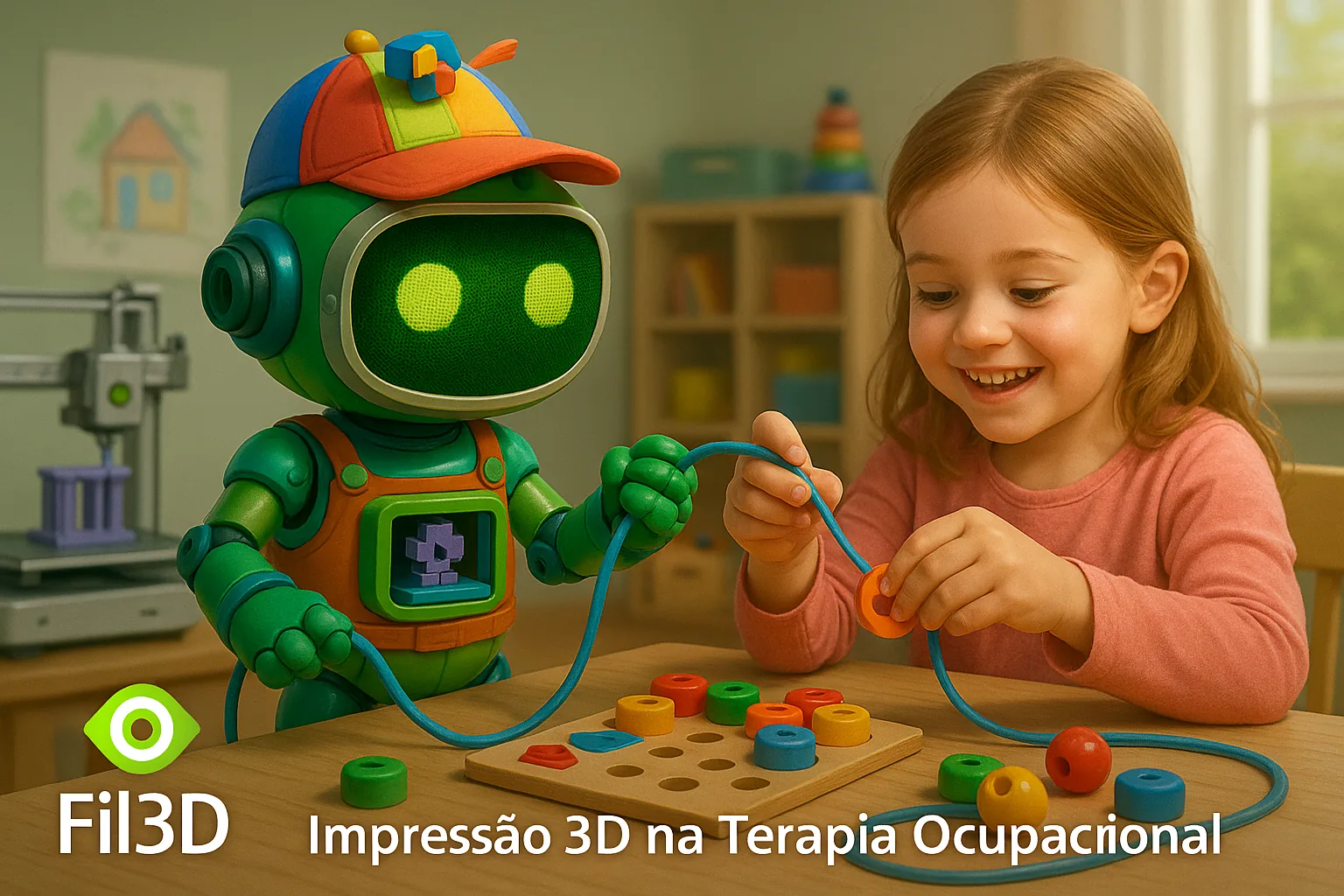
3D Printing in Cognitive Rehabilitation and Occupational Therapy
Solutions that Adapt to the Patient
Cognitive rehabilitation and occupational therapy are fundamental areas for improving the quality of life of people with motor, sensory or cognitive difficulties. Each patient has unique needs — and 3D printing, with its capacity for customization, becomes an indispensable ally for therapists, clinics and rehabilitation centers.
With Fil3D filaments, healthcare professionals are able to develop tailor-made devices and tools, adapted to each case, promoting autonomy, comfort and therapeutic effectiveness.
Theoretical Examples – 3D Printing as an Extension Therapeutics
Personalized cognitive training objects for reasoning, memory and language;
Utensils adapted for everyday tasks (e.g. cutlery, handles, enlarged buttons);
Sensory and manipulative games with specific textures, shapes and colors;
Technical aids to mobility or fine coordination (e.g.: guides, supports, anatomical molds);
Pieces for motor skills training such as tactile mazes or interlocking blocks.
Practical Examples – Therapy Tailored to Each Person
A therapist creates a set of pieces of different shapes and colors to train attention and visual memory in elderly people with Alzheimer's;
Printing a personalized wrist strap to help a child with cerebral palsy hold a pencil;
Developing a tablet holder with adjusted inclination, for a patient with reduced mobility at the cervical level;
Creating sensory stimulation cubes with varied textures for therapy with autistic children;
Printing educational pieces with letters in relief to support children with dyslexia.
Future Vision – 3D Printing as a Bridge to Inclusion
With the evolution of materials and printers, the next steps for 3D printing in rehabilitation include:
Printing with flexible and sterilizable materials compatible with environments clinicians;
Scanning of the patient's body to create personalized orthoses and technical aids;
Online platforms that connect therapists with 3D part designers;
Integration with augmented reality and robotics in training devices.
Why Choose Fil3D?
High quality materials, with diameter control and dimensional stability;
Fil2ndLife Line, with recycled filaments and sustainable packaging;
100% Portuguese production, with technical rigor and professional support.
Printed Therapy Tailored to Care
3D printing does not replace the therapist's empathy and knowledge, but it gives them tools to create more effective and personalized interventions. And with Fil3D, technology becomes an extension of human care.
Read more technical articles and learn about our filaments at: tucab.pt