
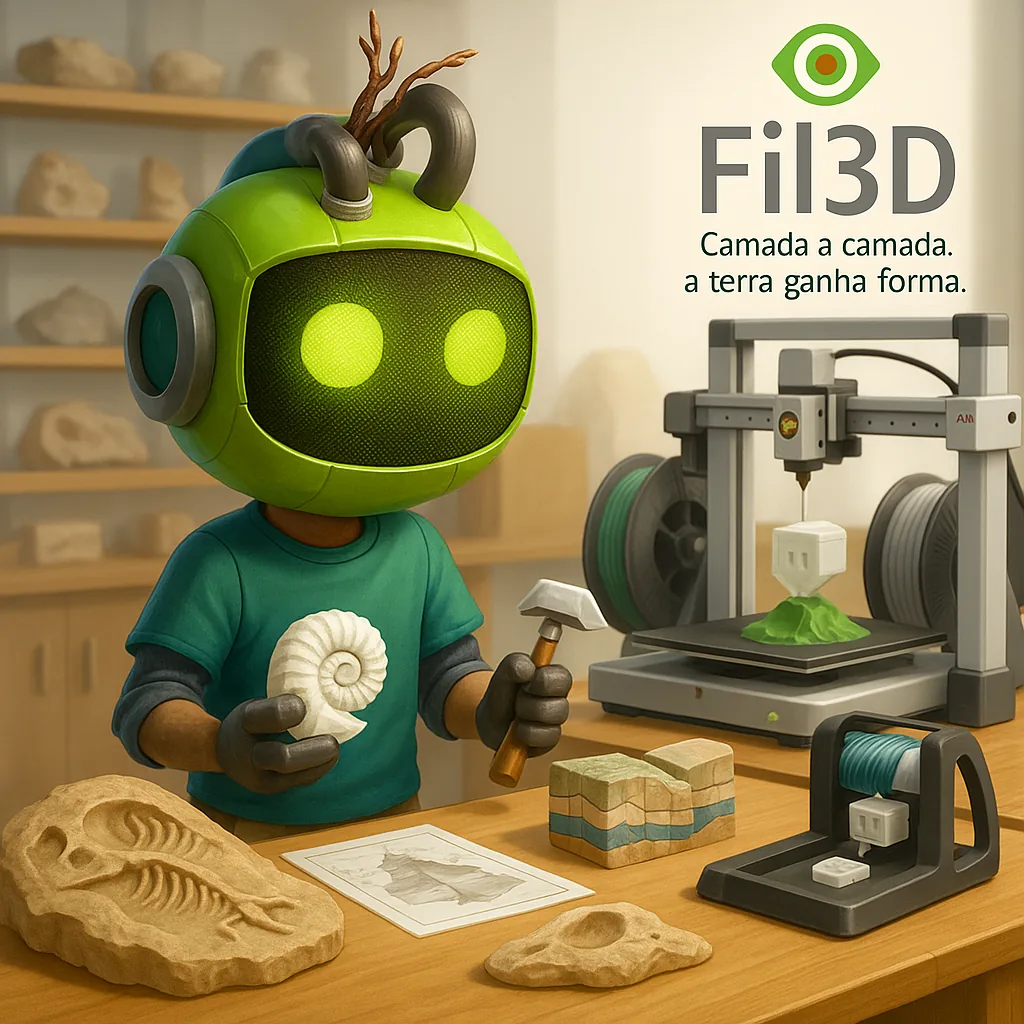
3D printing in the profession of Geologist: layers of knowledge on the surface
Geology is made of observation, interpretation and construction — both in the scientific and literal sense. As technology advances, geologists are looking for more accurate, visual and interactive ways to communicate their data.
That's where 3D printing comes in: a growing technology, with a direct impact on geological education, research, preservation, planning and communication.
At Fil3D, 3D printing is more than a prototyping tool: it's a bridge between land and knowledge.
Practical applications in the geologist's daily life
1. Creation of physical geological models
From digital data (GIS, CAD, topography, drone, lidar), geologists can print:
-
Stratigraphic sections with different sediment layers;
-
Models of folds, faults and sedimentary basins;
-
Models of risk zones (mass movements, active faults, volcanism);
-
Tactile representations of aquifers or underground structures.
Example practical: an engineering geologist prints the actual topographic profile of a slope before excavation to present to the construction team.
2. Replicas of fossils, artefacts and rare minerals
Often geological or paleontological pieces are unique, fragile or inaccessible. With 3D scanners and photogrammetry, it is possible:
-
Make exact copies of fossils for museums, schools and comparative studies; furniture.
Practical example: a paleontologist prints a sequence of fossilized vertebrae to demonstrate the structure of an extinct species without risking the original pieces.
3. Field tools adapted to needs
Geologists work in difficult conditions. 3D printing allows:
-
Create resistant transport boxes with custom-made compartments;
-
Adapters for measuring instruments or sensors;
-
Supports for smartphones with geolocation apps;
-
Templates for preparing slides thin.
Practical example: a geologist prints a modular box with a GPS fitting, hammer and sample bottles to facilitate field work in a remote area.
4. Didactic simulations in teaching and communication
Geology involves concepts that are often abstract. 3D printing helps make them tangible:
-
Collapsible models of geological cycles (rocks, erosion, metamorphism);
-
Interactive games for teaching mineralogy;
-
Representations of river basins and drainage networks;
-
Experiments with water flow models on inclined surfaces.
Practical example: in a class, students receive a 3D model of a volcano with visible and removable internal conduits.
The future of 3D printing in geology
-
Hybrid physical-digital models with QR codes that link to extra information or AR (reality enlarged);
-
Printing reactive models that change color with temperature (e.g. simulation of magmatic zones);
-
3D modeling systems integrated with drones and AI for immediate printing after survey;
-
Direct printing on geosynthetic materials, simulation of erosion and deformation in the laboratory.
“The geology of the future will be printed, manipulated and interpreted not only with a microscope, but also with an extruder.”
Fil3D filaments ideal for geologists:
| Material | Application |
|---|---|
| PLA | High-definition models, educational cuts |
| PETG | Rugged models for field work |
| ABS | Technical fittings and robust tools |
| Fil2ndLife | School workshops, educational prototypes |
Layer by layer, the earth takes shape
With Fil3D, geologists can study, teach and disseminate science in a practical, modern and visual way.
It's the power of 3D printing at the service of the earth.