
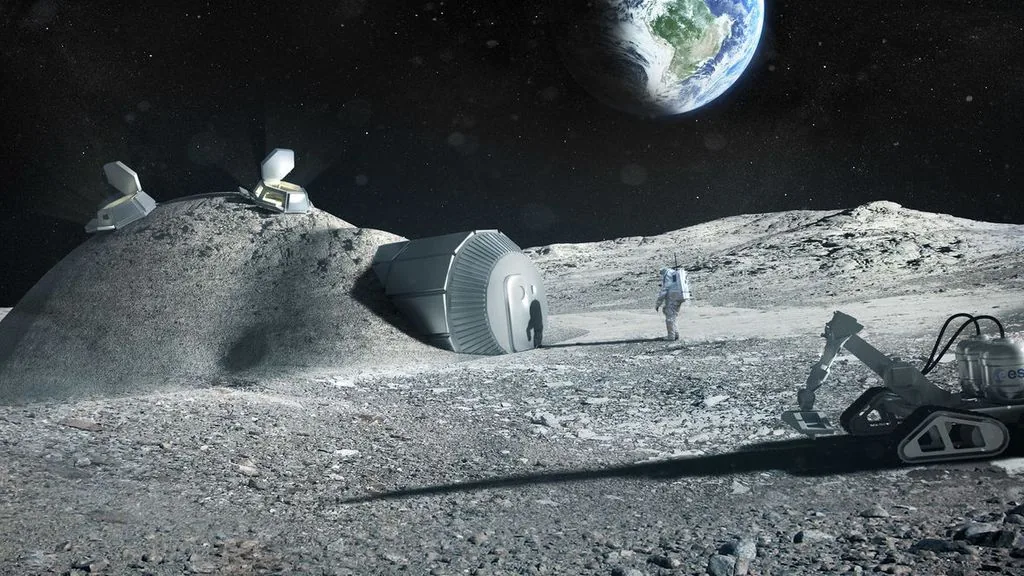
- Reducing Dependence on Land: A The ability to manufacture parts, tools and even structures in space reduces the need to transport everything from Earth, which is expensive and limited by the carrying capacity of space vehicles. This can allow for longer missions and the construction of permanent habitats.
- Recycling and Reuse: Recycled materials from the space environment itself or from the Moon/Mars could be used for 3D printing, promoting a circular economy](https://x.com/i/grok?text=nomia%2520circular)) and reducing waste.
2. Repair and Maintenance:
- Replacement Parts: With 3D printing, astronauts can create on-demand parts to repair equipment, avoiding the need to wait for replacements shipped from Earth, which can take months. r-rjixqe r-16dba41">Custom Tools: Creating specific tools for unexpected tasks or emergencies is made easier, increasing flexibility and responsiveness to technical problems.
3. Construction of Structures:
- Habitats and Infrastructure: 3D printing allows construction of habitats, laboratories and other infrastructure in space or on other celestial bodies using local materials (such as lunar regolith). This can be crucial for establishing permanent foundations. Radiation protection space, a major challenge for the health of astronauts.
4. Research and Development:
- Biology and Medicine: 3D printing can be used to manufacture tissues or organs for biomedical research in space, where conditions of r-1loqt21">microgravity may offer new insights into cell biology and tissue engineering.
- Experimentation: Enables rapid prototyping of scientific experiments, accelerating innovation and discovery. r-b88u0q">5. Colonization and Exploration:
- Colonization of Mars: The ability to build with local resources is fundamental a colonization of Mars, where transporting materials from Earth would be unfeasible for large populations.
- Advanced Exploration: Facilitates the exploration of resources in space, such as asteroid mining, where manufacturing in situ can be more economical and efficient.
Materials for 3D Printing in Space:- Plastics:
- PLA (Polylactic Acid): Although more common on Earth, PLA has been tested in space for printing smaller parts, despite its sensitivity to temperature.
- ABS (Acrylonitrile Butadiene Styrene): Used for parts that require heat resistance, although their tendency to warp in microgravity can be a challenge. href="https://x.com/i/grok?text=PETG%20(Polietileno%20Tereftalato%20Glicol)" role="link" class="css-1jxf684 r-bcqeeo r-1ttztb7 r-qvutc0 r-poiln3 r-liew4 r-1yqb93w r-mo87ph r-1ion2gp r-13wfysu r-1loqt21">PETG (Polyethylene Glycol Terephthalate): Offers a good alternative due to its impact resistance and less tendency to warp. r-rjixqe r-16dba41">Innovative Materials for Space:
- Lunar or Martian Regolith:
- Regolith Sintering: Processes such as laser sintering or selective melting of dust beds can transform lunar or Martian dust into solid structures. This is a key concept for building habitats and infrastructure using in-situ resources.
- Lunar or Martian Regolith:
- Metals:
- Aluminum: Can be printed with powder bed fusion techniques, offering the strength and lightness needed for space components.
- Stainless Steel: For parts that require high strength and durability.
- Titanium: Due to its strength, lightness and corrosion resistance, it is ideal for critical parts in space environments.
- Polymer Compounds:
- Carbon Fiber Reinforced Polymers: For parts that require high strength and rigidity, but also need to be light.
- Thermosetting Polymers: Used for applications where heat resistance is crucial, such as in spacecraft components.
- Recycling Materials:
- Recycled Plastics: In space, recycling existing plastics can be a source of material for 3D printing, reducing the need for new supplies from Earth.
- Technology: 3D printing in space faces challenges such as microgravity and radiation, which can affect the quality and accuracy of the print.
- Materials: The need to develop materials that work well in space, including those that can be manufactured from resources available in bodies celestial.
- Energy: The supply of power for 3D printers in remote locations like Mars or the Moon is an ongoing challenge.
Conclusion:While 3D printing in space cannot be considered the "salvation" of humanity in the literal sense, it is undoubtedly a tool for innovation which can be fundamental to the sustainability, security, and expansion of human presence in space. Technology offers solutions to many of the logistical, maintenance and construction challenges we face when considering life beyond Earth. Its implementation can be seen as a critical step towards humanity becoming a multiplanetary species, increasing our resilience as a species and expanding our knowledge and ability to explore the universe.