
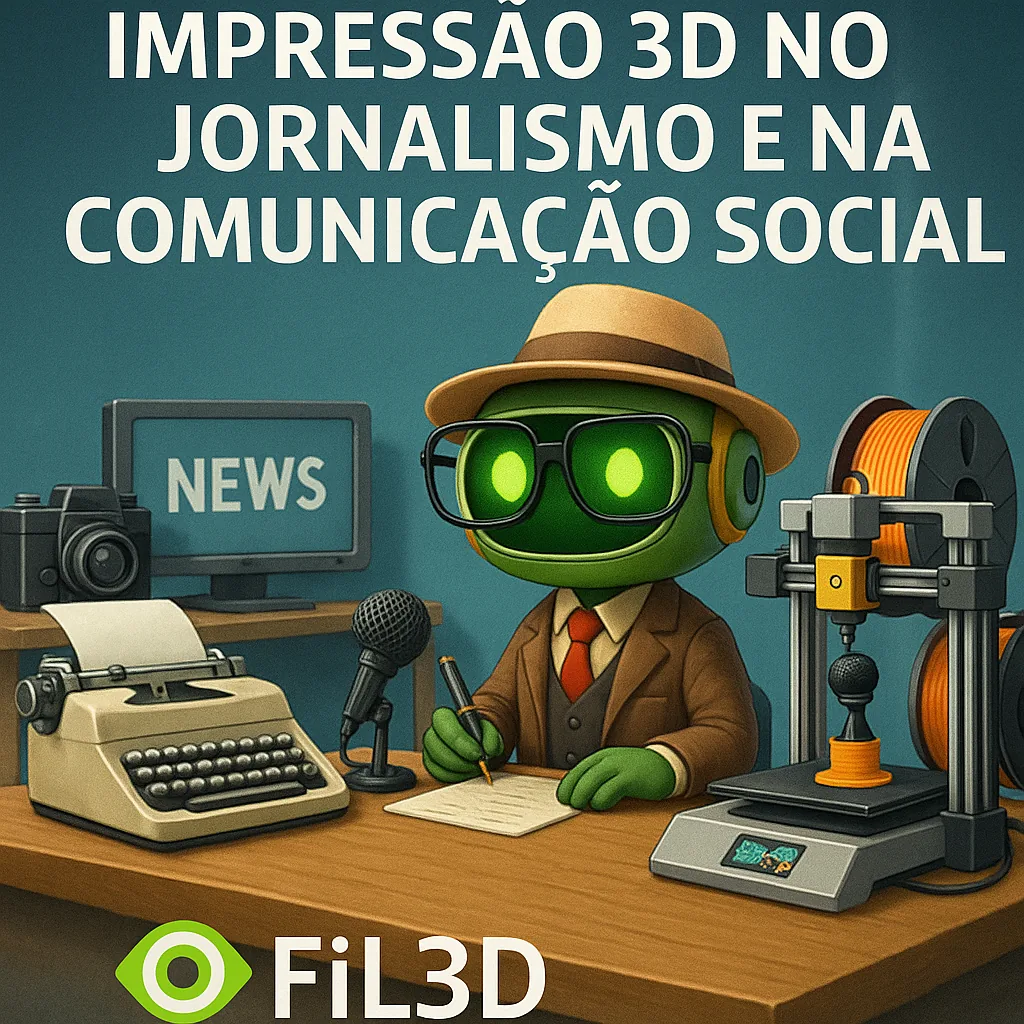
Throughout history, journalism and social communication have always evolved with the technologies of their time — from Gutenberg typography to radio, from television to the internet.
Now, 3D printing emerges as yet another tool capable of transforming the way news is produced, presented and experienced by the public.Practical applications
Data journalism and storytelling
-
Printing relief maps to explain wars, elections or natural phenomena.
-
Transformation of statistics and graphs into physical models that make information more accessible and inclusive (particularly useful for visually impaired audiences).
Television and multimedia
-
Quick creation of scenarios, props and models for studios and information programs.
-
Printing of logos, microphone stands and visual elements that reinforce the identity of each channel.
Radio and podcasts
-
Production of customized microphone stands, fixing systems and even acoustic parts, adapted to the needs of each studio.
Education and social communication
-
Replicas of historical objects, archaeological discoveries or research pieces for exhibitions and museums associated with journalism.
-
Making the news tangible, allowing the public to “touch the information”.
Advantages
-
Speed → pieces produced in hours, ideal for journalistic deadlines.
-
Total customization → solutions adapted to each newsroom or channel.
-
Cost reduction → replaces expensive and time-consuming processes.
-
Inclusion → information accessible to more audiences, including the visually impaired.
The Future of Social Communication
-
Newsrooms with 3D printers → support for immersive reporting and multimedia.
-
Interactive journalistic exhibitions → where the public can see and manipulate replicas of the news.
-
New narrative formats → union between augmented reality, 3D digital and printing physics.
Conclusion
3D printing could be, in the future, as important for journalism as the arrival of television or the internet.
More than telling stories, it will allow us to materialize them, making social communication more visual, inclusive and memorable.
At FIL3D, we believe that each printed layer can also help shape a new way of informing.
Discover more at: tucab.pt