
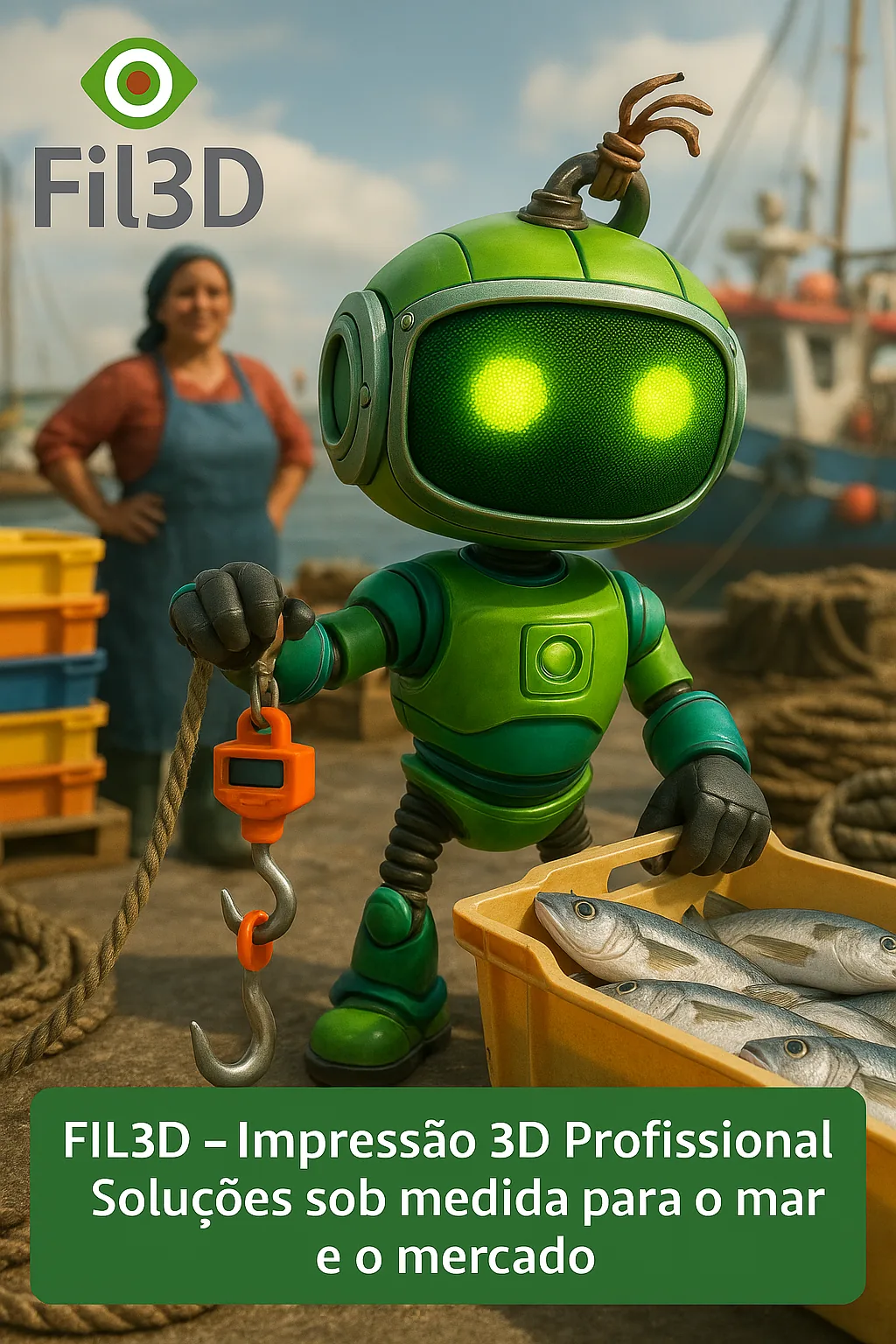
3D Printing at Sea and in the Market – How Fil3D Transforms the Work of Fishermen and Fishmongers
The sea doesn’t wait. And in the market, there is no time to waste either. Fishermen and fishmongers are masters of adaptation — they work with what they have, repair what breaks and invent solutions every day. Now, with 3D printing, they have a new tool in their hands: capable of creating, adapting and replacing, all in real time.
With Fil3D filaments, everyday challenges can be solved with speed, precision and... imagination.
On board: tailor-made solutions that resist salt and time
On a fishing boat, every inch counts. There's no room or time for unsafe improvisations.
With a 3D printer and rolls of Fil3D PETG or ABS, anglers can:
-
Print a rig holder that fits their boat's hull, rather than searching for a generic one that never fits.
-
Create a sturdy reel protector to prevent the equipment is damaged during maneuvers.
-
Produce reinforced hooks for ropes, with the ideal thickness and shape for each type of shackle.
-
Replace the handle of a transport bucket or the lid of a compartment, without depending on suppliers or specific parts.
Real example: A shipowner in the area de Peniche 3D printed a cable guide for the network winch. Result: prevented jams and increased the system's durability.
At the counter: organization, hygiene and personalization
Fishmongers need practical, resistant and easy-to-clean tools. 3D printing allows:
-
Knife holders that fit perfectly on the counter.
-
Adjustable dividers for fish boxes — without relying on fixed models.
-
Hooks and labels for price signage, reusable and water resistant.
-
Filleting molds with specific anatomy for each species (sea bass, sea bream, sardine).
Practical suggestion: Produce personalized molds for filleting, which guarantee always equal cuts — ideal for restaurants or detailed sales with standardization.
Creative bonus: Some fishmongers already use 3D printing to create fish miniatures in colored PLA as promotional gifts for children. Proximity communication, with technology.
Future: from improvisation to technological autonomy
With the advancement of 3D printing, professionals in the fish sector will be able to:
Digitize parts that break frequently, keeping files ready to reprint when necessary.
Share designs among fishing communities, creating technical support networks and reducing costs.
Adopt sustainable filaments, such as recycled or compostable PLA, in line with ocean protection.
Create custom-printed aquaculture or shellfish farming support structures depending on local conditions.
Near future example: A fishing boat yard might have a 3D printing station to supply parts to the entire fleet — from technical covers to custom panels.
Why Fil3D?
Because every printed part counts — and must withstand salt, pressure and continuous use.
With Fil3D:
-
You have filaments for demanding environments (PETG, ABS, ASA)
-
Guarantee of adhesion, finish and resistance
-
Local technical support, provided by those who know the reality of Portuguese companies
Conclusion
Tradition is alive — but now it speaks the language of innovation.
With 3D printing, fishermen and fishmongers stop depending on generic solutions and start creating their own. With Fil3D, the future is tailor-made… layer by layer.