
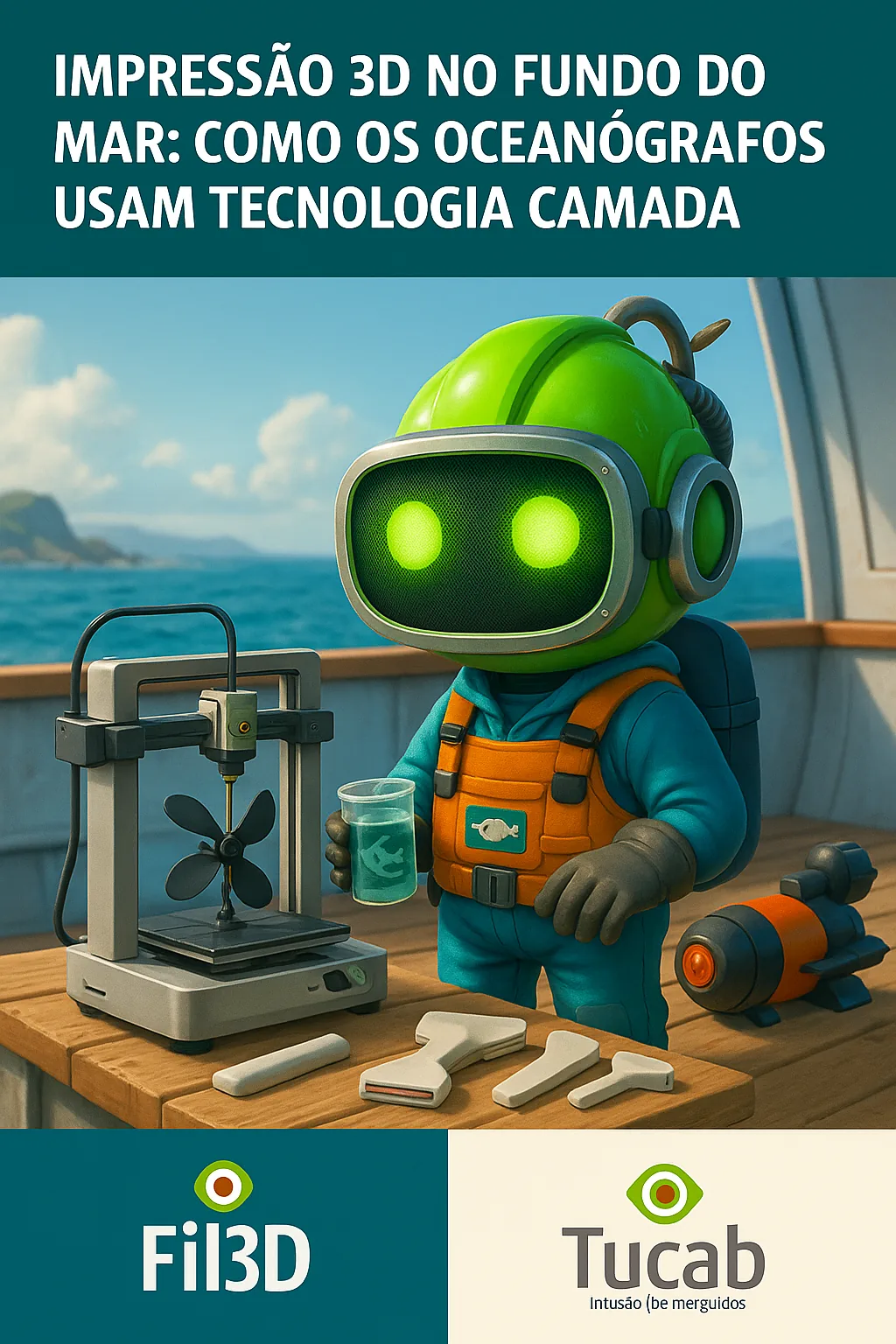
3D printing under the sea: how oceanographers use layer-by-layer technology
Exploring the ocean is challenging. Pressure, corrosion and isolation make marine research one of the most demanding fields in science. It is also one of those that benefits most from 3D printing, a tool that allows you to prototype, adapt and create customized solutions for extreme environments — all quickly and efficiently.
Fil3D accompanies these sea explorers, layer by layer.
What does an oceanographer do?
Oceanographers study the seas, marine ecosystems, water chemistry and the effects of changes climate. They work in laboratories, vessels or data collection platforms — and need reliable, resistant equipment adapted to the specific conditions of each mission.
Theoretical applications of 3D printing in marine research
-
Device customization: adapting sensors or structures to the exact dimensions of the areas to be studied;
-
Prototyping of structures complex systems, such as articulated arms, underwater drones or sample collection modules; practical in field work
-
Printing supports for underwater cameras installed on reefs;
-
Enclosures for salinity and pH sensors with personalized fittings;
-
Creation of surface buoys with logos of research institutions investigation
Reduce costs of specialized equipment;
-
Avoid the transport of fragile and heavy parts;
-
Reduce waste, with accurate and local production;
-
Create solutions to protect marine habitats, monitor pollution or raise awareness among coastal communities with educational models.
The Future of marine research with 3D printing
In the medium term, we could see:
-
Equipment printed with saltwater-resistant biomaterials;
-
Printing on mobile platforms, vessels or remote islands;
-
Creation of printed artificial coralline structures, for recover degraded ecosystems;
-
Low-cost modular sensors for continuous ocean monitoring.
Conclusion
Oceanographers are guardians of the blue planet. 3D printing, with its capacity for adaptation, resistance and innovation, is a natural ally for those dedicated to studying and protecting our oceans.
Fil3D – Printing that dives deeper.
-