
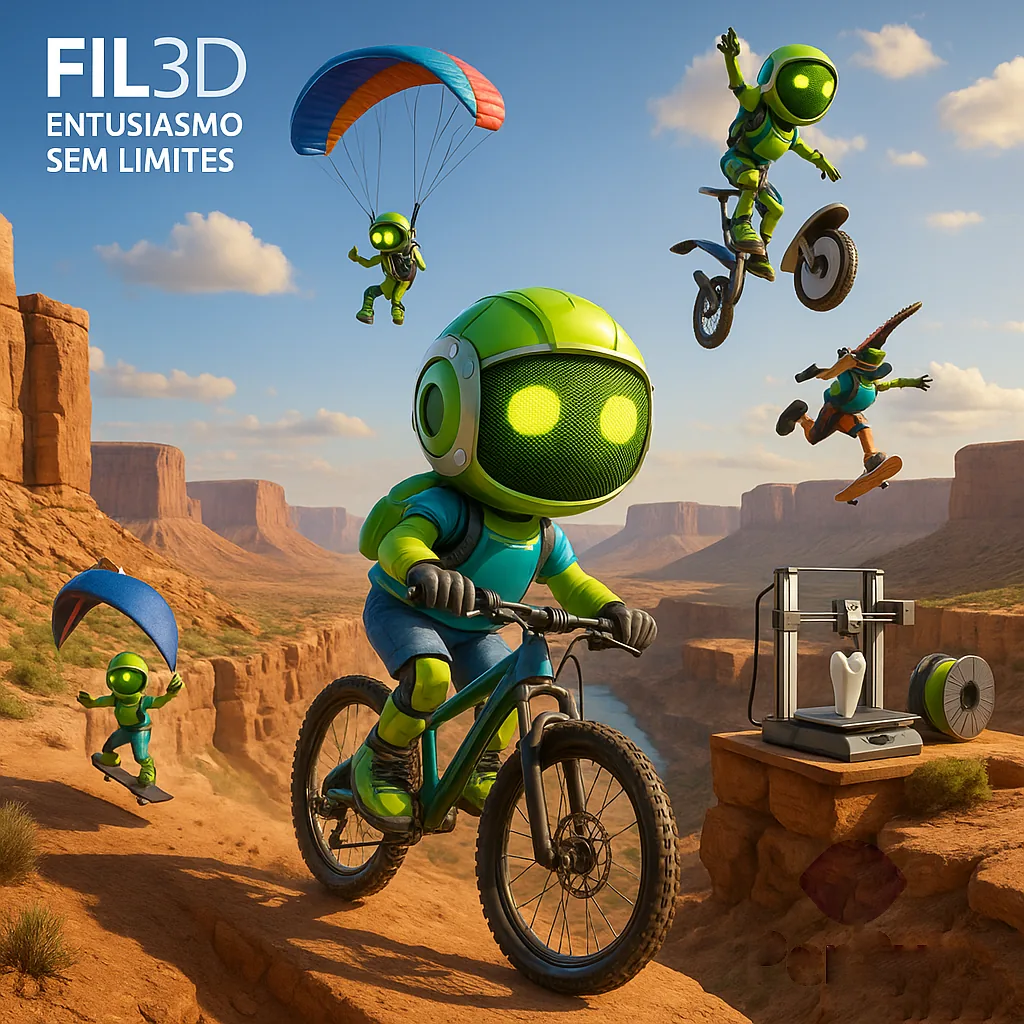
3D Printing in Extreme Sports
Technical tools, improvised solutions and adventure-proof innovation
The practice of extreme sports requires more than courage — it requires adaptation, speed of response and technical solutions in extreme situations. From high-performance athletes to recreational practitioners, 3D printing is transforming the way athletes face the extreme challenges of land, sea or air.
In your backpack, in a support van or even at base camp, a 3D printer can be the difference between continuing or giving up.
Practical cases – 3D printing in the daily lives of those who live in limit
Mountain cycling (MTB, downhill, enduro)
-
Printed mounts for GPS, cameras or lights adjusted to the bike's geometry
-
Clips for hydration pack or brakes
-
Custom derailleur and shifter protectors
-
Custom-made saddle adapters, brake pads or spacers
Climbing
-
Technical training jigs with PLA-printed tusks
-
TPU finger and joint protectors
-
Magnesium brackets or training carabiners
-
Equipment organizer by piece and function
Air sports (paragliding, paramotoring, skydiving)
-
Printed structures for flight instrumentation supports
-
Custom-made connecting parts between harness and cockpit
-
Casings for radios, beacons and devices emergency
Nautical and wind sports
-
Printed fins for windsurfing or kitesurfing boards
-
Connectors for line systems and trapezes
-
TPU keel protectors or board edges
-
Floating sports camera stands
Camping and survival
-
Hanging hooks, backpack racks, stove adapters
-
Cutlery, clips, fasteners, straps, filters or organizers
-
Flashlight stands and folding structures to set up tents with more stability
Applied theory – Why does it work?
3D printing is ideal for these situations because it allows:
-
Produce low weight parts with good resistance
-
Make functional and optimized design to the millimeter
-
Create geometries difficult to manufacture using traditional methods
-
Adapt parts to the user's body, backpack or equipment
Materials such as TPU absorb impacts, PETG withstands heat and humidity, and PLA guarantees dimensional accuracy in environments controlled.
The future of adventure with 3D printing
1. Mobile repair stations
4x4 vehicles with 3D printers on board, ready to print parts at the training or competition site.
2. Collaborative community design
Athletes share STL files of parts created by them (e.g. suspension protectors, saddle supports, adapted boards), opening an open and collaborative library.
3. Printing with new advanced materials
From carbon fiber composites to ultra-resistant biopolymers, the future of filaments will allow us to print critical structural components even in extreme environments.
4. Training for practitioners
Upcoming extreme sport workshops will include training in 3D printing, allowing each practitioner to create and maintain their own equipment.
Fil3D – The adventure doesn't stop for lack of parts
Because when you're at 2000 meters of altitude, or 10 km from civilization, what you carry in your backpack makes all the difference. And now, you can also bring your creativity to print.