
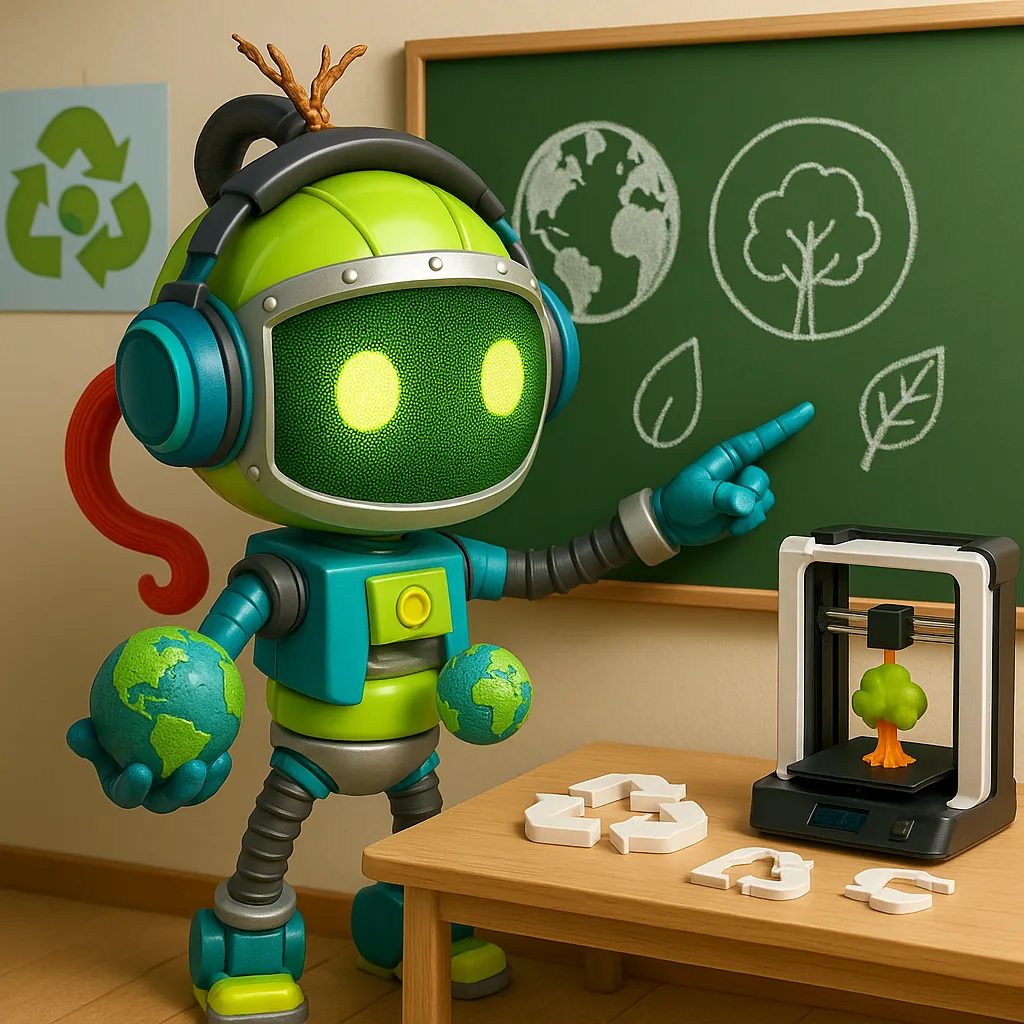
Environmental education's mission is to train conscious citizens, capable of protecting the planet with knowledge, action and creativity. 3D printing, when used with sustainable filaments like those from Fil3D, becomes a powerful tool for teaching, raising awareness and innovating.
Combining technology, ecology and active learning, 3D printing transforms any classroom into a laboratory of green experiments.
Why does 3D printing help teach sustainability?
Environmental education needs to be practical, visual and participatory. 3D printing allows:
-
Create educational models of ecosystems, natural cycles and protected species
-
Simulate environmental impacts, such as deforestation, erosion or pollution
-
Develop educational games with modular and reusable parts
-
Stimulate creativity in reuse, repair and ecological design projects
All this while promoting awareness about the responsible use of materials, sustainable design and the importance of local production.
Practical examples
1. Ecological board games
Print games about waste separation, biodiversity or renewable energy. Children learn to play, building their own game with pieces printed on recycled PLA.
2. Mini ecosystems and food chains
3D models of forests, deserts or oceans with printed species to demonstrate ecological balance and human impacts.
3. Animals at risk and habitats
Create pictures of endangered animals, native plants or topographic maps to explore themes such as extinction, habitats and environmental protection.
4. Repair and reuse projects
Students can design and print replacement parts for damaged objects, reducing waste and promoting the circular economy.
Why use Fil3D filaments?
-
Produced with 100% renewable energy
-
Strict dimensional control, ideal for educational pieces
-
Options in recycled materials and materials with low environmental impact
-
Recyclable packaging and ecological responsibility throughout the entire process
The future of education begins layer by layer
Schools are increasingly adopting 3D printing as part of their Environmental Education and STEAM (Science, Technology, Engineering, Arts and Mathematics) projects. The possibility of learning to create real solutions stimulates ecological awareness, teamwork and social innovation from an early age.
Conclusion
Sustainability is not just an idea — it is something that can be taught, printed and practiced. With Fil3D, each layer is a lesson and each printed part, a seed for a better future.
Fil3D – Printing with a conscience. Education with impact.