
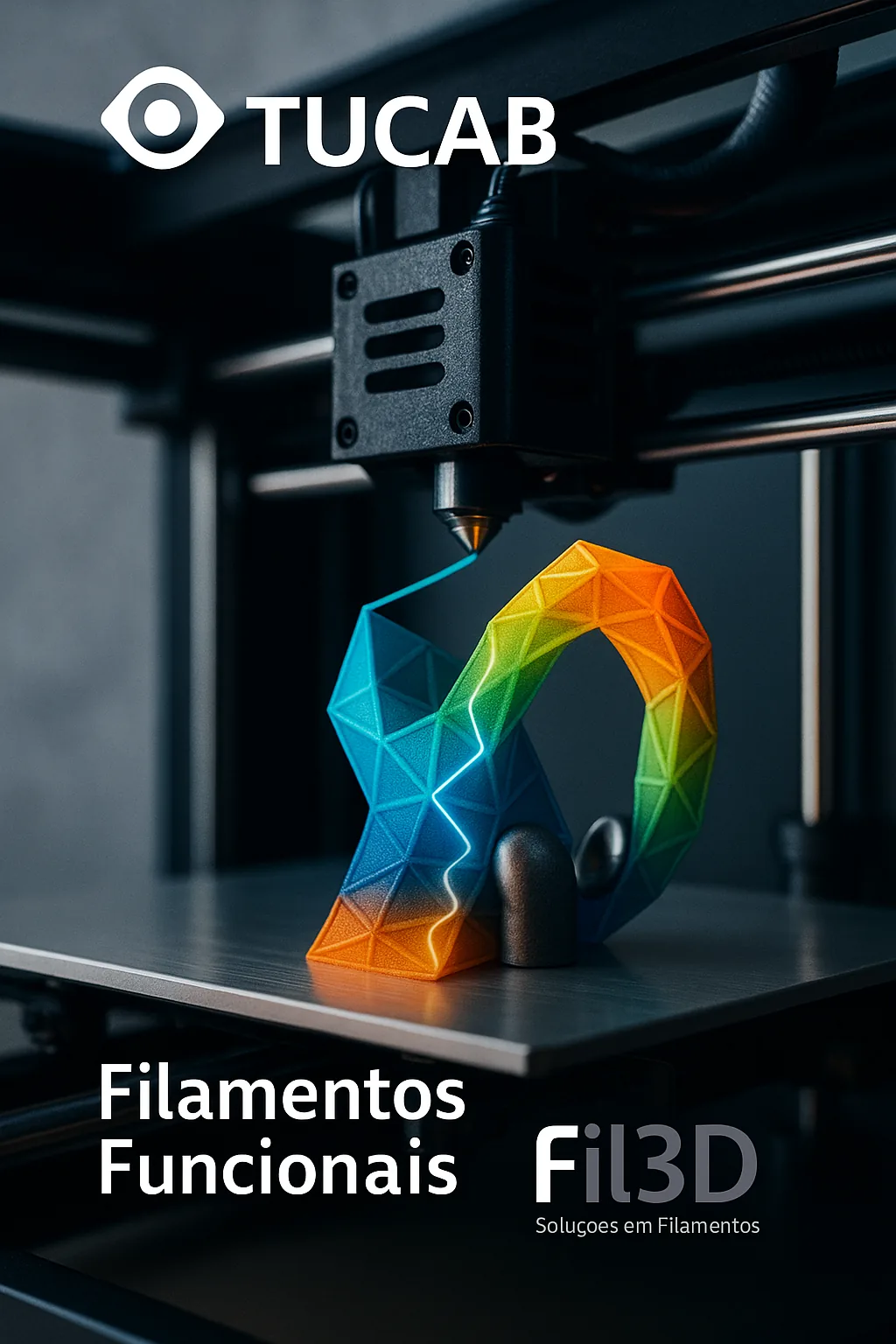
3D printing has revolutionized the way we produce prototypes, technical parts and customized solutions. But a new frontier is already beginning to gain prominence: 4D printing.
In this technology, printed objects are not just static — they react and transform in response to external stimuli such as heat, humidity, light or magnetic fields.
We are entering the era in which smart filaments allow us to create pieces that “come to life”.
Theory: what is 4D printing?
4D printing is based on the same process as 3D printing, but uses programmable materials. These materials are developed to respond in a controlled way to specific environmental conditions.
-
Change of shape: structures that bend or expand when heated.
-
Change of properties: filaments that change color, transparency or rigidity.
-
Change of function: parts that assume different roles depending on the stimulus.
In summary, 4D printing adds the time dimension to 3D printing, creating dynamic and adaptive parts.
Practical: application examples
-
Medicine
Stents or prostheses that expand on their own in the human body with temperature body.
-
Industrial engineering
Tubes that self-expand in contact with heat or pressure, facilitating maintenance in difficult environments. -
Architecture and design
Responsive structures that adapt to sunlight, opening and closing depending on temperature or luminosity. -
Consumption and sport
Smart textiles and accessories that adjust to the user during movement or environmental conditions.
The future of 4D printing
4D printing promises to transform entire sectors:
-
Automotive industry → parts that adapt to wear or temperature.
-
Aerospace sector → structures that change in orbit to adapt to different conditions.
-
Health → dynamic and personalized medical devices.
And most importantly: this technology opens the door to more sustainable production, reducing the need for multiple components and increasing energy efficiency.
The role of Fil3D® by TUCAB
At Fil3D®, we believe that the future involves researching new intelligent filaments capable of supporting these transformations.
Our commitment is to provide solutions that not only keep up with the current needs of the industry, but also anticipate the disruptive trends of additive manufacturing.
4D printing is not science fiction — it is the next step of 3D printing.
And at Fil3D®, we are ready to accompany this revolution.
Discover more about the future of 3D and 4D printing at:
tucab.pt