
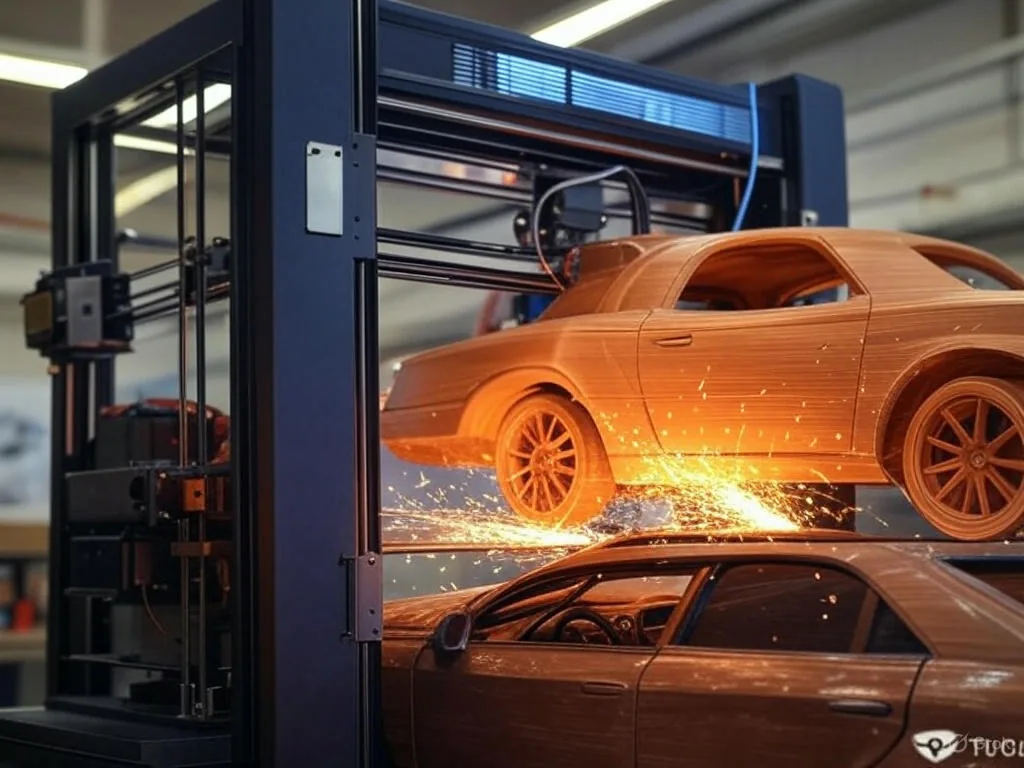
Imagine a world where you can print your own car in your garage, piece by piece, using a 3D printer. Sounds like something out of a science fiction movie, right? Well, with Fused Deposition Modeling (FDM) technology, this dream is getting closer to reality. Although it is not yet possible to print a fully functional car — including engine and suspension — with an FDM printer, there are already impressive examples of how this technology is revolutionizing the automotive industry. And TUCAB, the Portuguese company leader in filaments for 3D printing, is at the forefront of this transformation.
What Has Already Been Done: (Almost) 3D Printed Cars
FDM technology has already proven its value in creating significant automotive components. See two projects that capture the imagination:
- Urbee (2010): Developed by Kor Ecologic and Stratasys, the Urbee is a hybrid car with a futuristic body printed in ABS using FDM. Its lightweight, aerodynamic structure has been optimized for energy efficiency, showing how FDM can create complex and functional parts.
- Strati (2014): Produced by Local Motors, the Strati was the first "printed" car to drive on public roads. The body was manufactured in just 44 hours on a large-scale printer, using a pellet-based material (similar to FDM). This minimalist car reaches 64 km/h and relies on metal parts for the engine and suspension.
These examples show that FDM is perfect for non-structural parts — like bodies and interiors —, but it still doesn't replace traditional methods for critical components like engines or brakes.
Technical Details: How Does FDM Work in a Car?
FDM builds objects by depositing molten plastic filaments layer by layer. But how does this apply to a car? Let's get into the details:
- Materials: Filaments are the heart of FDM.
- PLA: Easy to print, but sensitive to heat.
- ABS: More robust, ideal for bodyworks (used on the Urbee).
- PETG: Combines flexibility and resistance.
- PEEK: Offers high performance, but is expensive and requires advanced printers.
- Printing Process: Every detail counts, from the layer height (e.g.: 0.2 mm for bodies) to the infill (internal filling), which defines the density and resistance of the piece.
- Scale: Home printers are small, but industrial models like the BigRep ONE (1000x1000x1000 mm) can print larger sections of a car.
Challenges: What's Holding Us Back?
Print a functional car with FDM is not as simple as pressing "print". Here are the main obstacles:
- Size: An average car is 4-5 meters long, requiring giant printers or assembly of multiple parts, which can compromise structural integrity.
- Mechanical Strength: Materials like ABS or PLA cannot withstand the high temperatures and stresses of an engine (200-300°C, >500 MPa).
- Time and Cost: Printing a body can take days, and advanced filaments like PEEK are expensive (500-1000€/kg).
The Future: Game-changing Innovations
A FDM is evolving rapidly, and the horizon is exciting:
- Giant Printers: Companies like BigRep and Cincinnati Inc. are creating machines capable of printing entire car bodies.
- Hybrid Materials: Carbon fiber-reinforced filaments are gaining traction, approaching the strength of light metals.
- Sustainability: Recycled filaments, such as TUCAB's FIL2NDLIFE, made from post-consumer plastic, reduce costs and environmental impact, aligning with the circular economy.
TUCAB at the Vanguard of Innovation
Based in Leiria, Portugal, TUCAB is a pioneering force in FDM. Its range of filaments includes:
- ABS: Tough and versatile for car bodies.
- PETG: Durable for flexible parts.
- FIL2NDLIFE: Recycled, sustainable and perfect for prototypes ecological.
With ISO 9001 and 14001 certifications, TUCAB guarantees quality and environmental responsibility, offering customization in colors and diameters (1.75 mm or 2.85 mm) for automotive designers. Its expertise in plastics extrusion not only drives innovation in the wood industry, but also opens doors to the future of sustainable automotive manufacturing.
Conclusion: The Printed Car Is Coming
Today, FDM may create stylish bodies and custom interiors, but engines and critical parts still belong to the world of metals. However, with bigger printers, stronger materials and TUCAB's vision, the day when we print complete cars is closer. Do you want to be part of this revolution? Explore TUCAB filaments at tucab.pt/en/Fil-3D and start building the future, layer by layer!