
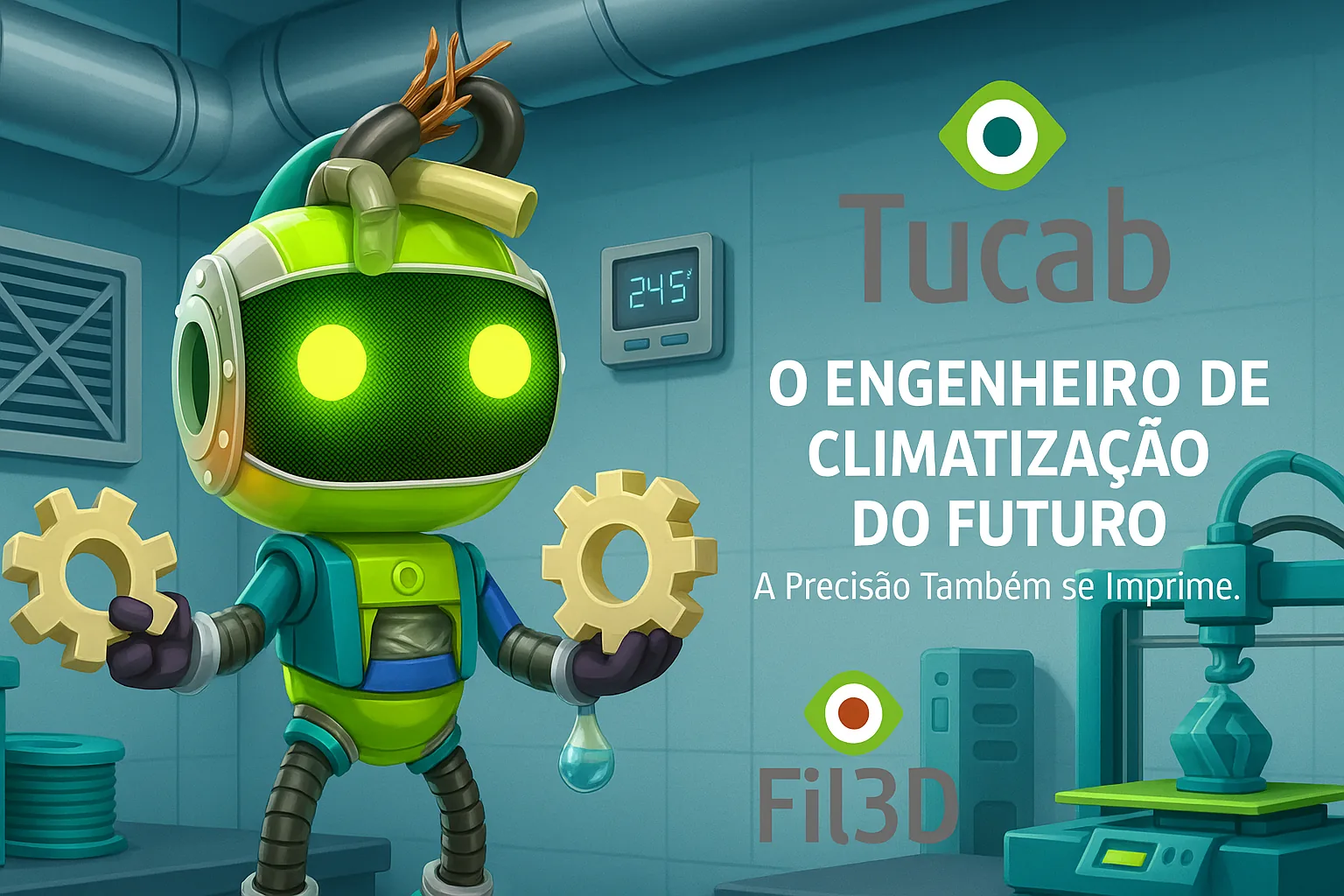
The Climate Engineer of the Future
3D Printing with FIL3D® at the Service of Thermal Comfort
When temperatures drop, thermal comfort becomes a matter of engineering.
Modern climate control depends on the precision of each component — ducts, supports, diffusers and connecting parts — where 3D printing with FIL3D® filaments from TUCAB® is taking on an increasingly important role.
With the ability to produce tailored, resistant parts optimized for air flow and temperature, air conditioning (HVAC) engineers find in 3D printing a tool that combines energy efficiency, rapid prototyping and sustainability.
Technology at the Service of Comfort
Printing 3D allows you to create complex technical parts, with internal geometries impossible to manufacture using conventional methods — optimized air diffusers, customized connectors, anti-vibration supports and duct prototypes.
With PLA, PETG and ABS FIL3D® filaments, the air conditioning engineer can test and validate components at scale real, before final production, reducing costs and accelerating development.
-
PETG Skygreen – resistant to heat and humidity, excellent for diffusers and adapters;
-
ABS FIL3D® – robust and stable, perfect for fittings and technical supports.
Each filament is produced with tolerance dimension of ±0.02 mm, ensuring perfect fits and uniform performance, essential in air conditioning systems.
Real Applications
FIL3D® is already used by professionals and companies to create innovative solutions in air conditioning and ventilation:
-
Prototyping of diffusers and ventilation grilles with aerodynamic profiles;
-
Customized connection parts between ducts of non-standard diameters;
-
Anti-vibration supports and technical structures for panels and sensors;
-
Temporary protectors and covers for system maintenance;
-
Functional air flow control models, printed and tested before installation.
Sustainability and Efficiency
In addition to speed and customization, 3D printing reduces material and energy waste.
Production is made only with what is necessary, and the possibility of using recycled filaments, such as FIL2NDLIFE®, reinforces TUCAB®'s commitment to sustainability and green engineering.
In a sector increasingly attentive to energy efficiency, 3D printing with FIL3D® allows the development of lighter, more efficient and environmentally responsible air conditioning systems.
Vision of the Future
The climate control engineer of the future will not only depend on conventional tools — he will depend on the ability to create solutions adapted to the environment and the user.
3D printing becomes an extension of technical thinking: each project can be tested, improved and produced with millimeter precision.
With FIL3D®, thermal innovation and functional design are now just a print away.
Conclusion
Thermal comfort is the balance between science, engineering and creativity.
With FIL3D® filaments from TUCAB®, HVAC engineers build the future — layer by layer, in every project.
“The precision of comfort begins with the precision of printing.”
TUCAB® | FIL3D® – Precision also prints.