
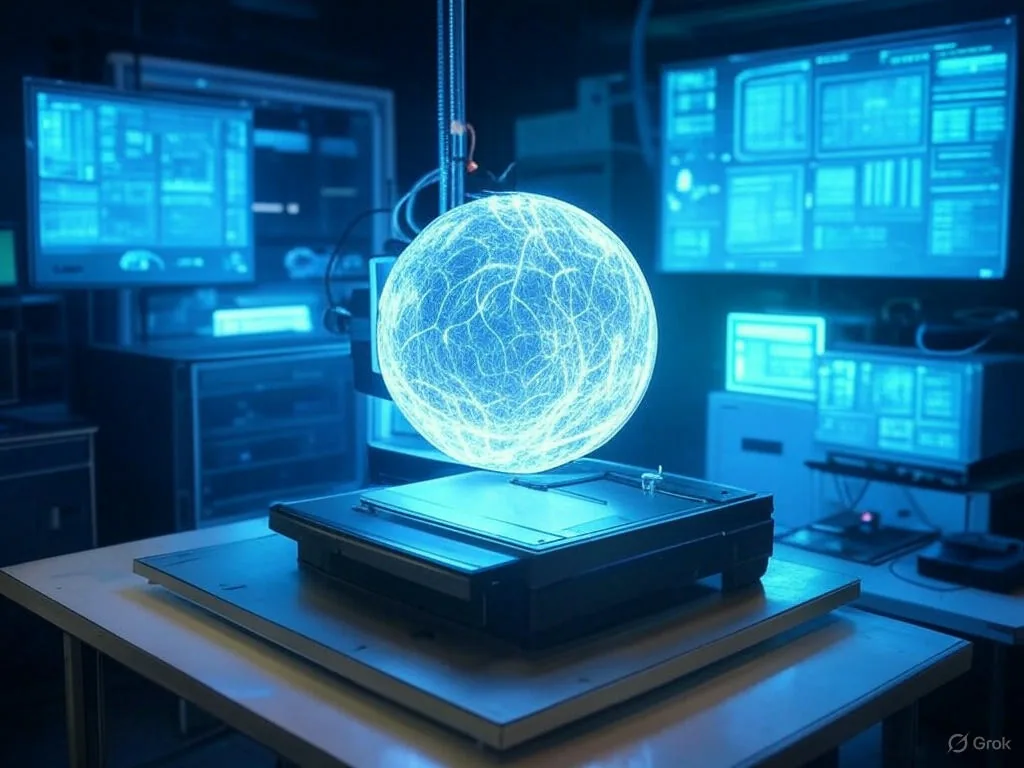
Fused Deposition Modeling (FDM) 3D printing has revolutionized additive manufacturing, allowing the creation of three-dimensional objects from thermoplastic filaments in an accessible and versatile way. Today, it is used by enthusiasts, small businesses and large industries for prototyping and producing functional parts. But what's to come? In this article, we will explore the current state of FDM technology and imagine a bold future, thinking "outside the box" about how 3D printing machines and filaments can evolve, bringing innovations that will transform society, the economy, and even our relationship with the planet and the universe.
The Current State of FDM 3D Printing
Currently, FDM printers work by heating and extruding filaments such as PLA, ABS and PETG, depositing them layer by layer to form objects. The technology is valued for its low cost and simplicity, but faces limitations such as moderate resolution, long print times for complex parts and restrictions on the variety of materials. Despite this, continued advances in hardware, software and materials are paving the way for an extraordinary future. Let's dive into the possibilities!
The Future of FDM 3D Printing Machines
The FDM printers of the future won't just be tools; they will become intelligent, autonomous and almost living systems, capable of operating in unimaginable scenarios. Here are some visionary ideas:
1. Autonomous and Self-Replicating Machines
Imagine 3D printers that not only automatically load and change filament, but also self-repair and self-replicate. Equipped with robotic arms and advanced sensors, they could replace worn-out parts by printing new ones directly from an in-house stockpile of material. Further, they could print copies of themselves, creating "living factories" that expand on their own in places like space colonies or deserts.
2. Evolutionary Artificial Intelligence
AI in the printers of the future will go beyond simply optimizing parameters. They will be able to "dream up" new designs, using neural networks to create objects never before imagined by humans, based on usage data and detected needs. For example, a printer in a home could observe wear and tear on furniture and suggest (and print) custom replacements, combining aesthetics and functionality like never before.
3. Quantum and Nanotechnology Printers
Thinking outside the box, FDM printers could integrate principles of quantum computing to process complex simulations in real time, fine-tuning printing at the molecular level. Combined with nanotechnology print heads, they could manipulate atoms to create materials with properties impossible today, such as objects as light as feathers but as strong as diamonds.
4. Multi-Dimensional and Holographic Printing
What if FDM printers transcended three dimensions? Future machines could incorporate "4D printing" as standard, creating objects that change shape over time. Furthermore, with holographic technologies, they could project and solidify structures in the air, eliminating the need for physical supports and allowing the instantaneous creation of floating or intangible objects until the moment of activation.
5. Planetary Printers
In the distant future, giant FDM printers could be sent to other planets, such as Mars, to build entire cities from regolith (lunar or Martian soil) processed into filaments. These machines would be powered by solar or nuclear energy, operating continuously to create habitats, vehicles and even artificial ecosystems, transforming barren worlds into new homes for humanity.
The Future of Filaments in FDM 3D Printing
Filaments are the heart of FDM, and their development will be as revolutionary as that of the machines. Here are some innovative ideas:
1. Living Filaments
Imagine filaments made from living cells or synthetic organisms that grow after printing. An object printed with this material could regenerate, like artificial skin that heals on its own, or even evolve, adapting to the environment. For example, a printed structure on a space station could automatically strengthen itself against cosmic radiation.
2. Energy Filaments
Filaments that store or generate energy can be game-changers. Think piezoelectric materials that produce electricity when pressed, or filaments with embedded microsolar cells, allowing the printing of custom, curved solar panels. Everyday objects, such as chairs or clothes, could become self-sufficient energy sources.
3. Cosmic Filaments
For space exploration, filaments could be created from stardust or extraterrestrial minerals collected by robotic probes. These materials, enriched with unique properties (such as resistance to extreme temperatures), would be used to print lunar bases or meteorite shields directly on site.
4. Reactive Chemical Filaments
What if filaments could react chemically after printing? Imagine printing a part that, when it comes into contact with water, releases oxygen to create air bubbles in submerged environments, or that dissolves in fertilizer for agriculture in poor soils. These filaments would open doors to temporary and ecological solutions.
5. Memory Filaments
Filaments with advanced "shape memory" could be programmed to assume multiple configurations. For example, a printed part such as a flat sheet could fold into a chair when heated, or a medical implant could expand within the body to support a broken bone, dissolving after healing.
Future Applications: A Leap Beyond the Imaginable
The future of FDM 3D printing is not limited to incremental improvements; it will redefine what it means to manufacture. Here are some bold possibilities:
1. Ecosystem Printing
FDM printers could create complete artificial ecosystems by printing enriched soil, synthetic plants and even microorganisms onto living filaments. In areas devastated by natural disasters, these machines could restore life within weeks, combining technology and nature in an unprecedented way.
2. Augmented Reality Printing
By combining FDM with augmented reality (AR), printers could create objects that interact with the digital world. Imagine printing a physical "portal" that, when viewed through AR glasses, reveals an interactive virtual environment, merging the physical and digital worlds into immersive experiences.
3. Printing Consciousness
In a speculative future, smart filaments and machines with advanced AI could collaborate to print objects with rudiments of consciousness. Think physical personal assistants that "think" and adapt to your emotions, printed on demand at home.
4. Temporal Printing
What if FDM printers could manipulate the timing of their creations? Using materials that degrade or evolve in precise cycles, they could create objects with "programmed lifespans," like temporary bridges that dissolve after a mission, or clothes that transform into new pieces after a year.
Challenges and Reflections
These bold visions face significant barriers:
- Technology: Current extruders and software would need to evolve drastically to support living, quantum or cosmic materials.
- Ethics: Printing consciousness or ecosystems raises questions about responsibility and environmental impact.
- Cost: Making these innovations affordable will require advances in scale and production.
Yet the rapid pace of innovation suggests that today's impossible may be tomorrow's ordinary.
Conclusion
The future of FDM 3D printing is a horizon of limitless possibilities. Intelligent and autonomous machines, living and reactive filaments, and applications ranging from space colonization to the creation of hybrid realities show that this technology is just beginning. Although technical and ethical challenges persist, FDM has the potential to redefine manufacturing, exploration, and even life itself. By thinking “outside the box,” we see a world where 3D printing not only creates objects, but shapes the future of humanity on cosmic and intimate scales. What would you print in a future like this?