
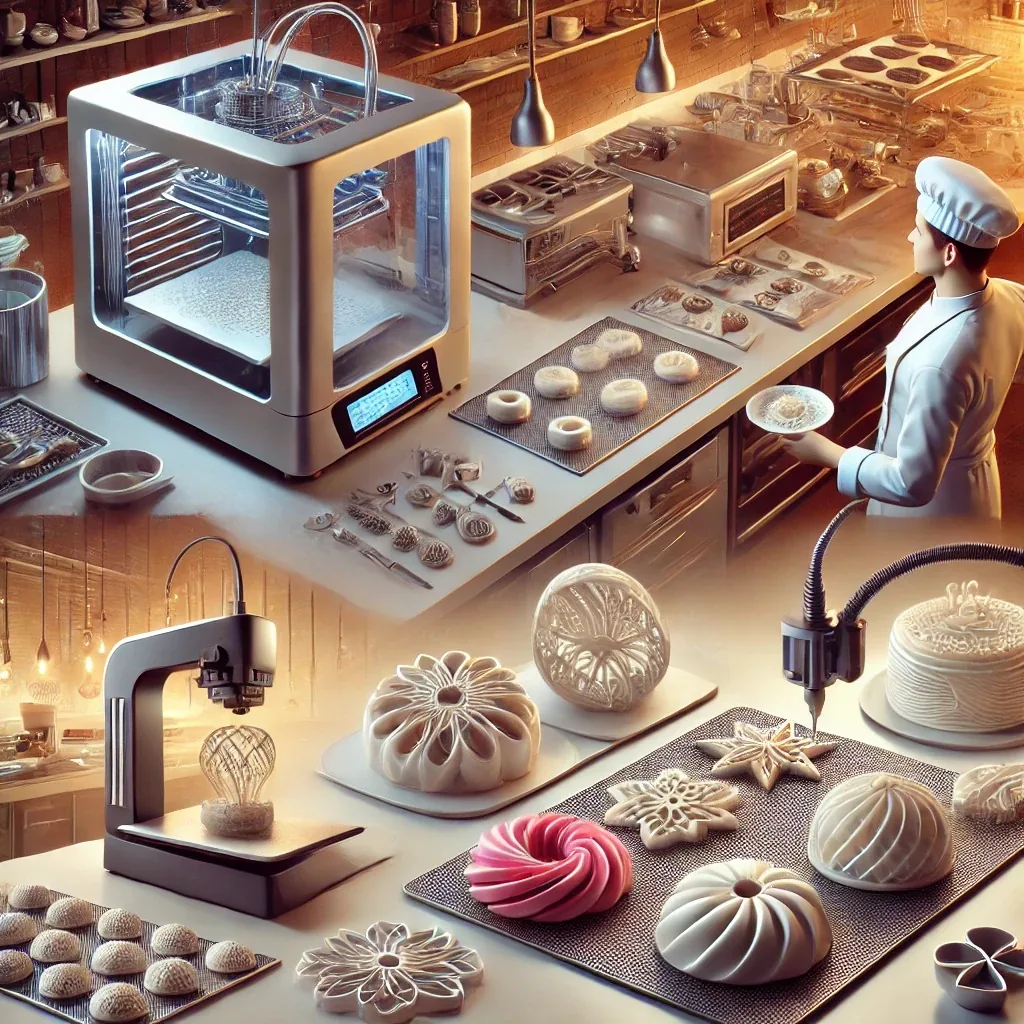
FDM 3D printing, or Fused Deposition Modeling, is a technique that builds objects layer by layer by extruding melted thermoplastic materials. Traditionally used to create plastic parts, this technology is being adapted to the food industry, particularly in pastry, where edible materials such as pasta, chocolates and creams are used. This innovation is revolutionizing the way pastry chefs create complex, personalized designs, offering new creative possibilities and efficiency.
Applications in Pastry
In pastry, FDM 3D printing has two main approaches:
- Mold Creation: Pastry chefs, like Dinara Kasko, use 3D printers to create silicone molds, which are then filled with dough to form complex geometric designs, such as cubes and spheres, that are difficult to reach manually. For example, Kasko uses software like Grasshopper to design molds before printing them with an Ultimaker 3 printer, increasing production capacity and creative control (Dinara Kasko's Website).
- Direct Pastel Printing: Companies like Digital Patisserie have developed printers that directly extrude food materials, allowing the creation of custom-shaped pastries and desserts, such as layered cakes with varied ingredients. One example is the Coral cake, a reinterpretation of the French Concorde pastry, created with the Patiss3 model (Digital Patisserie).
Benefits and Challenges
Benefits include precision, consistency and the ability to create designs artistic that attract customers. However, challenges such as food safety, due to the possibility of contamination in printed layers, and regulatory compliance are important concerns. Additionally, the durability of some printed materials may be lower than traditional methods.
An unexpected detail is that 3D food printing can be used to create personalized desserts for specific dietary needs, such as vegan options or for people with chewing difficulties, expanding its impact beyond aesthetics.
Detailed Note: FDM 3D Printing in Pastry – A Creative and Creative Revolution Technique
FDM (Fused Deposition Modeling) 3D printing is an additive manufacturing technology that builds objects layer by layer by extruding melted thermoplastic materials. Traditionally associated with the creation of plastic parts for prototypes and industrial products, this technology is being adapted to the food industry, particularly in pastry, where edible materials such as pasta, chocolates and creams are used. This report explores how the FDM process is transforming pastry, highlighting its applications, benefits, challenges and future perspectives, focusing on the context of the company Tucab, specialized in extrusion of tubes, profiles and seals.
Definition and Functioning of FDM
FDM works by feeding a thermoplastic filament, such as PLA or ABS, through a heated extruder, which melts the material and the deposits in thin layers on a construction platform, following a digital model. This technique is widely used in industries such as automotive and aerospace due to its versatility and cost-effectiveness. In the food context, the process is adapted to use edible materials, such as pastes or doughs, maintaining the principle of layer-by-layer extrusion.
Adaptation for Food
In pastry, extrusion-based 3D printing, similar to FDM, uses food materials instead of thermoplastics. These materials, such as chocolate, cake batter, cream or even fruit purees, are loaded into cartridges or syringes and extruded through a nozzle, forming layers that make up the final product. This adaptation allows you to create complex, personalized designs that would be difficult or time-consuming with manual methods.
Pastry Applications
There are two main approaches to using FDM 3D printing in pastry, each with significant implications for creativity and efficiency:
- Creating Molds:
- Pastry chefs like Dinara Kasko, a Ukrainian chef known for her geometric designs, use 3D printers to create silicone molds. These molds are digitally designed and printed using materials such as PLA, which are then turned into food-grade silicone. Molds allow you to shape pasta into complex shapes, such as cubes, triangles and spheres, inspired by art, architecture and nature. For example, Kasko uses software like Grasshopper to design its patterns before printing them with an Ultimaker 3 printer, increasing its production capacity and creative control (Dinara Kasko's Website). This approach is particularly useful for creating consistent pieces on a large scale, such as in bakeries or events.
- Direct Printing of Pastries:
- Companies such as Digital Patisserie have developed specific printers for food, such as the Patiss3 model, which allows the direct manufacture of free-form pastries. These printers extrude materials such as cocoa shortcrust pastry, chocolate mousse and fruit confit, creating desserts such as the Coral cake, a reinterpretation of the French Concorde pastry. This approach is ideal for restaurants and biscuit factories, offering high speed and design freedom (Digital Patisserie). Other examples include printing layered cheesecakes using ingredients such as cookie dough, peanut butter and jelly, as demonstrated by researchers at Columbia University (National Science Foundation).
Benefits
A 3D printing in pastry offers several benefits that may be particularly relevant to innovation in the extrusion industry, such as Tucab:
- Precision and Consistency: Allows you to create perfect and consistent designs, something difficult to achieve manually, especially for intricate shapes. This can be compared to the precision required in the extrusion of tubes and profiles, where uniformity is crucial.
- Creativity and Personalization: Pastry chefs can experiment with unique designs, such as geometric patterns or complex textures, increasing the visual appeal of products. Additionally, it can be used to customize desserts for specific dietary needs, such as vegan options or softer foods for those with chewing difficulties, expanding its impact beyond aesthetics.
- Efficiency: Reduces the time needed to create complex designs, increasing productivity, especially on a large scale, such as in cookie factories. This efficiency can be parallel to the optimization of processes in the production of seals and profiles by Tucab.
Challenges and Considerations
Despite the benefits, there are significant challenges that need to be addressed, especially in the context of safety and regulation, areas where Tucab already has experience with standards such as ISO 13485:
- Food Safety: Ensuring that materials and processes are safe for consumption is crucial. Materials such as PLA and PETG can be considered safe if they do not contain additives, but the printed layers can have cracks where bacteria can lodge, making cleaning difficult (Prusa Knowledge Base). For direct printing, materials must be approved for consumption, and the process must avoid contamination, which requires strict quality controls.
- Regulatory Compliance: 3D food printing is a new area, and regulations can vary, especially regarding the approval of new materials and processes. This may limit its adoption in formal commercial contexts, requiring alignment with standards such as ISO applicable to food safety.
- Durability and Texture: Some printed materials may not have the same texture or durability as traditionally made products, which may affect the sensory experience. This is particularly relevant to pastry, where presentation and flavor are key.
Future Outlook
The future of FDM 3D printing in pastry looks promising, with potential implications for innovation at Tucab. With advances in edible materials such as biocompatible filaments and hybrids, technology is expected to enable the creation of even more complex and nutritious desserts. Additionally, mass customization can become more accessible, allowing consumers to choose specific designs and flavors. Projects such as the European Union's PERFORMANCE program explore the use of 3D printers to create softer foods for the elderly, indicating potential for expansion for special dietary needs (3D Printing Industry).
Comparative Table: 3D Printing Methods in Pastry
| Appearance | Mold Creation | Direct Printing of Pastries |
|---|---|---|
| Process | Prints silicone molds with FDM, then uses traditional dough | Extrudes edible materials directly |
| Materials | PLA, transformed into food silicone | Dough, chocolate, cream, purees |
| Examples | Geometric molds by Dinara Kasko | Coral Cake from Digital Patisserie |
| Advantages | High precision, reusable, moderate cost | Full customization, complex designs |
| Challenges | Time to create molds, silicone safety | Food safety, texture final |
This table illustrates the differences between the approaches, offering a clear view for readers of the Tucab website, who can see parallels with the company's extrusion processes and innovation.
Conclusion
FDM 3D printing is transforming pastry, offering new ways to create artistic and personalized designs, both through molds and direct printing. Although it faces challenges such as food safety and regulation, its potential for innovation and efficiency is significant. For Tucab, this technology can inspire new applications in extruding edible materials or creating molds for innovative products, aligning with the mission of "Shaping Tomorrow" since 1996. As technology advances, it is expected to continue to shape the future of cooking, bringing creativity and accessibility to new levels.