
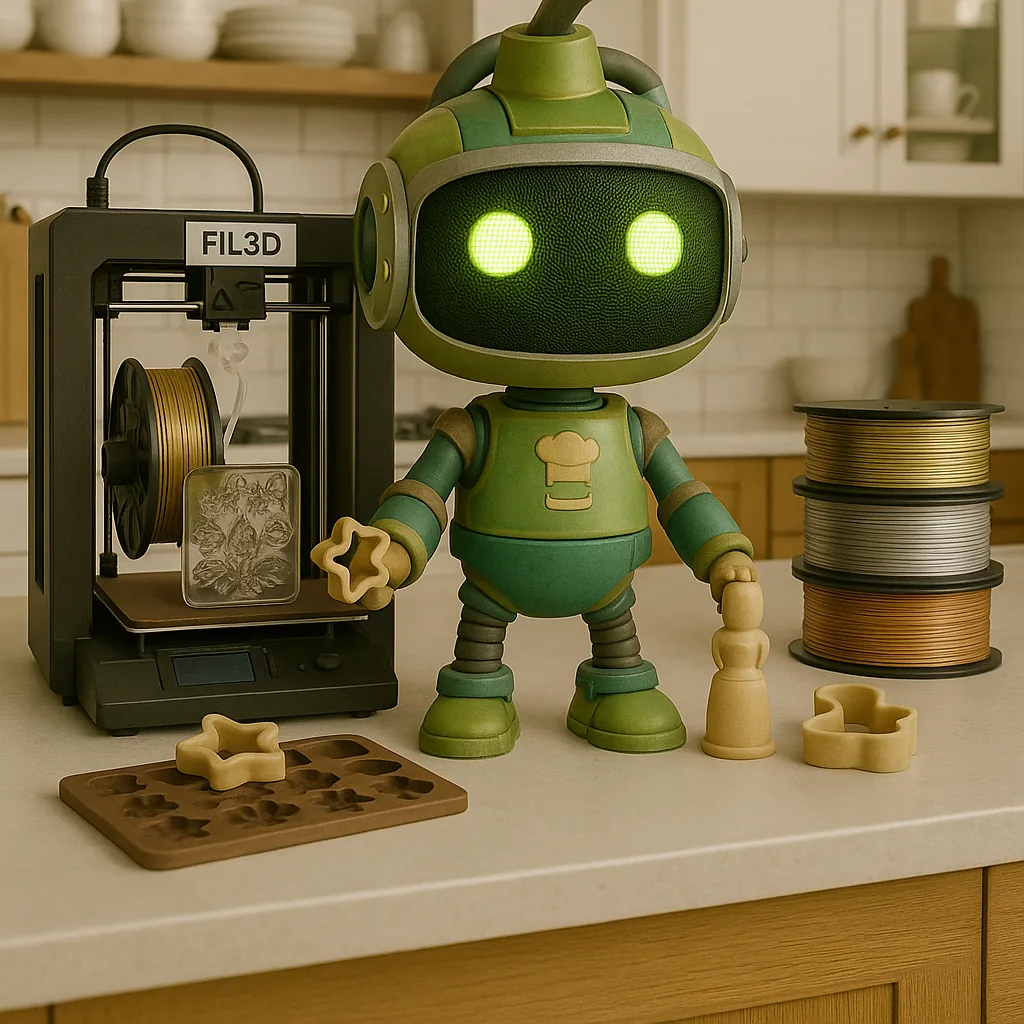
Tucabito in the Kitchen: How 3D Printing and FIL3D Are Transforming Creative Cooking
"Hello, I'm Tucabito, the TUCAB mascot! Today, I'm in a place full of aromas and creativity: a chef's kitchen! Did you know that 3D printing is revolutionizing cooking, allowing chefs and pastry chefs to create decorations, molds and even foods with incredible shapes? With TUCAB's FIL3D filaments, it is possible to bring innovation and personalization to gastronomy. I will show you how this technology works, with technical details and practical examples to inspire your next creation in the kitchen? 3D Printing in Culinary: Innovation at the Table
3D printing is gaining ground in cooking by allowing chefs and pastry chefs to create unique and personalized pieces. While direct printing of foods (such as chocolate or pasta) is more common with specialized printers, FDM technology with filaments like those from FIL3D is widely used to:
- Custom Molds and Cutters: Print molds for sweets, cookies or chocolates with specific shapes.
- Non-Edible Decorations: Create stands or toppers for cakes and desserts.
- Kitchen Tools: Manufacture custom-made utensils, such as holders for pastry nozzles or cutting guides.
The process begins with modeling in software such as Tinkercad or Blender, followed by printing with safe filaments suitable for indirect contact with food such as our PETG.
Practical Example 1: A pastry chef wants to create personalized star-shaped cookie cutters for an event. He models the cutter in Tinkercad (5 cm diameter, 1 cm high) and prints it with clear FIL3D PETG, which is safe for temporary food contact (ISO 10993-5). Printing is done with a 0.4 mm nozzle, temperature of 230°C, layer height of 0.2 mm and speed of 50 mm/s. Each cutter takes 30 minutes to print, uses 10 g of filament (€0.50) and allows you to cut cookies with precision, impressing customers.
2. Why is FIL3D Ideal for Cooking?
TUCAB's FIL3D filaments have characteristics that make them perfect for culinary applications:
- Food Safety: FIL3D PETG is biocompatible and can be used for temporary contact with food, as long as it is sterilized at 60°C. It has low emissions of volatile organic compounds (VOC < 0.01%), ensuring safety.
- High Accuracy: With a dimensional tolerance of ±0.03 mm, FIL3D filaments reproduce fine details, such as cutter edges or mold textures (e.g. 0.5 mm details).
- Aesthetic Colors: Metallic tones such as gold, silver and copper (seen on the reels in the image) are ideal for elegant decorations, such as cake toppers, with 85% brightness.
- Temperature Resistance: FIL3D PETG withstands up to 80°C without deforming, perfect for molds used with hot chocolate or heated dough.
- Printing Parameters: FIL3D PETG prints at 220-240°C, with 0.8 mm retraction to avoid flaws, and FIL3D PLA (for decorative pieces) prints at 190-210°C with a layer height of 0.2 mm and a speed of 60 mm/s.
Practical Example 2: A chef prints a heart-shaped chocolate mold with transparent FIL3D PETG. The mold, measuring 8x8 cm and 2 mm thick, is printed with a 0.2 mm nozzle, a temperature of 235°C, a layer height of 0.1 mm and a fill of 20%. Printing takes 1 hour and uses 15 g of filament (€0.75). The mold supports melted chocolate at 50°C without deforming and allows you to create 20 personalized chocolates for an event.
3. Technical Advantages of 3D Printing for Chefs and Pastry Chefs
3D printing with FIL3D offers practical benefits:
- Personalization: A cake topper with the customer's name (e.g. “Happy Birthday, Maria”) can be printed with gold FIL3D PLA in 1 hour, with a 0.1 nozzle mm, layer height of 0.05 mm and 10 g of filament (€0.50).
- Time and Cost Savings: A set of 5 custom cutters costs €2.50 in filament and takes 2.5 hours to print, while buying them ready-made would cost €15 and take days for delivery.
- Complex Details: A mold with floral texture (0.3 mm details) for sweets is printed with FIL3D PETG, withstanding up to 5 kg of pressure when unmolding, thanks to the material's 50 MPa resistance.
- Sustainability: FIL3D PLA is biodegradable, and 3D printing reduces waste compared to disposable silicone molds (50 g of waste per mold).
Practical Example 3: A chef prints a support for pastry nozzles with copper-colored FIL3D PLA, to organize 10 nozzles of different sizes. The support, measuring 15x5 cm, is printed with a 0.4 mm nozzle, temperature of 205°C, layer height of 0.2 mm and 30% infill. Printing takes 1.5 hours and uses 20 g of filament (€1), improving organization in the kitchen.
4. Tucabito in the Kitchen: A Day of Creation
"Today, in the kitchen, I'm watching 3D printing transform dishes into works of art! Next to me, a 3D printer is using transparent FIL3D PETG filament to create a chocolate mold with 0.5 mm floral details. The 1 kg spool rotates smoothly, and the print, made at 230°C with a 0.2 mm and a layer height of 0.1 mm, it's perfect! In the corner, I see gold, silver and copper FIL3D coils, ready to print elegant cake toppers. A star-shaped cookie cutter, printed in FIL3D PETG, is being used to make personalized cookies – it was printed in 30 minutes and cost just €0.50! innovate and surprise your customers!"
5. Call to Action
How about taking your cooking to a new level with 3D printing? With TUCAB's FIL3D filaments, you can create unique molds, cutters and decorations to impress your customers. Visit the TUCAB website, discover the FIL3D line and start turning your ideas into reality in the kitchen! Let's create unforgettable gastronomic experiences together?