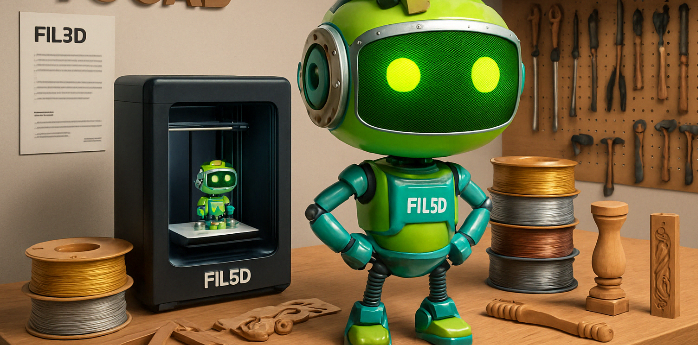

“Hello, I'm Tucabito, the TUCAB mascot! Today, I'm in a
carpentry full of creativity and innovation. 3D printing is
revolutionizing the way carpenters work, and with filaments
FIL3D from TUCAB, it is possible to create prototypes, customized tools and
decorative details with incredible precision. I'll show you how this
technology works, with practical examples and technical details for you
Start using 3D printing in your projects. Let's build something special
together?”
1. 3D Printing in Carpentry: Technology for Projects Most Accurate
3D printing, especially with FDM (Fused Deposition Modeling), allows carpenters to integrate innovation into their traditional processes. Using filaments like those from FIL3D, it is possible: Prototype designs: Test models of furniture or pieces before using wood, reducing errors and waste. Create custom tools: Print templates, supports or guides that optimize repetitive tasks. Produce Decorative details: Craft ornaments or components that complement furniture, such as handles or notches. The process begins with modeling in software such as Fusion 360 or Tinkercad, followed by printing on a 3D printer with settings adjusted for the material (e.g. temperature of the nozzle, speed and layer height).
Practical Example 1: A carpenter is designing a bench with legs angled at 30°. He models his legs in Fusion 360 and prints a 1:2 scale prototype with FIL3D PLA filament in color wood. The printer settings are: 0.4 mm nozzle, temperature 200°C, layer height of 0.15 mm and speed of 60 mm/s. The prototype of 15 cm tall takes 2.5 hours to print and uses 30 g of filament (about €1.50). With the prototype, he adjusts the angle to 32° before cutting the wood pine, avoiding waste.
2. Why is FIL3D Ideal for Woodworking?
TUCAB FIL3D filaments are designed to meet the technical carpentry needs:
- Resistance Mechanics:FIL3D PETG has a tensile strength of 50 MPa and elongation 20%, ideal for tools such as jigs that face pressure constant. It supports up to 15 kg of load on a 5 mm thick support. thickness.
- Colors and Aesthetics: The FIL3D line includes metallic tones such as gold, silver and copper, perfect for decorative details. These filaments have shine of 85% on the reflectance scale, giving a sophisticated touch to pieces such as furniture ornaments.
- Parameters Printing: FIL3D PLA prints between 190-210°C, with a shrinkage of 0.5 mm to avoid "stringing" (unwanted threads), and the FIL3D PETG requires 220-240°C with a reduced speed of 50 mm/s for higher adhesion between layers.
- Compatibility with Post-Processing: Both filaments can be drilled, sanded and glued with cyanoacrylate-based adhesives, facilitating adjustments manuals.
Practical Example 2: A carpenter needs a set of handles for a rustic cabinet. He chooses the FIL3D filament PLA in copper color and models 10 cm handles with 0.8 mm carved details. Printing is done with a 0.2 mm nozzle, temperature of 205°C, layer height 0.1 mm and a speed of 40 mm/s for greater detail. Each pull takes 1 hour to be printed, it uses 15 g of filament (€0.75) and is finished with sandpaper 400 to smooth the surface before attaching it to the furniture with 3-inch screws. mm.
3. Technical Advantages of 3D Printing for Carpenters
3D printing with FIL3D offers practical and measurable:
- Prototyping with Material Savings: A prototype of a 20 cm table length (1:5 scale) can be printed with 50 g of FIL3D PLA (€2.50), while cutting the same model in walnut wood would cost €15 and it would take 4 hours of manual labor.
- Tools Custom: A jig for 6mm holes in a table top can be printed with black FIL3D PETG. With a thickness of 4 mm and dimensions measuring 15x10 cm, it supports up to 20 kg of lateral pressure without deforming, thanks to the 50 MPa strength of PETG. Printing takes 1.5 hours at 230°C, with layer height of 0.3 mm and infill of 30%.
- Details Complex: Ornaments such as arabesques for a headboard can be printed with gold FIL3D PLA. A 12 cm arabesque with details of 0.5mm prints in 2 hours with 0.2mm nozzle and 0.1 layer height mm, using 20 g of filament (€1). Finishing is done with spray varnish for protection.
- Sustainability and Efficiency: FIL3D PLA is biodegradable (degrades in 2 years in ideal conditions) and reduces wood waste. A carpenter who tests 5 3D chair leg designs saves about 2 kg of wood per project, equivalent to €30 in material.
Practical Example 3: A carpenter is building a bookcase with curved shelves. It prints a curved mold with FIL3D black PETG for shaping plywood boards. The mold, 30x20 cm and 5 mm thick, it is printed with 40% infill, temperature 235°C, speed of 50 mm/s and layer height of 0.3 mm. Printing takes 3 hours and uses 80 g of filament (€4). The mold resists pressure of 10 kg during the molding process, ensuring a perfect curve on the shelves.
4. Tucabito in the Workshop: A Day of Innovation
"Today, in the workshop, the smell of wood and the sound of 3D printer create a unique atmosphere! I'm next to a printer that uses FIL3D PLA filament with a wood texture to create a prototype of a shelf with 1 mm decorative notches. 1 kg spool in wood color is rotating, and the print, made at 200°C with a 0.4 mm nozzle and height of layer of 0.2 mm, it is almost ready. In the corner, I see golden FIL3D reels, silver and copper, ready to print details such as table legs or ornaments. A template printed in black FIL3D PETG, with 6 mm and 4 mm holes thickness, it is being used to cut boards with precision – it was printed in 1.5 hours and supports up to 15 kg of pressure! 3D printing with FIL3D is helping carpenters work with more precision and creativity!"
Want to transform your carpentry projects with technology cutting edge? With TUCAB's FIL3D filaments, you can prototype designs, create Custom tools and add unique details to your furniture. Visit the TUCAB website, discover the FIL3D line and start innovating today! Let's go build something amazing together?