
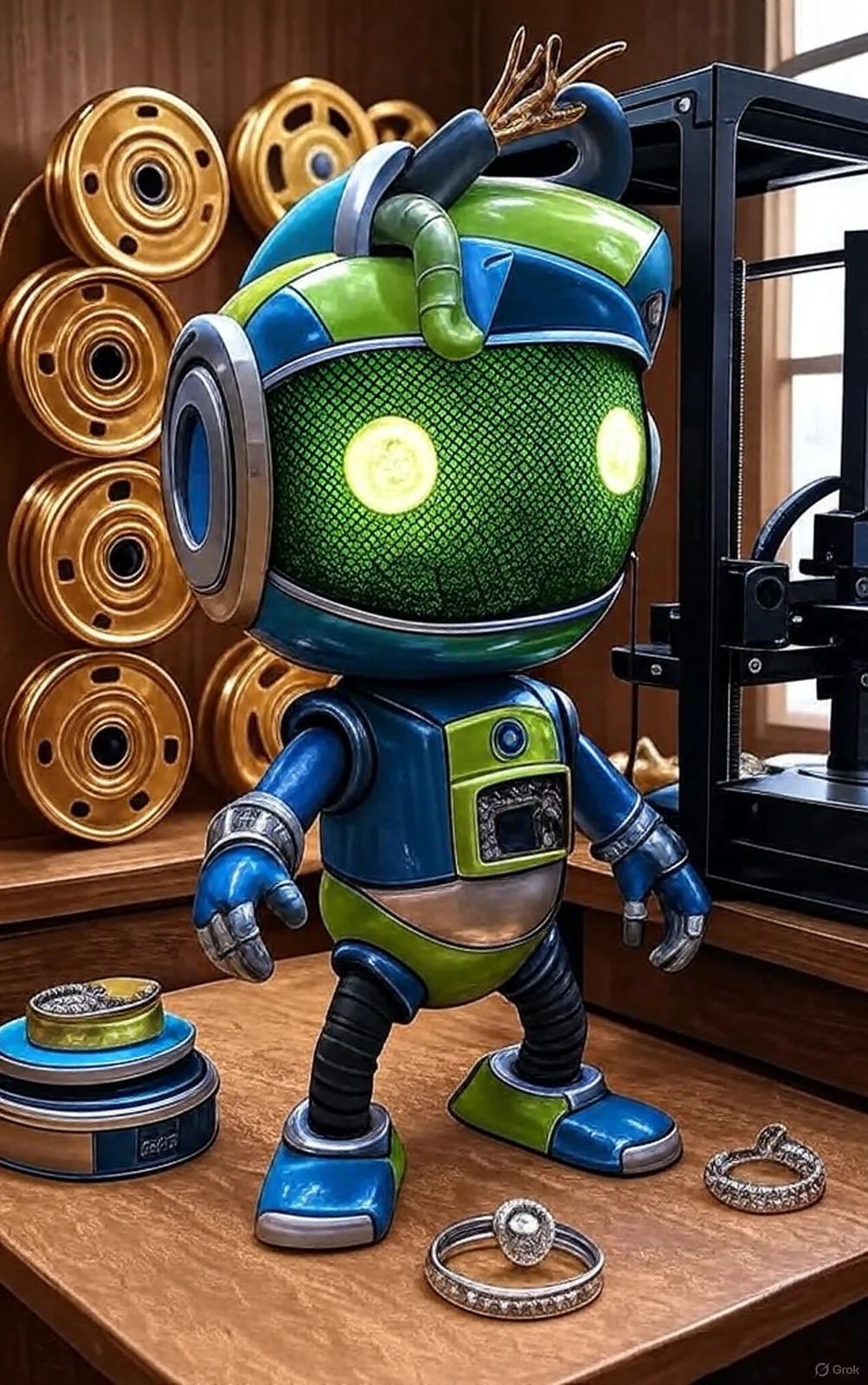
Tucabito in the Atelier: How 3D Printing and FIL3D Are Shining in Jewelry Design
Hello, I'm Tucabito, the TUCAB mascot! Today, I'm inviting you to a place where creativity comes to life: a jewelry designer's studio. 3D printing is revolutionizing jewelry, and with TUCAB's FIL3D filaments, designers are creating unique pieces with precision and efficiency. I'll show you how this technology works, with practical examples and technical details that make all the difference. Ready to see your jewelry shine in a new way?
1. 3D Printing in Jewelry: Technology at the Service of Art
3D printing, especially with FDM (Fused Deposition Modeling) technology, allows jewelry designers to transform digital models into physical pieces quickly and accurately. The process begins with 3D design software, such as Rhino or Blender, where the jeweler creates a detailed model – for example, a ring with geometric patterns or a pendant with organic shapes.
Then, this model is sent to a 3D printer that uses filaments like those from FIL3D to build the piece layer by layer. Printing can be used in two main ways:
- Direct prototyping: Creating a part for testing or presentation to the customer.
- Casting molds: Printing a model on filament that will be used in the lost wax casting technique, where the model is encased in plaster, melted and replaced with metal (such as gold or silver).
Practical Example: A designer wants to create a pair of earrings with an intricate floral pattern. It models the design digitally, adjusting minute details like 0.5mm-thick petals. With FIL3D, he prints the prototype in less than 2 hours, using a 3D printer with a 0.2 mm nozzle for high precision, and can present the part to the customer the same day.
2. Why is FIL3D Ideal for Jewelry Design?
TUCAB's FIL3D filaments are designed to meet the specific demands of jewelry:
- High Precision: With a dimensional tolerance of ±0.05 mm, FIL3D filaments ensure that even the smallest details, such as fine textures or carvings, are faithfully reproduced. This is essential for delicate pieces like custom engraved rings.
- Smooth Finish: FIL3D offers filaments with low surface roughness, reducing the need for post-processing. For example, a PLA filament from FIL3D with a glossy finish can be used for prototypes that already look polished.
- Variety of Materials and Colors: The FIL3D line includes options such as PLA (easy to print and ecological), PETG (more resistant) and filaments with metallic finishes (to simulate gold or silver). Colors like shiny gold or metallic silver help the designer visualize the final result.
- Casting Properties: Some FIL3D filaments are optimized for the lost wax technique, with low ash emission during burning (less than 0.01%), ensuring clean molds for casting in precious metals.
Practical example: A jeweler uses gold FIL3D PLA filament to print a heart-shaped pendant with 1 mm details. The part is printed at a temperature of 200°C and a speed of 50 mm/s, resulting in a smooth surface that impresses the customer. Then, he uses the same model to create a casting mold, which is filled with 925 silver, finishing the piece in just 3 days.
3. Technical Advantages of 3D Printing for Jewelers
3D printing with FIL3D brings specific benefits to the sector:
- Advanced Customization: The technology allows you to create custom-made jewelry. For example, a customer asks for a ring with intertwined initials. The designer models the letters 0.3 mm thick and prints the prototype in FIL3D PETG, testing the fit on the customer's finger before casting the final piece in gold.
- Cost and Time Reduction: Prototyping with precious metals is expensive and time-consuming. With 3D printing, a ring prototype can cost less than €1 in filament and be printed in 1 hour, while the same manual process would take days.
- Complex Designs: 3D printing allows you to create shapes that would be unfeasible by hand, such as a bracelet with a hollow structure or a necklace with intertwined three-dimensional details.
- Sustainability: FIL3D uses recyclable materials, such as corn starch-based PLA, reducing environmental impact. Additionally, 3D printing minimizes material waste – a prototype uses only the necessary filament, with no leftovers.
Practical Example: A designer creates a bracelet with a lattice pattern (0.8 mm interlocking structures). He prints the model with metallic gray FIL3D PETG, using a 0.1mm layer for high definition. The piece is tested, digitally adjusted, and then cast in 18K gold, saving weeks of manual labor.
4. Tucabito at the Studio: A Day of Creation
Today, in the studio, I'm next to a 3D printer working with FIL3D to create an incredible necklace with floral details. The golden FIL3D filament shines on the 1kg spool, and the printer, set to a temperature of 210°C and a 0.2mm nozzle, prints delicate petals 0.4mm thick. All around me, I see empty reels – a sign of a lot of creative work! In the corner, a finished ring, cast in silver from a mold printed with FIL3D, shows the final result: a unique piece that combines art and technology. 3D printing with FIL3D is turning dreams into real jewelry!
5. Call to Action
Are you ready to take your jewelry design to the next level? With TUCAB's FIL3D filaments, you can create detailed prototypes, test innovative ideas, and produce unique parts faster and more sustainably. Visit the TUCAB website, discover the FIL3D line and start shining with 3D printing! Let's create amazing jewelry together?