
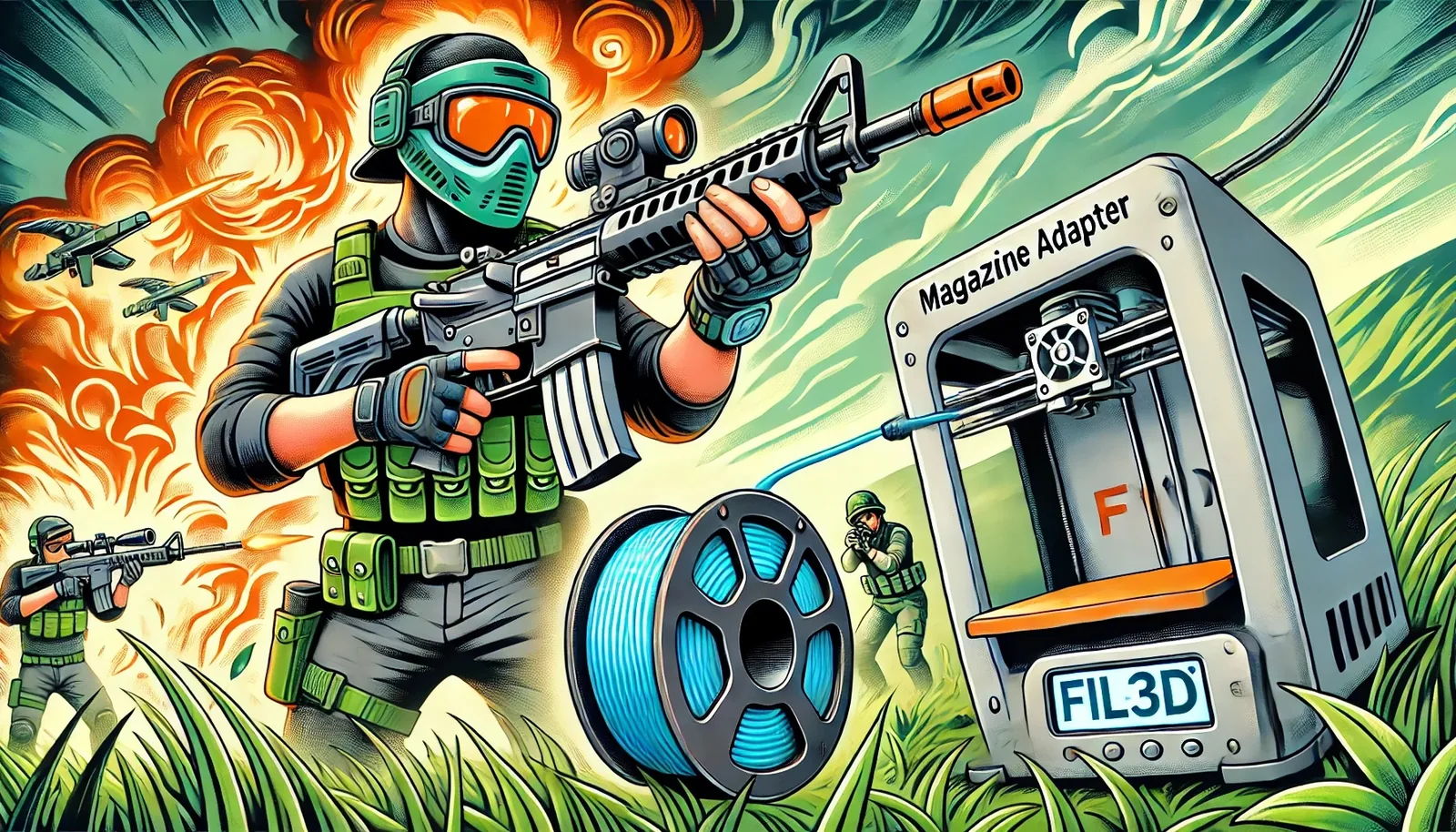
3D printing has revolutionized several areas, and action sports such as paintball and airsoft are no exception. This technology, which allows you to create three-dimensional objects layer by layer from digital models, offers gamers and enthusiasts the possibility to customize equipment, create unique accessories and even develop replacement parts quickly and affordably. In this article, we will explore how 3D printing, especially FDM (Fused Deposition Modeling) technology, is transforming paintball and airsoft, with practical examples, technical information, curiosities and future perspectives, highlighting the role of brands like Tucab's Fil3d.
Introduction
Paintball and airsoft are tactical simulation sports that combine strategy, adrenaline and teamwork. In paintball, players shoot biodegradable paint balls, while in airsoft they use replica guns that shoot BBs (6mm plastic spheres). Both sports require specific equipment, such as markers (weapons), masks, magazines and tactical accessories, which can be expensive or difficult to find. FDM 3D printing, which uses thermoplastic filaments like PLA, PETG and ABS, allows gamers to create custom parts, repair equipment and even innovate with unique designs, all at a reduced cost. This article analyzes the applications, benefits and challenges of this technology in paintball and airsoft, focusing on practical examples and technical details.
Technical Context of FDM 3D Printing
FDM 3D printing works by melting a thermoplastic filament through a heated nozzle (extruder) and depositing it layer by layer to form an object. The most common materials include:
- PLA (Polylactic Acid): Biodegradable, easy to print, ideal for decorative accessories or pieces that do not suffer much impact.
- PETG (Polyethylene Glycol Terephthalate): Water and impact resistant, with good flexibility, perfect for parts functional.
- ABS (Acrylonitrile Butadiene Styrene): Durable and resistant to higher temperatures, but requires printers with a heated chamber to avoid deformations.
Technical Detail: Print quality depends on parameters such as layer thickness (0.1 mm to 0.5 mm), nozzle temperature (180°C for PLA, up to 240°C for ABS) and the infill density, which can vary from 20% (light) to 100% (maximum resistance). For example, a part with 50% PETG fill offers a good balance between strength and material savings, with a tensile strength of around 50 MPa.
Practical Applications in Paintball and Airsoft
1. Custom Accessories
3D printing allows you to create unique accessories that improve the gaming experience and the aesthetics of equipment.
- Brackets and Adapters: In paintball, players print adapters to turn paintball markers into airsoft guns, as described in an Instructables guide. One example is the paintball adapter for airsoft, which replaces the paintball bolt with a 3D printed bolt, allowing you to fire 6mm BBs.
- Practical Example: A player printed an adapter for his Tippmann 98 marker, allowing him to use airsoft BBs at 700 FPS, adjusting the speed to safe levels (around 350 FPS).
- Fun fact: A standard paintball hopper, which normally carries 200 balls, can hold up to 8,000 airsoft BBs, offering an impressive capacity for tactical suppression.
- Grips and Grips: In airsoft, custom grips, such as foregrips or ergonomic grips, can be printed to improve comfort and accuracy.
- Practical Example: An airsoft player printed a PETG foregrip for his M4 rifle, adjusting the angle for better control during Mil-Sim games.
- Silencers and Muzzles: Mock suppressors are popular in both sports for aesthetics.
- Practical Example: An airsoft enthusiast printed an Osprey-style silencer in PLA, which is lightweight and compatible with 14mm threads, as reported by Airsoft Insider.
2. Replacement Parts
3D printing is ideal for manufacturing replacement parts, especially for old or discontinued equipment.
- Chargers and Hoppers: In paintball, custom hoppers or adapters for chargers can be printed.
- Practical Example: A player printed a hopper cap for his paintball marker, which fits perfectly and allows for quick reloads, as described on the STL Finder website.
- Internal Components: In airsoft, parts such as hop-up units or adapters Chargers can be printed, although with limitations.
- Practical Example: A Reddit user (r/airsoft) printed a charger adapter to convert an airsoft AEG charger to a paintball marker, using PLA with 50% infill.
- Fun Fact: Companies like SRU, since 2014, use 3D printing to produce polymer components for airsoft replicas, showing the commercial viability of this technology.
3. Weapons and Complete Replicas
Although printing complete weapons is more complex, it is possible to create functional replicas by combining printed parts and metal components.
- Airsoft Replicas: A notable example is the Mosquito Airsoft Kit, available on Printables.com, which allows you to print up to 95% of an airsoft replica, excluding the gearbox and engine, which can melt under intense heat.
- Practical Example: An engineer named Sam Logan created a 3D printed airsoft replica, using 876 grams of filament and additional parts like screws and a sprinkler tube, for just 50 dollars, as reported by 3DPrint.com.
- Paintball: In paintball, it is possible to print marker bodies or triggers, but components that withstand pressure (such as valves) must be metallic.
- Practical Example: A Reddit user (r/paintball) mentioned the creation of 3D printed dueling pistols that use CAM 870 cartridges, combining plastic and metal parts.
- Curiosity: In 2016, the Airsoft Insider highlighted that 3D printing allows you to create replicas that previously only existed in the imagination, such as futuristic designs for LARP games or cosplay.
4. Tactical Equipment and Accessories
3D printing is also used to create tactical accessories that improve functionality and aesthetics.
- Mounts and Rails: Rails for mounting scopes or flashlights can be printed from PETG for greater durability.
- Practical Example: A player printed a quad rail for his paintball marker, giving it a military look, as described in Instructables.
- Grenades and Game Accessories: In airsoft, impact grenades or flashbangs printed on 3D are popular.
- Practical Example: The Cults3D website offers models of reusable airsoft grenades, such as the "Meteorite", which can be printed in PLA and used in games.
Benefits of 3D Printing in Paintball and Airsoft
- Customization: Players can create unique pieces, adjusted to their preferences, such as ergonomic grips or lures with specific designs.
- Practical Example: An airsoft player printed a fist inspired by his favorite cosplay character, using a model from MyMiniFactory.
- Cost-Effectiveness: Printing accessories is cheaper than buying commercial parts. An airsoft paintball adapter can cost as little as $5 in filament versus $50 for a commercial part.
- Speed: A simple part like a stand can be printed in less than two hours, allowing for quick adjustments before a game.
- Innovation: 3D printing allows you to test new designs, like lightweight suppressors or custom magazines, without large investments.
Challenges
- Material Resistance: Parts printed in PLA may not withstand direct impacts, such as those suffered in intense games. PETG and ABS are more resistant, but still inferior to metal parts.
- Technical Information: PLA has an impact resistance of around 4 kJ/m², while PETG reaches 5 kJ/m², against 15 kJ/m² for aluminum.
- Durability: Components under stress, such as gearboxes airsoft, may melt or fail if printed on plastic materials.
- Practical example: A Reddit user (r/airsoft) reported that a gearbox printed in PLA failed after 500 shots due to the heat generated.
- Legality: In some countries, such as the United Kingdom, the printing of replica weapons (even airsoft) it may be illegal, especially if they are receivers, as mentioned on Quora.
Choosing the Right Filament
- PLA: Ideal for aesthetic accessories or lightweight parts (density: 1.24 g/cm³; resistance: 50 MPa).
- PETG: Recommended for functional parts that require impact resistance (density: 1.27 g/cm³; resistance: 50 MPa).
- ABS: For parts that face greater stress or heat (density: 1.04 g/cm³; resistance: 40 MPa; up to 80°C).
Tucab's Fil3d offers high-quality filaments, such as PETG and ABS, tested for demanding applications, ensuring durability and precision in paintball and airsoft games.
Future Perspective
With the advancement of 3D printing technology, stronger filaments, such as those reinforced with carbon fiber (resistance up to 70 MPa), allow the creation of more durable parts. Additionally, the popularity of online communities such as Thingiverse and MyMiniFactory will continue to grow, offering free and paid templates for paintball and airsoft accessories. In the future, more affordable and accurate 3D printers may become common on playing fields, allowing for on-site repairs and customizations.
Conclusion
FDM 3D printing is opening up new possibilities in paintball and airsoft, allowing players to customize equipment, create unique accessories and repair parts quickly and cost-effectively. Despite challenges such as material strength and legal issues, the technology has a promising future, especially with the support of brands like Tucab's Fil3d, which offer reliable filaments to meet enthusiasts' needs. Whether creating an innovative adapter or a custom replica, 3D printing is an indispensable tool for the modern paintball and airsoft player.