
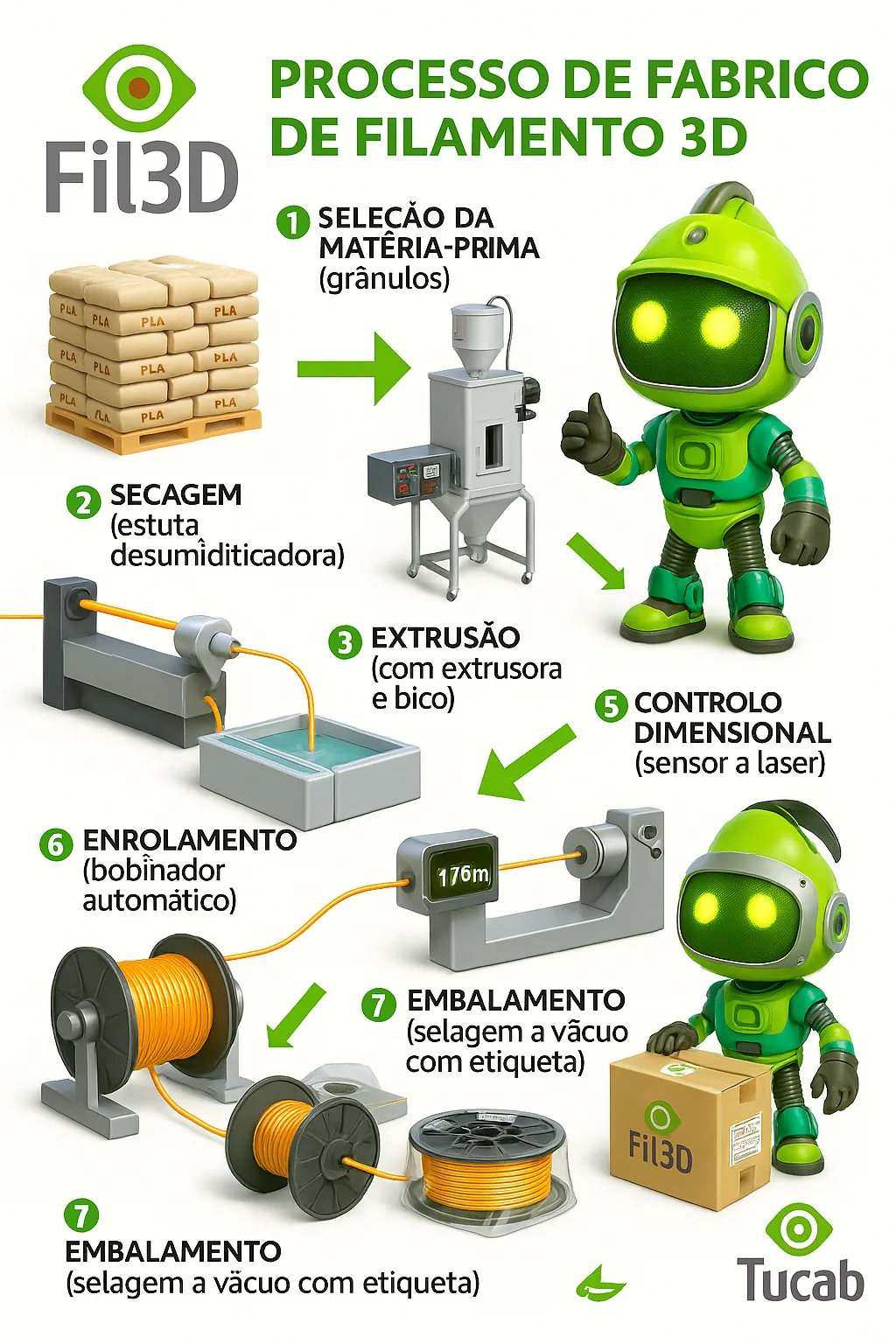
How Fil3D filament is made: precision from the bead to the spool
Introduction
Phases of the Fil3D filament manufacturing process
1. Selection of raw material
-
We use high quality technical polymers: PLA, PETG, ABS, TPU, among others.
-
The granules are certified, with full traceability to the supplier.
-
Each batch is tested before shipping. extrusion.
2. Drying the raw material
-
Moisture is the biggest enemy of extrusion: it causes bubbles, variations in diameter and fragility.
-
Each type of polymer is dried at a specific temperature and time (e.g. PLA at 55°C for 8 hours, PETG at 70°C for 6 hours).
-
We use industrial greenhouses with active dehumidification and digital monitoring.
3. Extrusion
-
The dried granules feed into a single screw extruder, where they are melted and mixed.
-
The melt is pushed through a calibrated die (1.75 mm or 2.85 mm).
-
The temperature, pressure and speed are constantly adjusted by PID sensors.
-
The extrusion zone is completely closed to avoid contamination and thermal fluctuations.
4. Cooling and stabilization
-
The filament goes through two temperature-controlled water bath stages (typically 25°C and 15°C).
-
The first stabilizes the shape, the second locks the final dimension.
5. Measurement and dimensional control
-
We use double-axis laser sensors, with an accuracy of ±0.002 mm.
-
Any deviation activates automatic correction of the traction speed.
6. Winding
-
The filament is wound on spools by torque-controlled motors, ensuring constant tension.
-
Prevents tangling and overlapping turns.
-
Each spool undergoes a final visual inspection.
7. Packaging
-
The reels are vacuum sealed with desiccant silica.
-
We include label with batch, date, type of polymer, color and tolerance.
8. Laboratory and testing
-
Samples are taken from each production for testing:
-
Fluidity tests (MFI)
-
Tension
-
Adhesion between layers (printed)
-
Diameter (micrometric and optical)
-
Compatibility with commercial extruders
-
Practical example: impact of dimensional accuracy
In a batch of Fil3D PETG intended for the production of technical parts for medical devices, the diameter variation was less than ±0.015 mm. This allowed the uninterrupted printing of more than 200 parts, with tolerance margins of just 0.2 mm — something that would not have been possible with inconsistent filament.
Fil2ndLife – recycled filament with the same control
-
The same process is applied to the filaments of the recycled line.
-
We use certified post-industrial materials.
-
We guarantee dimensional consistency and a finish equal to virgin ones, with complete traceability.
Conclusion
The quality of the filament begins in the detail. And at Fil3D, every detail counts: from the bead to the tip of your nozzle.
Therefore, each coil we deliver is the result of a tested, documented and technically controlled manufacturing process.