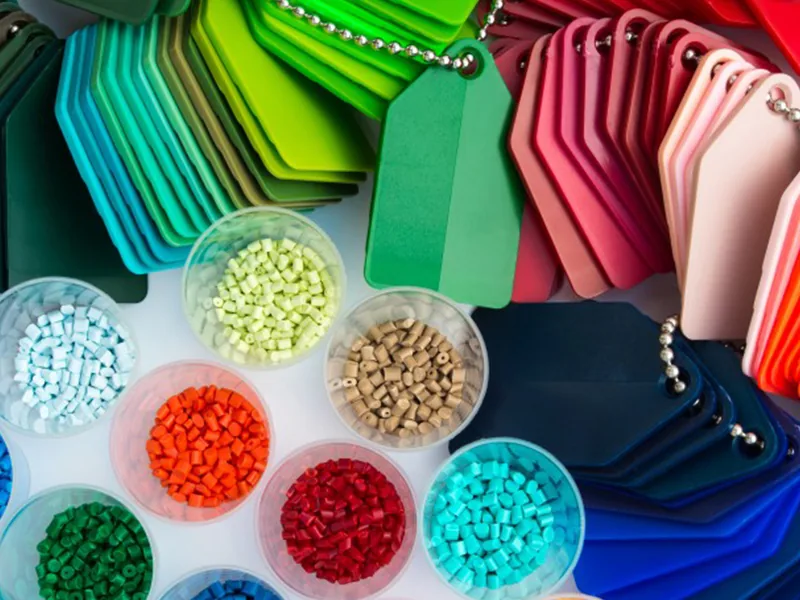
Thermoplastics, as the name suggests, are a type of plastic formed by polymers united through intermolecular interactions resulting in linear or branched structures. This category of plastics, when subjected to high temperatures, transform into a viscous and malleable material. This change of state allows the creation of an infinite number of shapes, starting to solidify when cooled.
This characteristic allows thermoplastics to be increasingly present in our lives, as they can adopt any shape we can imagine and, in parallel, carry out the modeling process on several occasions, favoring the circular economy and the environment. However, it is important to consider its thermal history, as the physical properties of the material will gradually change and molecular interactions will weaken as the material is heated and cooled to acquire new shapes.
Now that we know what a thermoplastic is, what types does Tucab work with? Here is a list of the most used:
PE (polyethylene) Polyethylene is the chemically simplest polymer. It is a material that works very well at low temperatures and is easy to weld. Extremely versatile, which combined with its low price and ease of manufacturing makes it one of the most used plastics in the world. This thermoplastic is widely used in the manufacture of all types of pouches/bags, airtight containers, irrigation tubes, kitchen cling film and much more.
PP (polypropylene) It is a transparent and lightweight material that does not absorb water and is very resistant to stress cracking. Examples of applications are textile fibers, couplings, transport containers, carpets, ropes, packaging and furniture.
PVC (polyvinyl chloride) It is a very versatile plastic, resistant to adversities such as wear, chemical and climatic influences and fire. It is used in the paper industry and in the manufacture of packaging for food, credit cards, furniture, toys and clothing.
TPU TPU is an abbreviation for polyurethane thermoplastic, which corresponds to a polyurethane elastomer that has the following properties: elasticity, transparency, resistance to oils, grease and abrasion. It is for this reason that the product ends up being highly requested in different sectors.
SBEBS TPE (SEBS or SBS) are materials that behave similarly to rubber, but with similarities to plastic. They are materials with two phases. A flexible elastomer-type rubber phase, which gives them the typical properties of soft touch, elasticity, flexibility and minimum temperature of use. And a rigid plastic phase that determines hardness, recycling and maximum temperature of use. Usual applications: Shoe soles, gaskets, electrical covers, carpets, cables, bed springs, agitators, toothbrushes, wheels,…
HDPE - High density polyethylene HDPE, high density polyethylene (in English HDPE – high density polyethylene) is a polymer from the polyolefin family, with mechanical and interesting thermal properties, making it widely used due to its high durability and ease of installation. High-density polyethylene (HDPE) is the most consumed worldwide. It has many advantages when compared to other types of polyethylene, as its chemical structure is linear, that is, it has few side branches, increasing its density, crystallinity, strength and opacity. This linearity also makes HDPE withstand higher temperatures, with peaks of 120° C and continuous temperatures of 110° C.
LDPE (low-density polyethylene) This is one of the most used plastics and not by chance, it is very stable, versatile, cheap and has excellent insulating properties, is easy to process and can come into contact with food. This thermoplastic can be found in bottles, containers and shipping containers, packaging and toys.
PETG PETG (Polyethylene Terephthalate Glycol) is a thermoplastic adapted from the famous plastic PET (polyethylene terephthalate). However, PETG is more resistant, durable and suitable for high temperature applications without losing its characteristics.
PLA PLA is a biodegradable thermoplastic of natural origin and renewable sources, such as corn starch or sugar cane. The use of PLA material is very old in the general market, being used mainly for manufacturing bags plastic and disposable cups.
ABS (acrylonitrile butadiene styrene) It is an amorphous thermoplastic that is very resistant to shocks and is widely used in the automotive and domestic industries. One of its most important properties as an engineering plastic is its high tenacity, even at low temperatures. At the same time, it is hard, rigid, has low water absorption and acceptable chemical resistance. It is very resistant to abrasion and can be easily covered with metallic layers. One of the most popular uses is in LEGO bricks.
EVA EVA (ethylene vinyl acetate) is a thermoplastic made by polymerizing ethylene and vinyl acetate to form a copolymer. It is a cross-linked material, which means that a chemical reaction occurred during the injection molding process, forming strong bridges between the long polymer chains. |